Summer 2026 Issue
A Hinge in History
Peering into the dying days of the Republic of Venice, Ben Street finds a pulse in the tragicomic frescoes of Giovanni Domenico Tiepolo, and particularly in Tiepolo’s commedia dell’arte character Pulcinella, that continues to beat in the works of such artists as Paul Cezanne, Philip Guston, and Nicole Eisenman.
Peering into the dying days of the Republic of Venice, Ben Street finds a pulse in the tragicomic frescoes of Giovanni Domenico Tiepolo, and particularly in Tiepolo’s commedia dell’arte character Pulcinella, that continues to beat in the works of such artists as Paul Cezanne, Philip Guston, and Nicole Eisenman.
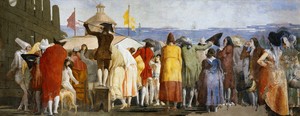
Giovanni Domenico Tiepolo, Mondo Novo (The New World), 1791, torn fresco, 6 feet 8 ¾ inches × 17 feet 2 ¾ inches (2.1 × 5.3 m), Museo del Settecento Veneziano/Ca’ Rezzonico, Venice. Photo: Scala/Art Resource, New York
Giovanni Domenico Tiepolo, Mondo Novo (The New World), 1791, torn fresco, 6 feet 8 ¾ inches × 17 feet 2 ¾ inches (2.1 × 5.3 m), Museo del Settecento Veneziano/Ca’ Rezzonico, Venice. Photo: Scala/Art Resource, New York
It’s the end of the eighteenth century and it feels like the end of the world. In his villa in the small town of Mirano on the Venetian mainland, Giovanni Domenico Tiepolo, then in his late sixties and with decades of success behind him, is painting a series of frescoes. Unlike his earlier mural commissions for palaces in Vicenza, Bavaria, and Madrid and for the churches of his native Venice, these are made for his eyes alone. He paints what he wants to see, and what he wants to see is above all Pulcinella, the ancient Neapolitan clown of the commedia dell’arte tradition.
Tiepolo’s Pulcinella wears his traditional garb of a beaky mask and towering, conical white hat. He’s a gluttonous, slovenly character with a humped back and a round belly, gorging on gnocchi. He’s also rascally and playful, forever in and out of scrapes. In the semiimprovised commedia performances staged in streets and squares across Europe since the Middle Ages, Pulcinella had been the everyman, the one you root for. Yet here, in Tiepolo’s frescoes, he’s mostly an observer of the action, not a participant in it. Multiple Pulcinellas populate the paintings. They applaud acrobats doing backflips in the street. They gaze at a distant horizon. They watch each other swing on a wobbly-looking rope. They booze and bicker and lounge. But what they mostly do is look. They watch their world end.
Around fifteen miles away from Tiepolo’s rural villa, the thousand-or-so-year-old Venetian Republic is drawing to an ignominious close. In 1797, the year Tiepolo completes his fresco cycle, the city’s grand council unanimously votes for its own abolition. That same year, in a heavy-handed act of political symbolism, Napoleon Bonaparte, the city’s new de facto ruler, has the famous bronze horses from the façade of St. Mark’s Basilica removed and reinstalled atop a new triumphal arch in Paris. (They’re back now.) Napoleon also outlaws performance of both the commedia and the Carnival of Venice, of which the commedia is a part. (The Carnival is back now.) Tiepolo’s frescoes, then, document the dispersal of a city’s vital cultural energy. Yet the end of the Republic of Venice is also the beginning of the Venice we know today, a crumbling stage for a succession of temporary events: weddings, Biennales, festivals, holidays. Tiepolo’s Pulcinellas are looking back, to the distant glories of this impossible city, but they’re looking forward too. What they anticipate is the modern society of spectacle, of which Venice itself might be the quintessential embodiment. After all, what other city so constantly reproduces itself, be that via a watery reflection, a million cheap souvenirs, or the backdrop to a billion selfies?
The largest painting in Tiepolo’s cycle is called The New World, a title it was given when it and the other frescoes were bought by the Italian state in 1906 and painstakingly removed from their walls in Mirano. In its new home of Ca’ Rezzonico, the museum of eighteenth-century art in Venice, the fresco remains one of the strangest works of art in the city—even in a Biennale year. A wall of turned backs fills its long, wide expanse. Figures crane their necks and adjust their monocles for a better look at . . . something. Within this crowd is the answer: a small domed building bedecked with flags. It’s a magic lantern, known in Venice as a mondo novo (literally “new world”). Its operator raises a flap using a long stick, granting visual access to the interior through a tiny aperture. A man is lifting a little boy in yellow to give him a better look. What he must be seeing inside are illuminated cityscapes, most likely of popular destinations on the Italian peninsula, appearing in the dark as though by magic. They are lit up by candles, doubled by mirrors, and animated by hidden mechanisms. Like Parisian paintings of the following century—think of Manet’s listless bourgeoisie, or Seurat’s workers gazing into nothing—Tiepolo’s painting identifies a principal modern preoccupation: watching. That crowd, jostling to see, is easily transposed into the contemporary world. They’re elbowing their way to the front of the queue to get the best view of a passing celebrity. They’re impatiently waiting to get into the Biennale exhibition that everyone’s been raving about. The magic lantern in the painting even resembles a national pavilion in the Venetian Giardini, principal site of the Biennale and always mobbed by crowds during the opening days. Tiepolo’s painting marks a hinge in history. The new world is here.
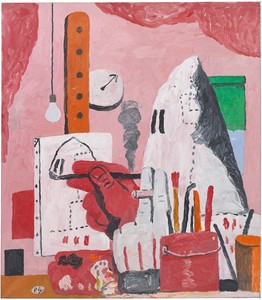
Philip Guston, The Studio, 1969, oil on canvas, 48 × 42 inches (121.9 × 106.7 cm) © The Estate of Philip Guston, courtesy Hauser & Wirth. Photo: Genevieve Hanson
It’s the end of the 1960s and it feels like the end of the world. Every night, the television shows unedited acts of brutal violence in American cities. Cops are beating protesters with clubs. Blood runs in the street. In his studio in the small town of Woodstock in New York State, the celebrated abstract painter Philip Guston, shaken by what he’s seen, gets to work. In his new paintings and drawings he’s processing these images of violence through a revival of ideas in his earlier work that he’d long since abandoned. Hooded figures, once standing unambiguously for Ku Klux Klansmen, return in altered guise. These new hoods no longer lynch and burn; instead, they stare emptily out of cars idling around the edge of town, they puff stogies and point at each other, they look at paintings or paint them. In their patched and splattered white robes, these figures resemble some ragged amalgam of Klansman, Catholic flagellant, and commedia character. They are, like Tiepolo’s Pulcinellas, emblematic figures of helpless, sardonic, melancholy observation, both a part of and somehow detached from the scenes they watch. Guston’s elongation of the hood’s circular eyeholes into long black slits contributes here, giving them the goonish affect of the Pulcinella mask. It’s as though they can’t believe what they’re seeing.
When Guston some years later described the hoods as self-portraits, he did so in part to frame them as emblems of white supremacy. Yet they are also tokens of cultural marginality, even redundancy, just like the Pulcinellas in Tiepolo’s frescoes. In one of his best-known Klan paintings, The Studio (1969), Guston shows a hood delicately daubing a self-portrait. The sight gag reflects on the absurdity of studio practice in the teeth of a national crisis, a position that brought him genuine pain. The artist’s well-known declaration of self-flagellation—“What kind of a man am I,” he asked, “to adjust a red to a blue” in the face of the political turbulence of the time—is the same kind of question posed by Tiepolo’s clowns. Both Guston’s hoods and Tiepolo’s Pulcinellas watch their own demise from the sidelines with sad eyes. But Guston’s painter is comic, too: He’s a caricature of the self-serious artist, the kind of painter Amy Sillman has sarcastically described as “so earnest, so caring—with a smock, and [his] tongue between [his] teeth, trying so hard.” This ambivalence lies at the core of Pulcinella as a tragicomic character: lovable and devious, appealing and grotesque, hero and fool all at once. It’s Guston’s self-image, and perhaps also Tiepolo’s.
Commedia figures allowed artists of the late nineteenth and early twentieth centuries—that is, artists at work within the accelerated culture of industrial modernity—to stake a position outside the mainstream. The itinerant entertainers depicted in Pablo Picasso’s 1905 painting Family of Saltimbanques set up camp at the edge of town, just as artists did. In the canvas, the one identifiable commedia figure—in this case Harlequin, in his distinctive diamond-patterned clothing—even takes on the unmistakable features of the young artist. It’s little wonder that Picasso returned many times over his career to this shapeshifting, chameleonic commedia character as an oblique self-portrait. Yet to do so was also to establish a foothold in a tradition encompassing both Domenico Tiepolo and his better-known father, Giambattista, as well as their near contemporaries Antoine Watteau and Francisco Goya. In his 1888–90 painting Harlequin, depicting his son Paul in that costume, Paul Cezanne was likely recuperating this history. Yet he was at the same time making it available for artists who revered him, as Picasso did: granting permission. In his four paintings of the subject, Paul Junior loiters awkwardly in his father’s studio, wearing the harlequin outfit that had been hanging there neglected for months. He has something of the melancholy aspect of Tiepolo’s Pulcinellas from a century earlier: He looks shifty, lost, anxious.
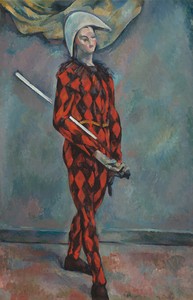
Paul Cezanne, Harlequin, 1888–90, oil on canvas, 39 ¾ × 25 ⅝ inches (101 × 65 cm), National Gallery of Art, Washington, DC. Photo: Art Resource, New York
This removed quality—this condition of looking on as the world ends—characterizes many of the twentieth century’s reprisals of commedia figures. The return of this strand of imagery in the traumatized years following World War I encapsulates its nature. André Derain’s 1924 painting Harlequin and Pierrot is a case in point: The two figures are shown in a barren landscape, their feet aloft in a dismal dance as they strum their stringless instruments. The work itself is bare and thinly made. This disavowal of Derain’s own, earlier Fauvist practice, with its loose impasto marks and hot color—a move perhaps comparable to Guston’s about-turn at the tail end of the ’60s—evinces a profound cynicism about modernism’s efficacy in a world gone wrong. It’s a painting made as any Pulcinella would make it: ironic, darkly comic, and heartbroken. It’s a premonition, too, of commedia’s return in later twentieth-century culture. In the video for David Bowie’s 1980 song “Ashes to Ashes,” codirected by Bowie and David Mallet, the singer wears a commedia costume—Pierrot—as he walks slowly, in a kind of funeral march for his Major Tom character, along the East Sussex shingle. The absurd anachronism of the costume is a suitable accompaniment to lyrics that announce the end of his 1970s phase, a plunge from that peak to “an all-time low.” Here as before, the commedia figure announces a threshold, a fold in time.
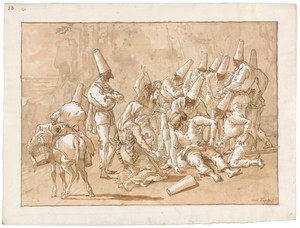
Giovanni Domenico Tiepolo, Pulcinella Collapses on the Road, from the series Divertimento per li regazzi (Entertainment for children), c. 1797–1804, pen and brown ink and brush and brown washes, over traces of charcoal, on off-white laid paper, 14 ¼ × 18 ¾ inches (36 × 47.5 cm), Art Institute of Chicago. Photo: Art Institute of Chicago/Art Resource, New York
In 1797, the same year as the dissolution of the Venetian government and Napoleon’s assumption of power, Tiepolo began a new project using the figure of Pulcinella: a suite of 104 pen-and-wash drawings collectively entitled Divertimento per li ragazzi (Entertainment for children). In the opening image, a humpbacked Pulcinella, holding a rag doll under one arm, stands before a large tomb on which is engraved the series’ title. The image makes clear just what kind of entertainment will be on offer here: an amalgam of the playful and the deathly, the beginning and the end of life. The Divertimento drawings, as befits their medium, are looser, wilder, and more explicit than the earlier frescoes. Across the series, various Pulcinellas are shot in a firing squad, abducted by an eagle, hanged in a public square; they’re born from huge eggs and die surrounded by weeping doppelgängers. Who is mourning whom is a moot question. The thing about a mask is that anyone can wear it.
Tiepolo’s Divertimento drawings make clear the relationship between the commedia and the carnivalesque: their antipuritanical and anarchic attitude, which for Tiepolo meant deliberately upending the received visual tropes of the culture into which he was born. Their phony resurrections and counterfeit assumptions parody Christian imagery in the irreverent spirit of the pre-Lenten Carnival celebrations. It’s this, I think, that gets at what remains contemporary about Tiepolo’s imagery of commedia characters. The prevalence of the grotesque in contemporary art—from the leering jokers of Cindy Sherman’s Clowns series (2003) to the gooey bodies of Tala Madani’s Shit Moms paintings (2019–) and Nicole Eisenman’s ungainly figurative sculptures—testifies to the eternal return of the carnivalesque spirit, especially at moments of political crisis or transition. In Eisenman’s sculptural group Procession (2019), a parade of clumsy, farting, flat-footed characters slump through the landscape, lugging flyswatters, flagpoles, and empty cans of tuna. They seem to pick up on and continue the processional energy of Tiepolo’s stumbling buffoons, who stagger their uncertain way across the world, from their past into our present, watching things come to an end.

Ben Street is a freelance art historian and educator based in London. He is the author of How to Enjoy Art (Yale University Press, 2021) and of the award-winning children’s book How to Be an Art Rebel (Thames & Hudson, 2021). His research focuses on illuminating points of contact between historical and contemporary art. Photo: David Owens