June 11, 2026
To Tell a Story—Now:John Berger & Susan Sontag
In the midst of John Berger’s centennial year, Tara Anne Dalbow considers To Tell a Story, a new book that explores his dynamic exchanges with Susan Sontag, recently published by Canongate Books.
In the midst of John Berger’s centennial year, Tara Anne Dalbow considers To Tell a Story, a new book that explores his dynamic exchanges with Susan Sontag, recently published by Canongate Books.
In 2010, John Berger was helping to develop a documentary about his life. For one scene, he had a specific suggestion: ping-pong. “It’s what Silver and I liked doing best,” he wrote to Tilda Swinton, coproducer of The Seasons in Quincy: Four Portraits of John Berger. Silver was his nickname for Susan Sontag, drawn from the streak in her hair that she wore as a badge of victory after her first bout with cancer, nearly thirty years before she succumbed to leukemia in 2004. Berger kept a table in the hayloft above his home in Quincy, a hamlet tucked in the French Alps, and when the American critic came for a visit, they played. One can only imagine their matches: jovial, quick, competitive, neither willing to concede a point. Or as Berger himself once put it: “one surprise prompting another.”1 At its best, To Tell a Story, the newly gathered record of their conversations and correspondence edited by writer and filmmaker Benoît Bourreau, has all the same qualities. In it, what the two volley back and forth in place of plastic balls are notions about the meaning and making of stories and images.
Table tennis, like much of Berger’s life, was less recreational than relational. It was a form of being together that required presence, attentiveness, and a willingness to return what the other gave. He described the role of the storyteller in similar terms in a 1983 debate with Sontag for the British program Voices, which, forty years on, remains prescient about what stories are for and what’s at stake if we lose the ability to tell them. In the video recording, Sontag and Berger sit across from one another at a small round table; three kilim rugs hang behind them. The central tension between the two critics is visible even before they speak it. Berger cants his body forward, elbows outstretched, hands gesturing as though shaping his idea from air. Sontag, for her part, leans back, composed, almost severe; she breaks her stillness primarily to shake her head in dissent. Their body language—him leaning toward her, her pulling away—gives form to their argument. For Berger, stories are bound up with relation and record; for Sontag, with freedom and fantasy.
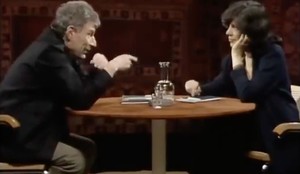
Still from “To Tell a Story,” Voices, Channel 4, London, 1983; pictured: John Berger and Susan Sontag
The two critics appear on-screen without a host, yet they are not entirely alone. Walter Benjamin—a formative influence on both—assumes the role of tacit mediator. The terms of his 1936 essay “The Storyteller” furnish a shared vocabulary that each writer draws on and bends to divergent ends. In his opening remarks, Berger evokes Benjamin’s itinerant “journeymen” when he envisions a story as a shelter set against a vast and frightening expanse, a place where the traveler might find a “kind of home.” Within that shelter, he says, is another: What the story tells is itself protected from “oblivion, forgetfulness, and daily indifference.”2 Storytelling appears, from the outset, as a rescuing operation, an act of recovery pitched against the ceaseless march of days.
For Berger, the need for rescue begins in the simple fact that a life has been lived, and to demonstrate this, he shares one such story: A shepherd from Quincy fell in love with a married woman, gave her half of everything he owned, and was cast out. He died shortly after, the consequence of a hunger strike. “When I think of him now, I can see his face, his very large hands, his eyes,” Berger says. “That was the truth, then I tried to write the story.” Sontag cuts in: “And then you started inventing.”3 Berger agrees but adds that the invention is always in relation to the truth. He tells stories, he says, because he sees meaning in an individual life and wants to retain it so that “it’s not lost, not forgotten.”4 Against our contemporary suspicions around authorship and permission, he insists that empathy and imagination make relation possible, and with it, the ability to relay. “I believe absolutely in experience being shareable,” he says.5 Even so, a story is never, for him, the product of a solitary consciousness. It arises from the meeting of three subjectivities—the teller, the protagonist, and the reader—and takes its meaning from those interconnections. It is the shelter within the shelter that makes such coherence possible, even portable.
If for Berger stories begin in the world, for Sontag, they begin within, as language imposes itself upon the writer’s mind.
Sontag interrupts early. Not all stories, she reminds him, are stories of life. Some are fabulous, speculative, exorbitant. Their claim on us lies in their capacity to transport us, conjure alternative futures, heighten feeling across registers. Of the works she’s read recently—including Flush (1933), Virginia Woolf’s novel narrated by a cocker spaniel—she says it is not the story but “character and hallucinatory detail” that move her.6 Storytelling, she says, is “an activity that faces in two directions”: on one side, truth, and on the other, “invention, imagination, lies.”7 If for Berger stories begin in the world, for Sontag, they begin within, as language imposes itself upon the writer’s mind. “I hear a sentence. . . . And I hear a voice,” she says.8 What matters, finally, is less that fiction preserves an account of human experience than that it enlarges its boundaries. Estranging the quotidian might, however provisionally, clear what William Blake referred to in his 1794 poem “London” as our “mind-forg’d manacles,” revealing alternative ways of seeing and living.
Berger does not deny this. What differentiates them is the ends to which those freedoms are put. “You want to be carried away by the story,” he tells her. “I want the story to stop things being carried away into oblivion and into indifference.”9
From the conversation’s closing lines, it is tempting to cast Berger as the ethical witness and Sontag as the partisan of aesthetic autonomy. When she insists that people are freer than ever before to make choices about their lives, Berger replies simply: “Who is ‘we’ there?”10 The political implications reverberate backward across the dialogue. One can almost see him tapping the plastic ball over the net, and Sontag watching it bounce, roll, drop to the floor. Who can argue with that? Still, the exchange resists so neat a distinction.
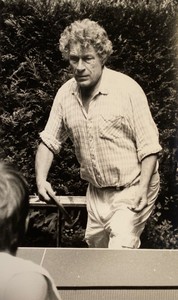
John Berger playing ping-pong (with his son Yves Berger). Photo: © Jean Mohr, courtesy the John Berger Estate
Sontag’s fidelity to fiction’s formal liberties is not indifference to the world, but adherence to another kind of truth. “I’m interested in moral fantasies,” she says. “Moral science fiction, even.”11 Berger, meanwhile, is not a mere custodian. As his own books can attest, to convey lives forward, stories depend on the same imaginative acts and aesthetic experimentations that she prizes, the very means by which one life becomes comprehensible to another. Beneath their disagreement lies a common conviction that meaning is forged through language. Doubtless, their respective positions were sharpened, if not exaggerated, by the occasion of live debate, the theatrics that any televised exchange invites.
“John, we’re going to go on talking about this for many years, I’m sure,” Sontag says in closing, “but now alas we have to stop.”12 She was right. The book makes clear that their argument never concluded, only evolved.
The correspondence and transcripts contained in To Tell a Story similarly confirm the suspicion that at the core of their propositions are values that in form and function are of a piece. A decade before Voices, Berger and Sontag shared a stage at the 1974 International Design Conference in Aspen. Barely acquainted, having met only the day before, they decided on impulse to abandon their separate talks and appear together instead. The resulting conversation has a quality of discovery as the two thinkers realize in real time that they’ve been circling the same problem—that of the image and its political viability—from different, but adjacent, angles. Responding to the previous evening’s photography presentation, they both lament the conversion of suffering into spectacle. An image of agony, Berger argues, once severed from the very real human event, becomes doubly isolated. The moment of pain, already removed from the continuity of the subject’s daily experience, is then isolated yet again by the photo frame, removing it from process, history, and, perhaps most critically, any imaginable field of action. The viewer recognizes the urgency of the suffering and feels, simultaneously, that nothing can be done to ameliorate it.
Sontag, answering, points to cumulative effect: streams of images that erase historical significance and render all struggles as interchangeable. Citing one of the photographs—of a Turkish village encircled by Greeks—she notes that it “could just as well be a Greek village surrounded by Turks.”13 What the media continually does, Berger says, is “deny space—space for thought”: The sequence moves so fast that a relationship between the viewer and what they are seeing can never solidify.14 If one of those images had been held on-screen for even ten minutes, he argues, “this would actually be the beginning of the searching for a political solution.”15 What matters, for both thinkers, is context, and that images, like language, retain some trace of the lived experience they arrest and frame.

Susan Sontag. Photo: Mikhail Lemkhin, courtesy Macmillan
“We are very different but we come from the same place,” Berger wrote in a 1990 letter to Sontag.16 Aspen, and the common ground it surfaced, might just be the place he had in mind.
Half a century later, the dangers they identified have only widened in scope and consequence. They apply not only to the onslaught of images delivered by twenty-four-hour news cycles and social media feeds, but to representation of all kinds. Narrative itself has undergone a similar attrition. Words, reduced to labels, evade the complications and nuance of subjectivity. Information and its attendant data proliferate while sensuous experience grows harder to comprehend, let alone articulate and exchange. For Benjamin, the end of storytelling meant the end of what he called “the epic side of truth, wisdom” and with it our capacity for counsel and consolation.17 What happens when the words we use to make sense of ourselves, of others, no longer correspond to a shared reality? What happens when what we mean means nothing? The answer, if their argument holds, is a culture increasingly disposed to estrangement and apathy, resigned to conditions it no longer recognizes as human-made.
Without Sontag, Berger was forced to follow this crisis of communication to its current manifestation alone. In Confabulations, published in 2016, the year before his death, he wrote, “Language is a body, a living creature,” whose “physiognomy is verbal and whose visceral functions are linguistic.”18 Living language is continuous with us; it bears forth memory and history, even as it evolves, holding together the articulate and the inarticulate, the seen and the merely sensed. It remains, crucially, irreducible, resistant by nature to simplification and generalization. Words, though, can be sheared from this creature of language. Dissociated, they become inert, empty, interchangeable. Berger heard this deadening, or what he called “gobbledygook,” everywhere in public discourse, in the acronyms, euphemisms, jargon, and algebraic abstractions that fill official speech.19 Corporate and political imperatives—to keep it short, smooth, straightforward—process out the variability and friction that gives language its purchase on the tangible, the corporeal. Without it, there is no means by which one consciousness might reach across the divide to another. What other technology do we have but words for understanding someone else’s life from the inside?
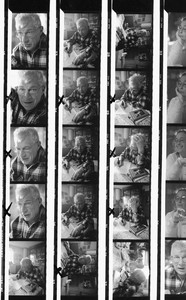
Contact sheet of John Berger (and his wife, Beverly Berger). Photo: © Jean Mohr, courtesy the John Berger Estate
The damage, for Berger, is civic as well as psychic. When language can no longer signify life, it also loses its ability to place us in time—to connect the present with any recognizable past or imaginable future. The result is what Berger called sans domicile fixe: unhoused, historically unmoored, marooned in an endless and uncertain present.20 This cultural amnesia manifests in wars prosecuted with the same justifications that discredited the last ones; in platforms that measure to the decimal the potential damage to human flourishing and continue apace; in our apparently limitless capacity to know what is coming ecologically, and to regard it as something other than an emergency. Berger and Sontag identified years earlier how the mass media produces and perpetuates this displacement in images. Now, narratives too are reduced to fragments, stripped of sense-making context, and presented to us “as shocks not stories.”21 They arrive in continuous succession, a relentless barrage of sound bites, each swiftly replaced by the next before it can be comprehended or assimilated. In this environment, immured in our own indifference, public life becomes easier to manage but harder to inhabit. You cannot look for a political solution to what you have not been allowed to recognize as a political problem. Hannah Arendt saw the banality of evil in Adolf Eichmann’s inability to think; had she lived to scroll through a feed, she might have found it in our own.
That we need stories that both document and defamiliarize is clear enough. Yet the present falls differently on Berger’s and Sontag’s initial arguments. In a culture saturated with vacuous content and fraying relations, Berger’s fear—that the forms once able to preserve and relay experience are being hollowed out—becomes harder to deny. In one of the final scenes in The Seasons in Quincy, Berger describes the storyteller as a passer, someone who gets contraband across a frontier. This new collection, To Tell a Story, so alive with the rigor of its subjects’ attentions, feels a bit like a smuggled object: an instance of transmission Benjamin might still have called counsel, even wisdom.
In one of her final lectures, “At the Same Time: The Novelist and Moral Reasoning” (2004), Sontag made the ethical stakes clear: “The nature of moral judgments depends on our capacity for paying attention, a capacity that, inevitably, has its limits but whose limits can be stretched.” When she died a few months later, Berger wrote to her in the present tense, likening her to quicksilver, “darting between past and future to shed light on the otherwise dark present.”22 Game and set to you, Quicksilver.
1 John Berger and Susan Sontag, To Tell a Story, ed. Benoît Bourreau (Edinburgh: Canongate Books, 2026), p. 145.
2Ibid., p. 12.
3Ibid., p. 14.
4Ibid., p. 18.
5Ibid., p. 47.
6Ibid., p. 32.
7Ibid., p. 13.
8Ibid., p. 43.
9Ibid., p. 33.
10Ibid., p. 51.
11Ibid., p. 20.
12Ibid., p. 51.
13Ibid., p. 127.
14Ibid., p. 131.
15Ibid.
16Ibid., 101.
17Walter Benjamin, “The Storyteller,” in The Novel: An Anthology of Criticism and Theory 1900–2000, ed. Dorothy J. Hale (Malden, MA: Blackwell Publishing, 2006), p. 364.
18John Berger, Confabulations (London: Penguin Books, 2016), p. 5.
19Ibid., p. 113.
20Ibid., p.78.
21Ibid., p. 139.
22Berger and Sontag, To Tell a Story, p. 146.
John Berger and Susan Sontag, To Tell a Story, ed. Benoît Bourreau (Canongate Books, 2026)
A new biography of John Berger will also be published on September 15: Tom Overton, John Berger: From Life (Verso/Penguin Random House, 2026).

Tara Anne Dalbow is a writer living in Los Angeles. Her work has been published in the Los Angeles Times, Frieze, Artforum, ARTnews, Bomb, Los Angeles Review of Books, Momus, Hyperallergic, The Art Newspaper, Artsy, and elsewhere.