
Now available
Gagosian Quarterly Summer 2026
The Summer 2026 issue of Gagosian Quarterly is now available, featuring Ellen Gallagher’s Fast-Fish and Loose-Fish (2026) on the cover.
Extended through May 23, 2014
Two pioneering artists separated by a generation, Diane Arbus (1923–1971) and Cady Noland (b. 1956) have probed the power of the everyday to reveal the dark underpinnings of American culture and society. In her unflinching photographs of the 1960s and 1970s, Arbus documented a challenged and changing nation, while Noland’s disjunctive sculptures and installations of the 1980s and 1990s literally embody the emptying-out of values in contemporary American life.
Representing distinctions between public and private, contrived and real, Arbus’ photographs reveal alternative histories to the idealized postwar American narrative. Beginning in the mid-1950s, Arbus found many subjects in New York, drawing equally from subculture and mainstream. During visits to Pennsylvania, Florida and California, she captured diverse domestic rituals, as well as local events and festivals. Some photographs offer prosaic yet touching glimpses of modern life: a teenage couple, awkward in oversized formal attire; a decorated Christmas tree in a suburban Long Island living room. Others explore social taboos and hint at the pervasiveness of violence and perversity: a nudist family, lounging in a grass field, gazes confidently at the camera; a grimacing boy gripping a toy grenade evokes the horrors of war in the benign setting of Central Park. Insightful dispatches from a transitional era, Arbus’ photographs epitomize the psychology of a post-war nation in flux.
Cady Noland has been described as a “dark poet of the national unconscious.” Like Arbus, she mines quotidian culture, but typically through the use of popular media headlines and generic cultural artifacts rather than human subjects. Implicating viewers in her sculptural situations, Noland shows contemporary reality to be alienating and dystopic. Urban refuse such as tires, chain-link fencing and slabs of beer cans are the building blocks of her sculptural installations. In Trashed Mailbox (1989), a domestic mailbox sits atop a shopping basket of empty bottles, oil cans, and a crumpled American flag to convey the ravaging of the American dream. In The Mirror Device (1987), a pair of handcuffs and a gun, clamped to a metal bar that hangs in front of a vanity mirror, place the viewer in the role of perpetrator. Noland’s work often treats the normalization of violence, presenting images of heroes and anti-heroes—a cowboy, terrorist-heiress Patty Hearst, psychopath Charles Manson, assassin Lee Harvey Oswald—as silkscreened cut-outs propped against the wall. The decline of the American psyche, Noland suggests, is rooted in the media’s exploitation of society's best and worst proclivities.
Diane Arbus was born in 1923 in New York City, where she died in 1971. Public collections include Metropolitan Museum of Art, New York; Museum of Modern Art, New York; Museum of Contemporary Art, Los Angeles; Tate Modern, London; and Centre Georges Pompidou, Paris. Arbus was the first American photographer to have work exhibited at the Biennale di Venezia (1972). Major museum exhibitions include Museum of Modern Art, New York (1972); Seibu Museum, Tokyo (1973); "Diane Arbus: Revelations," San Francisco Museum of Modern Art (2003, traveled to Los Angeles County Museum of Art; Museum of Fine Arts, Houston; Metropolitan Museum of Art, New York; Museum Folkwang, Essen; Victoria and Albert Museum, London; CaixaForum, Barcelona; and Walker Art Center, Minneapolis, through 2006); and “Diane Arbus,” Galerie nationale du Jeu de Paume, Paris (2011, traveled to Fotomuseum, Winterthur; Martin-Gropius-Bau, Berlin; and Foam, Amsterdam, through 2013).
Cady Noland was born in 1956 in Washington, D.C., and lives and works in New York. Public collections include Solomon R. Guggenheim Museum, New York; Museum of Contemporary Art, Los Angeles; Museum of Contemporary Art, Chicago; San Francisco Museum of Modern Art; Migros Museum für Gegenwartskunst, Zurich; Museum für Moderne Kunst, Frankfurt; and Le Consortium, Dijon. Major museum exhibitions include Museum Boijmans Van Beuningen, Rotterdam, The Netherlands (1995); Wadsworth Atheneum Museum of Art, Hartford, Connecticut (1996); “Strange Abstraction: Robert Gober, Cady Noland, Philip Taaffe, Christopher Wool,” Touko Museum of Contemporary Art, Tokyo (1991); Documenta 9, Kassel (1992); “MONO: Olivier Mosset, Cady Noland,” Migros Museum für Gegenwartskunst, Zurich (1999); “Cady Noland: The American Dream,” De Hallen Haarlem (2010–11); and “Regarding Warhol: Sixty Artists, Fifty Years,” Metropolitan Museum of Art, New York (2012).
The Summer 2026 issue of Gagosian Quarterly is now available, featuring Ellen Gallagher’s Fast-Fish and Loose-Fish (2026) on the cover.

In this video, Jenny Saville sits down inside her first major exhibition in Venice to discuss how the great Venetian artists of the past and the city’s heritage influence her work. The show brings together more than thirty canvases and works on paper from the 1990s to the present, tracing the development of her practice, which is deeply rooted in the history of painting.
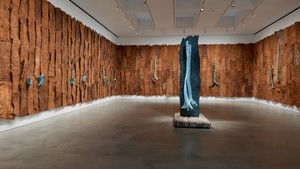
On the occasion of his exhibition The Reflection of Bronze at Gagosian, New York, Giuseppe Penone and curator Adam D. Weinberg sit down to discuss the genesis of, and their collaboration on, the show.
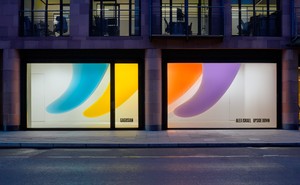
Ahead of Alex Israel’s exhibition of four new Fin sculptures at Gagosian, London, the artist spoke with Susan Casey, author of The Wave: In Pursuit of the Rogues, Freaks, and Giants of the Ocean (2010), about the ocean, surfing, and Los Angeles.
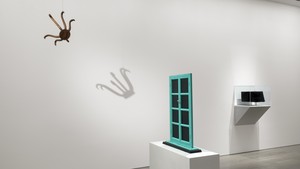
Marcel Duchamp is the inaugural exhibition of the gallery’s new ground-floor space in the historic building at 980 Madison Avenue. In this video, the Quarterly’s Alison McDonald discusses the artist’s most iconic readymades and their connection to New York City.
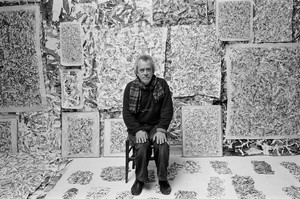
On July 9, Simon Hantaï: the last studio opens at Gagosian, Gstaad. Curated by Anne Baldassari, the show comprises sixteen of the artist’s dernier atelier (last studio) paintings of 1982–85. The exhibition is accompanied by an illustrated catalogue, copublished by Gagosian and Skira, which features an essay by Baldassari and an extensive portfolio of previously unpublished photographs by Édouard Boubat. Here, we share the introductory chapter from the publication.
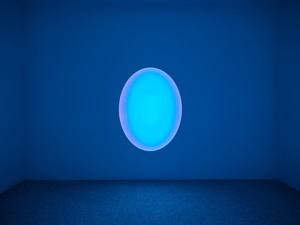
An exhibition at Gagosian, Hong Kong, brings together three of James Turrell’s Glasswork pieces along with site plans, photographs, and models of his Skyspaces and Roden Crater. Here, Alice Godwin explores the history of the Glassworks and their relationship to the artist’s wider practice.

On April 16, the Institute of Contemporary Art, Boston, opened the first midcareer survey of Derrick Adams’s multidisciplinary practice. Covering over twenty years of work, the exhibition, titled View Master, brings together the artist’s painting, sculpture, collage, performance, and video, as well as a vibrant new commission created for the museum’s façade. Ahead of the opening, Adams met with Tessa Bachi Haas, cocurator of the survey, to discuss his formative experiences with television, the impact of his work in arts education on his practice, and the importance of taking a more complex, more joyful, and more expansive approach to Black American life and culture.

Adam D. Weinberg has been working with Giuseppe Penone on an exhibition of the artist’s new sculptures, The Reflection of Bronze, that opens at Gagosian, New York, on April 22. The works explore the character and possibilities of bronze. Here, Weinberg considers Penone’s enduring engagement with the alloy and addresses the conceptual underpinnings of the exhibition’s three-room structure.

Jeff Koons tells Alison McDonald about his appreciation for the pioneering artist and thinker Marcel Duchamp.
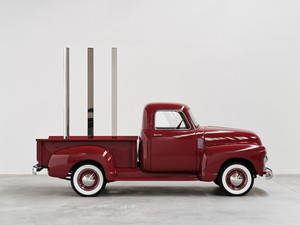
The Singular Experience at Gagosian’s Le Bourget gallery is the largest exhibition of Walter De Maria’s work in France in several decades. Organized by Donna De Salvo, senior adjunct curator at Dia Art Foundation, the exhibition marks the first time De Maria’s final sculpture, Truck Trilogy (2011–17), is being shown outside of the United States. Here, De Salvo speaks with artist Lucy Raven about her evolving kinship with De Maria and more.
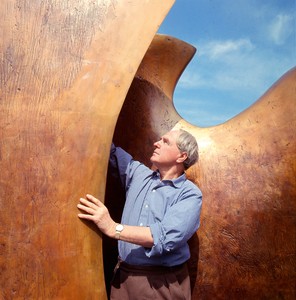
Laura Bruni writes about a major exhibition celebrating the work of the British sculptor Henry Moore at the Royal Botanic Gardens, Kew, London.
