
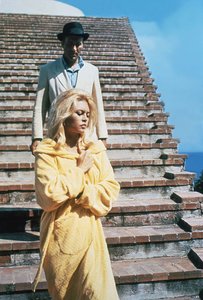
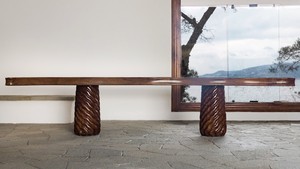
Presented in Design Miami’s Special Projects section, Casa Malaparte: Furniture marks the first time that the celebrated editions of furniture designed by the visionary writer and intellectual Curzio Malaparte (1898–1957) will be shown at an international design fair.

#CasaMalaparte

Gagosian’s booth at Design Miami 2025. Furniture by Curzio Malaparte © Malaparte. Video: Pushpin Films

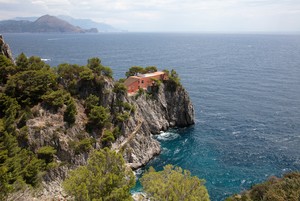
In 1938, nonconformist Italian writer Curzio Malaparte (born Kurt Erich Suckert) purchased a large tract of land on Capo Massullo, a rocky peninsula along the coast of Capri. Measuring a scant one hundred feet long and thirty feet wide and situated above limestone cliffs that drop a dramatic 650 feet into the Mediterranean waters below, it was far from the pinnacle of welcoming terrains. One could only reach the locale by foot or by boat, effectively averting all but the most motivated of visitors to the rugged promontory. To Malaparte—who had recently been released from nearly three-year period of internal exile—the peninsula’s inaccessibility, combined with its untamed natural beauty, was the realization of a fantasy: a quiet place where he could write without distraction and find solitude rather than seclusion.

Curzio Malaparte, Lipari, Italy, 1934. Photo: courtesy Malaparte Literary Trust

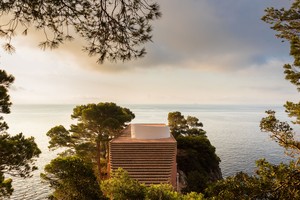
Casa Malaparte—the eponymous residence that Malaparte designed and built on this property—is a triumph of design, both inside and out. An unparalleled marriage of landscape and architecture, it extends along the entire length of Capo Massullo, a starkly sculptural presence that at once hearkens back to classical traditions while looking toward the modernist preferences typical of Malaparte’s avant-garde milieu. Moreover, Casa Malaparte is, perhaps, the most potent manifestation of a man’s self as a structure to ever exist, a true casa come me, or “house like me,” as Malaparte would come to describe his cliffside retreat—an autobiography in limestone and stucco.

Casa Malaparte, Capri, Italy. Photo: Sebastiano Pellion di Persano

Today I live on an island, in a house that is sad, hard, severe, that I built by myself, solitary on a sheer rock over the sea: a house that is the spectre, the secret image of prison. The image of my nostalgia. Maybe I never desired, not even then, to escape from jail. Man is not meant to live freely in freedom, but to be free inside a prison.

—Curzio Malaparte

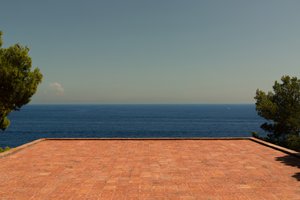
In 2019, Tommaso Rositani Suckert—Malaparte’s youngest descendant—founded Malaparte Design, a company dedicated to preserving and continuing the legacies of his ancestor’s iconic home through the re-creation of Casa Malaparte’s bespoke furniture. Like every other aspect of the villa, from its signature exterior staircase leading to the sun-drenched roof to the Pompeiian-red paint on its stucco walls, Malaparte determined every detail of his home’s furnishings.

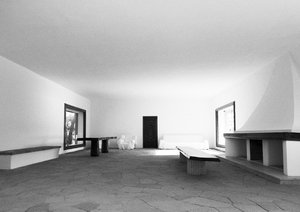
Malaparte Design focuses on pieces from in and around the villa’s living room, which boasts distinctive stone flooring laid in the ancient Roman mode of opus incertum, or “irregular work”; four large, walnut-framed picture windows positioned so as to capture the most arresting views rather than according to symmetrical balance; and a custom-made console table, bench, desk, and sofa, among other furnishings, specifically designed and placed for maximum impact and meaning—all made famous as the backdrop for Jean-Luc Godard’s 1963 film Le Mépris (Contempt). Malaparte Design’s reconstructions of the furniture, like their original counterparts, harness their conceiver’s maverick spirit and respect for ancient traditions and personal ritual, as well as the intrinsic qualities of his chosen materials. Rositani Suckert and his team have sourced the highest-quality materials and sought the talents of the best local artisans to craft and carve the furniture’s elements with the same respect for the materials’ natural properties while also making sure to carefully replicate the original designs.

Living room of Casa Malaparte, Capri, Italy. Photo: courtesy Malaparte

Console Table

Walnut and tuff stone console conceived in 1941 by Curzio Malaparte

Curzio Malaparte

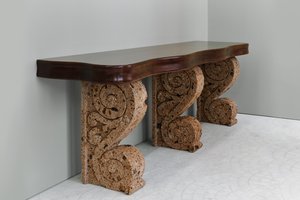
Console Table, 1941/2024, 2024

Walnut and tuff stone

26 × 105 ½ × 35 ½ inches (66 × 268 × 90 cm)

Edition of 12 + 2 AP

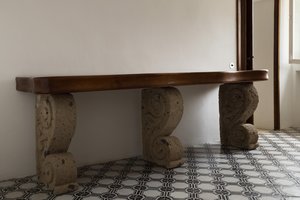
Malaparte designed the console table for the hallway just off the villa’s living room, at the top of the staircase to its second floor. It is made of European walnut and tuff stone, a type of rock made from the compaction and cementation of volcanic ash. The piece is at once commensurate with Casa Malaparte’s furnishings—many of which are constructed of similar materials—and wholly set apart from them due to its remarkable carved legs, whose intricated scroll-like shape recalls the volute capitals atop columns from classical architecture.

Original walnut and tuff console conceived in 1941 by Curzio Malaparte in situ at Casa Malaparte, Capri © Malaparte. Photo: Dariusz Jasak

During his extensive research into the making of the console table, Rositani Suckert discovered yet another possible and compelling influence: Malaparte’s relationship with Surrealism, and specifically Salvador Dalí’s 1931 painting The Dream. An architectural element situated in the painting’s distant register, along its left edge, is a near match for the legs’ carved shape. Malaparte was a true admirer of Surrealism, and many claimed that Casa Malaparte was, itself, a Surrealist manifestation of its creator. He wrote: “Now I live on an island, in an austere and melancholy house, which I built myself on a lonely cliff above the sea. It's the image of my desire.”

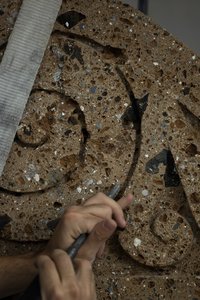
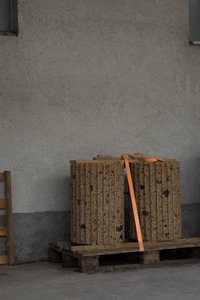
Tuff stone being carved to create the legs of the console table

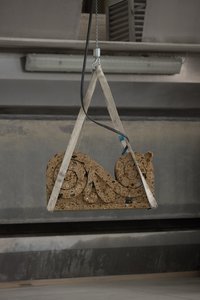
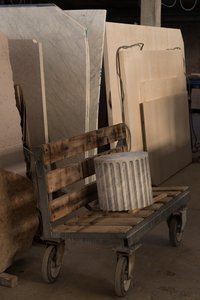
Completed tuff stone console table leg being moved in the factory

Bench

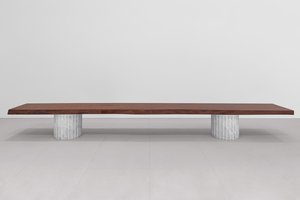
Walnut and Carrara marble bench

Curzio Malaparte

Bench, 1941/2020, 2020

Walnut and Carrara marble

18 ½ × 171 ¼ × 22 ⅛ inches (47 × 435 × 56 cm)

Edition of 12 + 2 AP

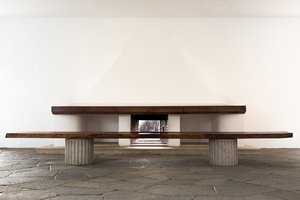
Malaparte’s bench offers, perhaps, the most personal and introspective experience of all his custom furniture. In the villa, it is situated in front of a glass-backed fireplace; its fluted Carrara marble legs and walnut seat form a post-and-lintel structure—which is repeated in the fireplace it faces—that strongly calls to mind the ancient temples that still pepper the Mediterranean landscape. With or without a fire in the fireplace, the bench invites moments of self-reflection and meditation; either the dancing flames or the pristine view provides ample fodder for imaginative tranquility.

Original walnut and Carrara marble bench conceived in 1941 by Curzio Malaparte in situ at Casa Malaparte, Capri © Malaparte. Photo: Dariusz Jasak

Outside Casa Malaparte, the bench continues to offer such moments of repose without the distraction of superfluous details, its clean lines recalling not only antiquity’s timeless structures but also the streamlined simplicity of modernist aesthetics—the beauty of such simplicity that only superior materials allow. Carrara marble, a distinctly white or blue-gray stone, has been continuously mined in the hills outside Carrara, Italy, since Ancient Roman times. It was used to build the Parthenon and Trajan’s Column, among other notable monuments and buildings, and it was Michaelangelo’s material of choice for his famed sculptures. Malaparte certainly knew of this the marble’s significant history within the region, and his choice to use it here suggests a strong connection to Italy’s artistic heritage.

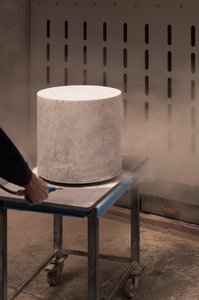
Carrara marble after initial carving into a cylinder to create the bench legs

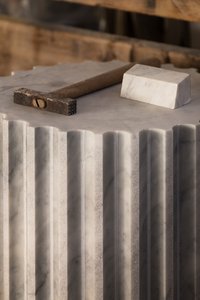
Detail of fluted carving on the Carrara marble bench leg

Completed Carrara marble bench leg in the factory

Desk

Glass and tuff desk conceived in 1941 by Curzio Malaparte

Curzio Malaparte

Desk, 1941/2024, 2024

Tuff stone and glass

27 ¼ × 78 × 26 ¾ inches (69 × 198 × 68 cm)

Edition of 12 + 2 AP

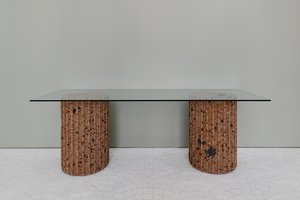
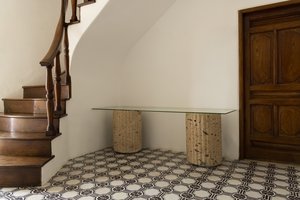
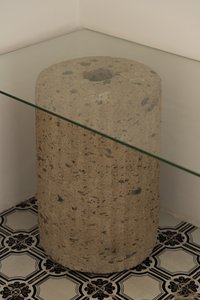
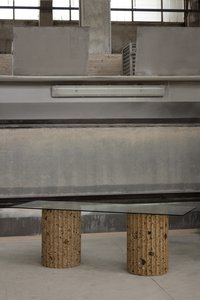
Malaparte’s desk—a construction of glass and tuff stone—is an unembellished ode to old-world materials and style filtered through the lens of streamlined modernist aesthetics. Two large cylinders of the volcanic stone form its legs, meticulously carved with a classic fluted pattern—a decorative device that recalls the classical architecture for which Italy is so famous, but also one that encourages a play of light. Landing on the ridges and curving around the grooves of the hollow channels, light becomes an active element of the piece.

Original tuff stone and glass desk conceived in 1941 by Curzio Malaparte in situ at Casa Malaparte, Capri © Malaparte. Photo: Dariusz Jasak

Detail of the original tuff stone and glass desk conceived in 1941 by Curzio Malaparte in situ at Casa Malaparte, Capri © Malaparte. Photo: Dariusz Jasak

The desk’s glass top suggests that, perhaps, Malaparte wanted to further toy with illumination and shadow in his design, as the translucent material allows for light’s passage through to the tuff legs below. The fluting also flaunts the stone’s natural properties, its dappled and speckled surface adding yet another element of visual interest to the otherwise simple design. Tuff has been a common building material throughout Italy since the Etruscans—an ancient civilization that predates the Romans. Malaparte’s choice to pair tuff with such recognizably classic motif suggests a deep awareness of and connection to this past.

Pair of completed tuff stone desk legs in the factory

Completed desk in the factory

Sofa

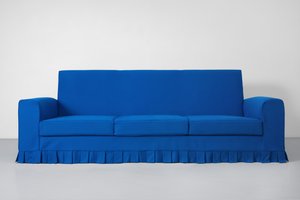
Blue sofa with ruffles on the bottom

Curzio Malaparte

Sofa, Tribute to “Le Mépris,” 1963/2024, 2024

Walnut, leather, linen, and blue cotton slipcover

37 ⅜ × 106 ⅜ × 33 ½ inches (95 × 270 × 85 cm)

Edition of 30

The Malaparte sofa is perhaps the most iconic piece from the villa. Malaparte Design is revisiting the famed sofa in a new, limited edition in collaboration with Philippe Pérès, a master craftsman and furniture maker and a renowned figure in the world of avant-garde design. Here, the pair specifically re-creates the sofa made famous in Contempt—with its electric blue slipcover, chosen by Godard himself to complement Malaparte’s original furniture design—which has since become emblematic of both the film and the villa in which most of it was set.

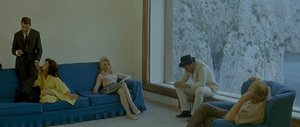
Still from Le Mépris (Contempt) (1963), directed by Jean-Luc Godard, filmed at Casa Malaparte, Capri, Italy © 1963 STUDIOCANAL, Compagnia Cinematografica Champion SPA, all rights reserved 

Throughout Contempt, Brigitte Bardot and her fellow cast members often congregate on and around the striking piece, which was crucially situated next to one of the villa’s large picture windows framing Capo Massullo’s plunging cliffs and the azure waters below. Indeed, an image of the actor sprawled across its blue cushions graced the film’s poster. Like the bench’s top and the villa’s windows, the sofa’s base is made from European walnut—a strong, foundational link to both the house and its other pieces of Malaparte-designed furniture.

Michel Piccoli and Brigitte Bardot at Casa Malaparte on the set of Le Mépris (Contempt), Capri, Italy, c. 1963

Michel Piccoli and Brigitte Bardot at Casa Malaparte on the set of Le Mépris (Contempt), Capri, Italy, c. 1963. Photo: Marceau-Cocinor/Les Films Concordia/Georges de Beauregard/Carlo Ponti/Collection Sunset Boulevard/Corbis via Getty Images

Casa Malaparte, Capri, Italy. Photo: Sebastiano Pellion di Persano

All furniture production photography: Dariusz Jasak