To celebrate the twentieth anniversary of Christo and Jeanne-Claude’s The Gates, The Shed is hosting an immersive exhibition on the monumental, temporary work of public art and other unrealized projects for New York City, accompanied by an augmented-reality experience in Central Park. On the occasion, Gagosian is featuring this online presentation, including six newly released related drawings.

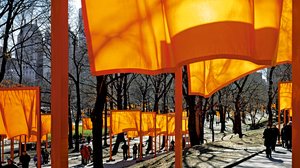
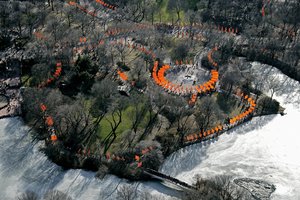
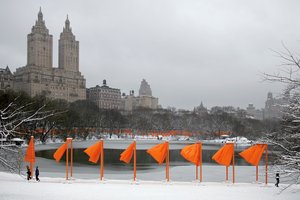
On February 12, 2005, Christo and Jeanne-Claude—accompanied by New York City Mayor Michael R. Bloomberg, among other local officials—unfurled the first panel of saffron fabric for their epic public artwork The Gates, in the city’s storied Central Park. Comprising 7,503 saffron gates, each topped with a panel of free-hanging saffron fabric, The Gates meandered through twenty-three miles of the park’s walkways. Evoking Japanese torii installed at entrances to Shinto shrines, the site-specific work encouraged visitors to linger on the paths, explore new corners of the park, and above all, remember that Central Park is an oasis of nature intended for everyone to enjoy, without strictures of class, race, or other forms of societal division. For the sixteen days that The Gates remained standing, four million people—New Yorkers and visitors from all over the world—flocked to the park to experience Christo and Jeanne-Claude’s captivating and utopian vision.

Aerial view of The Gates installed in Central Park, New York, 2005. Artwork © 2005 Christo and Jeanne-Claude Foundation. Photo: Wolfgang Volz

“All of our work is about freedom,” the artists explained in 2004, as preparations for The Gates were fully underway. “Nobody can buy our projects, nobody can sell tickets to experience our projects. Freedom is the enemy of possession and possession is equal to permanence. That is why our projects cannot remain and must go away forever. Our projects are ‘once-in-a-lifetime’ and ‘once upon a time.’”

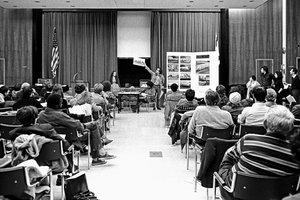
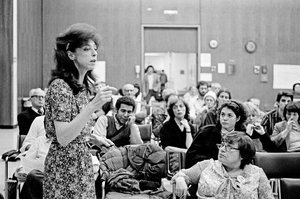
Christo and Jeanne-Claude first proposed The Gates to city officials in 1980; after countless meetings, however, the project was ultimately rejected, despite Christo’s assurance that it would not cost the city a penny. Rather, it would create hundreds of jobs and bring an influx of capital from the tourists that would come to see it. As with all of the artists’ monumental projects, The Gates would be entirely paid for by the sale of Christo’s artworks—preparatory drawings and collages visualizing the temporary intervention that are exceptional works unto themselves.

Christo

Christo introducing The Gates to the members of Manhattan Community Board 7, one of five community boards adjacent to Central Park, New York, December 2, 1980. Photo: Wolfgang Volz © 1980 Christo and Jeanne-Claude Foundation

Jeanne-Claude introducing The Gates to the members of Manhattan Community Board 7, one of five community boards adjacent to Central Park, New York, December 2, 1980. Photo: Wolfgang Volz © 1980 Christo and Jeanne-Claude Foundation

It would take over twenty years until The Gates was reconsidered; in the months after 9/11, the newly elected Mayor Bloomberg and the artists returned to the project, hoping its utopian ideals and intrinsic beauty would be a powerful restoration of the city’s joy, as well as a reassurance of the park’s role as a communal place to rest and heal. As longtime New Yorkers themselves—Christo and Jeanne-Claude called Manhattan their home from 1964 until their respective deaths in 2020 and 2009—the artists likewise sought solace in the realization of this decades-long dream for their adopted city.

In anticipation of the work’s opening, in 2004 the Metropolitan Museum of Art—also located in Central Park—organized an exhibition of Christo’s artworks related to the project. After The Gates was dismantled, a similar exhibition was organized in Zurich, which also included artworks related to other projects for New York City that Christo and Jeanne-Claude had proposed over the decades but had yet to see realized; these other works served as an introduction to their long-standing interest in New York as a site for one of their monumental undertakings.

Even at first blush, it was clear that “The Gates” was a work of pure joy, a vast populist spectacle of good will and simple eloquence, the first great public art event of the twenty-first century.

Michael Kimmelman

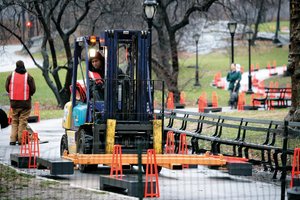
Workers installing The Gates in Central Park, New York, January 2005. Photo: Wolfgang Volz © 2005 Christo and Jeanne-Claude Foundation

Workers installing The Gates in Central Park, New York, January 2005. Photo: Wolfgang Volz © 2005 Christo and Jeanne-Claude Foundation

The Gates’ installation within Central Park was a feat of technical, bureaucratic, and civic planning. Each of the 7,503 gates stood sixteen feet tall and varied in width—from five and a half to eighteen feet—as the walkways narrowed and widened. Pairs of steel bases, weighing between 613 and 837 pounds each, were placed twelve feet apart to support extruded vinyl poles that were then adorned with fabric panels—almost a million square feet of nylon. Every aspect of the work was a brilliant saffron orange—an explosion of color amid the winter landscape. From the windows of surrounding buildings, the installation was a glowing golden river snaking through the park; to those walking the paths, it was a vibrant, billowing ceiling. It took six hundred workers to erect the structures, and another three hundred to take it down. Christo and Jeanne-Claude paid for every aspect themselves, from materials to installers, monitors, and security staff. And as with their other monumental works, no trace remained on-site after the project ended.

The Gates installed in Central Park, New York, 2005. Artwork © 2005 Christo and Jeanne-Claude Foundation. Photo: Wolfgang Volz

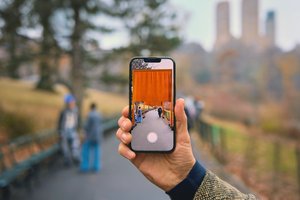
Early image of “The Gates: An Augmented Reality Experience” in Central Park, available through the Bloomberg Connects app beginning February 12, 2025. Artwork © 2025 Christo and Jeanne-Claude Foundation. Photo: © 2025 Joe Pugliese and Dirt Empire

Now, twenty years after this landmark event, a section of The Gates is being reimagined along the very paths where it once stood. Thanks to an augmented-reality experience, available via the Bloomberg Connects app, visitors to Central Park can again walk through The Gates simply by raising their phones. A concurrent exhibition at The Shed traces the twenty-six-year journey to realize the project. Through a selection of Christo’s drawings, collages, and scale models—the artworks whose sale funded The Gates—as well as materials and immersive video and photography from the 2005 installation, the exhibition will reanimate the artists’ vision for Central Park. It will also showcase other unrealized proposals for New York by Christo and Jeanne-Claude, thereby expanding our understanding of their creative engagement with the city.

Vladimir Yavachev, director of operations for the Christo and Jeanne-Claude Foundation, discusses Christo and Jeanne-Claude’s The Gates. Artwork © Christo and Jeanne-Claude Foundation. Video: Pushpin Films

The Gates

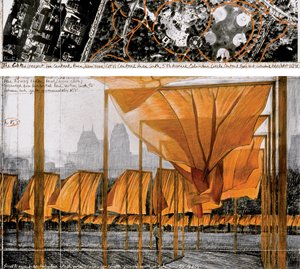
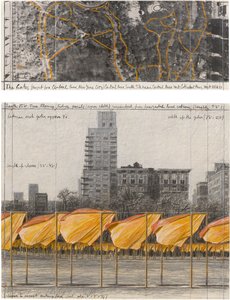
Christo’s drawings and collages for The Gates stand out as among his most distinctive preparatory works. Pairing illustrations of the saffron gates with detailed maps of Central Park’s walkways, geographic coordinates, aerial photography, fabric swatches, and other technical data, these works on paper capture the essence of Christo and Jeanne-Claude’s monumental vision while also revealing Christo’s superb skill as a draftsman. Major art museums in New York City—the Metropolitan Museum of Art, Solomon R. Guggenheim Museum, and Whitney Museum of American Art—all hold drawings and collages of The Gates in their permanent collections—a testament to both the works’ striking beauty and the project’s historical importance to the city.

Drawing of saffron gates in Central Park and aerial map

Christo

The Gates (Project for Central Park, New York City), 2001

Graphite, charcoal, pastel, wax crayon, and photograph on paper, in 2 parts
Top: 15 × 65 inches (38.1 × 165.1 cm)
Bottom: 42 × 65 inches (106.7 × 165.1 cm)

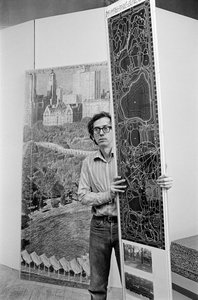
Christo in his studio with a preparatory drawing for The Gates, New York, 1984. Artwork © 1984 Christo and Jeanne-Claude Foundation. Photo: Wolfgang Volz

Drawing of saffron gates in Central Park and an aerial map

Christo

The Gates (Project for Central Park, New York City), 2001

Graphite, charcoal, pastel, wax crayon, fabric, and aerial photograph on paper, in 2 parts
Top: 12 × 30 ½ inches (30.5 × 77.5 cm)
Bottom: 26 ¼ × 30 ½ inches (66.7 × 77.5 cm)

I always do the drawings and sketches of the project before it is realized. The first drawings are always skeletal, unclear. Drawing helps me think, and the last drawing will be the closest to reality. 

Christo

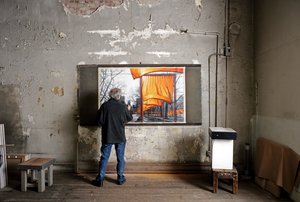
Christo in his studio working on a preparatory drawing for The Gates, New York, December 2004. Artwork © 2004 Christo and Jeanne-Claude Foundation. Photo: Wolfgang Volz

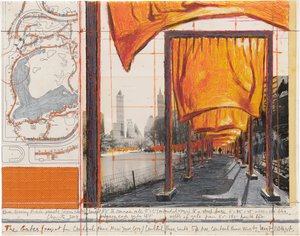
Drawing of saffron gates in Central Park and an aerial map

Christo

The Gates (Project for Central Park, New York City), 2004

Graphite, wax crayon, enamel paint, photograph by Wolfgang Volz, map, fabric sample, and masking tape on paper
11 × 14 inches (27.9 × 35.6 cm)

Other Unrealized Project for New York City

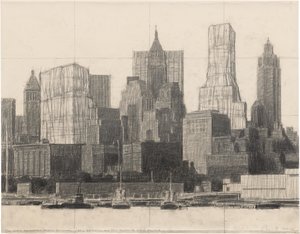
When Christo and Jeanne-Claude moved from Paris to New York in 1964, the downtown Manhattan skyline––a jagged march of high-rises, spires, and prewar roofs––particularly sparked Christo’s creative imagination. From his first glimpse of the urban landscape from the bow of the SS France (the ship upon which he and Jeanne-Claude crossed the Atlantic), New York City’s architecture inspired the artist to expand the scope of his practice. In a graphite drawing for Two Lower Manhattan Packed Buildings (Project for 2 Broadway and 20 Exchange Place) (1964–66)— the first proposal to wrap a public building that Christo and Jeanne-Claude actually attempted to execute—he visualized swathing two downtown buildings exemplifying opposite architectural styles in identical fabric. Despite intensive negotiations, the project was never realized due to the owners’ denied permission.

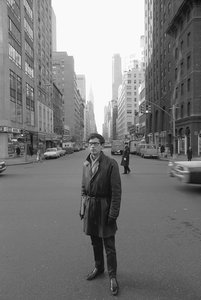
Christo standing on the corner of Lexington Avenue and East 57th Street in New York City

Christo at the corner of Lexington Avenue and East 57th Street, New York, c. 1966. Photo: Ugo Mulas © 1966 Christo and Jeanne-Claude Foundation and Ugo Mulas Heirs

Drawing of cityscape

Christo

Two Lower Manhattan Packed Buildings (Project for 2 Broadway and 20 Exchange Place), 1964–66

Graphite on paper
22 × 28 inches (55.9 × 71.1 cm)

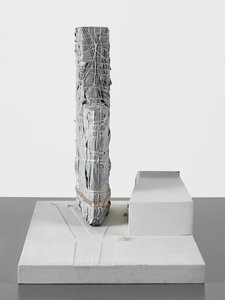
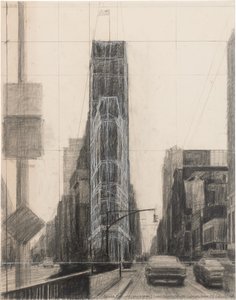
Christo and Jeanne-Claude also set their sights on Times Square—today a tourist center but in the mid-1960s, a burgeoning scene of peep shows and other forms of adult entertainment. They focused on a twenty-five-story skyscraper that stood alone at the iconic address of One Times Square, unattached to any other buildings. Built in 1903–04 as the headquarters of the New York Times, by 1963 the building had been sold to Allied Chemical, who stripped the building of its façade down to the steel frame, leaving a modern, featureless wall. Amazingly, Christo and Jeanne-Claude had the support of Allied Chemical, whose board chairman was friends with one of Christo’s first collectors, but ultimately, the project was denied for insurance reasons. Christo’s preparatory drawings such as Packed Building (Project for 1 Times Square, Allied Chemical Tower, New York) (1968) bring to life the artists’ striking vision, with the extreme contradiction between the negative space on the page and the heavily worked drawing of the urban cityscape.

Scale model of a wrapped building

Scale model for Christo’s Packed Building (Project for 1 Times Square, Allied Chemical Tower, New York) project, 1968. Photo: Eeva-Inkeri © 1968 Christo and Jeanne-Claude Foundation

Drawing of a building

Christo

Packed Building (Project for 1 Times Square, Allied Chemical Tower, New York), 1968

Graphite, charcoal, wax crayon, and wash on paper
28 × 22 inches (71.1 × 55.9 cm)

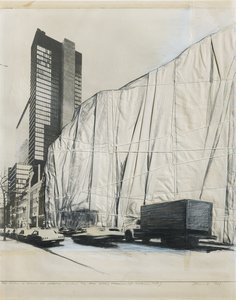
The artists’ plans to intervene in New York’s landscape did not stop there. In 1968, they proposed several ideas for projects within the Museum of Modern Art, which they intended to be realized at the same time. They wanted to inflate a package of air in the museum’s sculpture garden; build a wall of oil barrels down 53rd Street; erect an oil barrel mastaba in the main hall, surrounded by wrapped trees; and—the pièce de résistance—wrap the museum’s building itself. Rather than allowing these interventions to proceed, MoMA organized an exhibition of Christo’s preparatory works titled Christo Wraps the Museum: Scale Models, Photomontages, and Drawings for a Non-Event, which opened in June 1968. Executed in graphite, charcoal, and wax crayon, and incorporating a photostat of the museum, fabric, and thread, The Museum of Modern Art, Wrapped (Project for New York) (1968) exemplifies the artists’ visionary goal of transforming architecture and the urban environment.

Drawing of a city street with one building wrapped in fabric

Christo

The Museum of Modern Art, Wrapped (Project for New York), 1968

Graphite, charcoal, wax crayon, photostat from a photograph by Ferdinand Boesch, cardboard, fabric, thread, staples, and adhesive tape on cardboard
28 × 22 inches (71.1 × 55.9 cm)

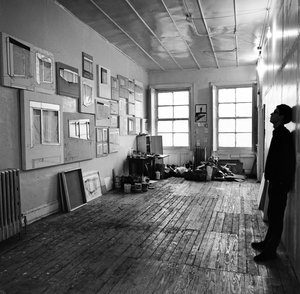
Christo standing in his studio in New York

Christo in his studio with works from his Store Fronts series (1964–68), New York, 1965. Photo: Ugo Mulas © Christo and Jeanne-Claude Foundation and Ugo Mulas Heirs