Nature and Inspiration: Henry Moore at Houghton Hall
Sebastiano Barassi reflects on the centrality of nature in the work of Henry Moore—as form, material, inspiration, and site.
In conjunction with the exhibition Henry Moore and Greece at Gagosian, Athens, the Henry Moore Foundation has released three previously unpublished prints from a cycle of seven lithographs and etchings that was completed by the artist in 1984.
For Henry Moore, printmaking was a natural and important extension of his interest in drawing, becoming a larger part of his practice as the activity of producing sculpture became more challenging. He came to the medium relatively late and had made only a hundred prints by his seventieth birthday in 1968. After this date, however, he produced more than six hundred.
Moore began his printmaking career with two woodcuts for the journal The Island in 1931. In the immediate postwar years, he worked for the first time with etching and bookmaking, experimented with color, conveyed production information by drawing on translucent paper, and used drawings as source material. By the mid-1960s he had replaced the detailed imagery of his earlier work with rapidly sketched figures, and was working with printers, artisans, and publishers in a collaborative mode. Among his most significant projects of the late 1960s and early 1970s are two etching portfolios, Elephant Skull Album (1969–70) and Sheep Album (1972/1974).
In the 1970s, Bernhard Baer of Ganymed Press, publisher of Moore’s print Stonehenge VI: Fallen Giant (1973), persuaded the artist to make facsimiles of his early sketchbooks; he was also responsible for Moore’s first portfolio of colored etchings and aquatints, The Reclining Figure (1977–78). Moore produced portfolios himself, too, including Nudes (1974), which was based on contemporary drawings, and continued to experiment with graphic media. The artist’s final etchings and aquatints, editioned by Jim Collyer and John Crossley of J. C. Editions, included the monumental portfolio Mother and Child (1983), which he signed just a month before his death in 1986.
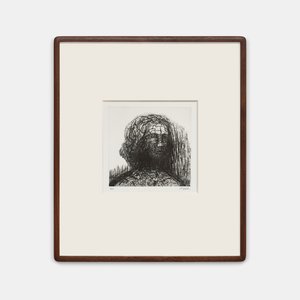
Head of Girl: Sectional, 1981
1-color photoetching
17 ⅛ × 14 ⅞ inches (43.5 × 37.8 cm)
Framed: 24 × 20 ⅝ × 1 ⅜ inches (61 × 52.2 × 3.3 cm)
Edition of 50
In the densely worked portrait photoetching Head of Girl (Sectional) (1981), Moore depicts his young female subject using sectional lines that help to define the solidity and dimensionality of her head and shoulders. Moore admired etching as a natural medium for a sculptor because of its relative directness, and this work expresses that quality. The image also reveals the inspiration of several artists, in particular Rembrandt and Georges Seurat, reinforcing Moore’s stated idea that true works of art can only come about through “the development and experience of a lifetime combined with all these influences.” It also reflects his lifelong interest in representing the human head, which he regarded—contrary to many viewers’ expectations—as the most important part of a piece of sculpture.
I think etching compared with, say, lithography is a more natural thing for a sculptor because etching is a very direct thing.
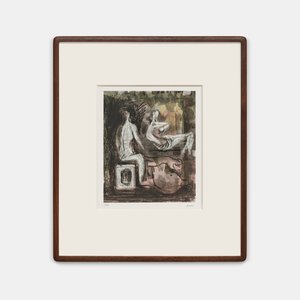
Ideas for Figures in a Setting, 1984
8-color lithograph
22 ⅛ × 17 ¾ inches (56 × 44.9 cm)
Framed: 24 × 20 ⅝ × 1 ⅜ inches (61 × 52.2 × 3.3 cm)
Edition of 50
“The whole of my development as a sculptor,” Moore commented, “is an attempt to understand and realize more completely what form and shape are about, and to react to form in life, in the human figure.” The lithograph Ideas for Figures in a Setting (1984) depicts two figures in white—one seated, the other reclining—against an abstracted backdrop, with a suggestion of a third figure sketched in black outline between them. As insinuated by its title, the entire composition represents an experiment in potential form and placement. The seeming appearance of a hole in the boxlike form on which the seated figure is positioned resonates with Moore’s use of pierced forms and hollow spaces to link his sculptures more completely with their sites.
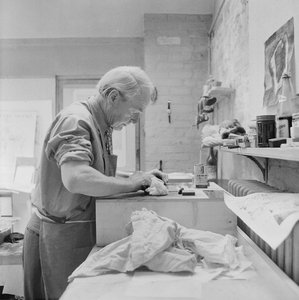
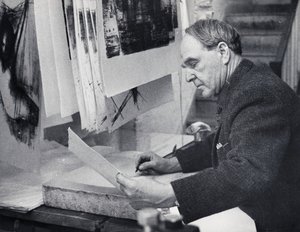
Henry Moore treating a plate in his Bourne Maquette Studio, Perry Green, England, 1971. Photo: Errol Jackson
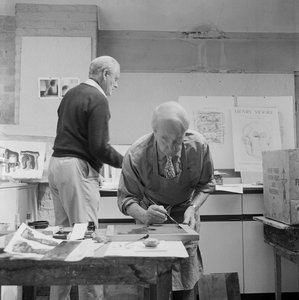
Henry Moore working in his Bourne Maquette Studio with Gerald Cramer in the background, Perry Green, England, 1971. Photo: Errol Jackson
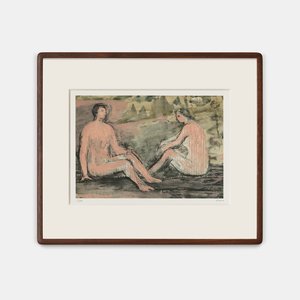
Man and Woman in Landscape, 1984
8-color lithograph
17 ¾ × 22 ⅛ inches (44.9 × 56 cm)
Framed: 20 ⅝ × 24 × 1 ⅜ inches (52.2 × 61 × 3.3 cm)
Edition of 50
The delicately colored lithograph Man and Woman in Landscape (1984), which depicts two seated nude figures facing one another against a backdrop of tree-covered hills, combines Moore’s ongoing focus on bodily form with a timeless study of landscape. “In my opinion,” the artist remarked, “long and intense study of the human figure is the necessary foundation for a sculptor.” Reflecting this profound engagement with corporeality in association with an immersion in images of the wider natural world, Man and Woman in Landscape suggests a profound and universal interaction between people and place.
In a graphic work you can try out ideas and not lose the previous one, because you can retain the previous states. . . . It allows you to experiment.
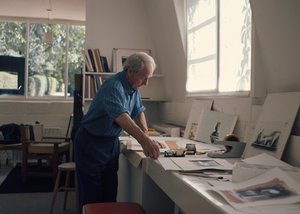
Henry Moore working on lithographs at Gildmore Graphics Studio, Perry Green, England, 1974. Photo: Errol Jackson
Sources for quotations
Henry Moore, interview by Alan Haydock, The Arts This Week, BBC Radio 3, June 20, 1971
Henry Moore, interview by Nigel Rees, Kaleidoscope, BBC Radio 4, May 22, 1975