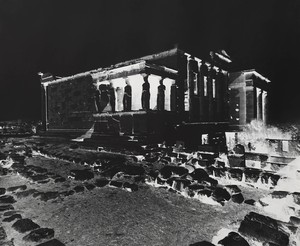
Vera Lutter: Time Travel
Jean Dykstra reports on Vera Lutter’s new series, produced on the occasion of a commission to photograph Athens.
November 20, 2015
Vera Lutter speaks with Gagosian’s Derek Blasberg about her Museum of Fine Arts Houston exhibition, using a shipping container as a camera, and her place in photography as we enter a digital age.
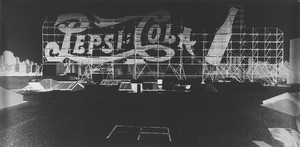
Vera Lutter, Pepsi Cola (small logo): August 10, 2002, 2002, gelatin silver print, 13 ¼ × 27 ½ inches (33.7 × 69.8 cm), unique
Vera Lutter, Pepsi Cola (small logo): August 10, 2002, 2002, gelatin silver print, 13 ¼ × 27 ½ inches (33.7 × 69.8 cm), unique
Derek BlasbergHow did this show in Houston come about?
Vera LutterThe Chief Curator of Photography at the MFA in Houston, Malcolm Daniel, was formerly the Chief Curator of Photography at the Met in New York, so I’ve known him for 20 years. We met soon after my graduate show—I attended the School of Visual Arts in New York—in 1994. He had heard about my work but the show was down, so he came to my apartment since at the time I didn’t have a studio. I guess he liked what he saw because he became a big champion of my work and the Met became one of my greatest supporters. In fact, it was through the Met that I was introduced to Larry Gagosian. So, when Malcolm moved to Houston and had an opening in his programming schedule, he invited me to collaborate with him again, and of course I was elated.
DBWhat’s in this show?
VLIt’s something of a mini retrospective. It includes twelve large photographs with a variety of subjects, and it includes works dating back to 1998.
DBWould you describe it as a survey of your work?
VLIt certainly gives an overview of the different themes I’ve considered.
DBI’m often drawn to your more industrial images, were any of these selected for the show?
VLYes, there’s an oil rig that I photographed in a German shipyard, and it’s one of my favorite pieces. It’s from 2000 and it’s called Kvaerner Shipyard, Rostock Warnemünde, IX: December 5, 2000. I used to title my works according to the place where they were photographed, but I was forced to stop doing that when I discovered that another photographer was traveling to those locations in an attempt to duplicate my work.
DBOne of your most iconic series, and one of my favorites, is your work from the Pepsi Cola factory.
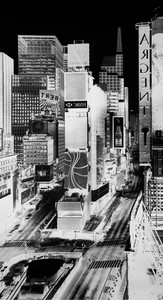
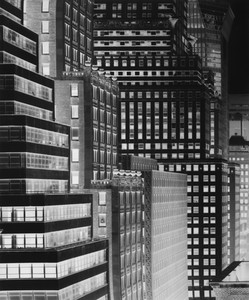
Vera Lutter, Times Square, New York, V: July 31, 2007, 2007, gelatin silver print, 101 × 56 inches (256.5 × 142.2 cm), unique
VLYes, that’s in the show as well. I photographed these works in 1998, so it’s one of my earliest series. I discovered the Pepsi Cola sign one night when I was out with my friends and we were driving down the East Side of Manhattan, and there it was across the river in Long Island City. The factory allowed me to use their roof to set up my equipment for the picture, and then they let me photograph the inside of their factory too, which lead to many more conceptual images, such as Pepsi Cola Interior, XXIII: July 1–31, 2003.
DBTalk to me a little bit about your process. How do you find a location?
VLMost often things start with an idea in my head, and many times I don’t even know the location. I get an image in my head and then I look for it in the world and for a space to realize it. Sometimes people will make suggestions to me. There’s an image of a massive mining machine in the show, which my mother told me about. She said this would be a great topic for me, so I went and saw it and she was totally right.
DBThe first “camera obscura” that you ever created was in your apartment. You turned your entire apartment into a camera. How has your technique evolved?
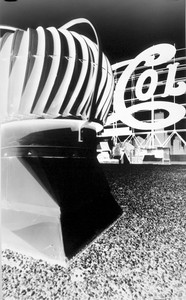
Vera Lutter, Pepsi Cola, Big Vent and Logo, Summer 2000, 2000, gelatin silver print, 19 ½ × 12 inches (40.5 × 30.5 cm), unique
VLWell, I don’t have a studio apartment anymore. That’s the good news! But the process is the same: I still work with a camera obscura, which can be a room, it can be my studio, it can be a cabin I build or a shipping container that I rent. I always take the easiest route: If there’s nothing, I’ll build a little house or rent a shipping container. At the Pepsi Cola Bottling Factory in Long Island City, it wasn’t possible to crane a shipping container onto the roof, so my friends and I built a little cabin, and that became my camera.
DBAnd then technically speaking, how long does it take to find and create an image?
VLIt varies. The Pepsi works from the interior of the factory were probably a one month exposure. The longest I’ve ever exposed an image was for three months, at the interior of the Nabisco Factory which is now Dia Beacon.
DBYour work is typically monochromatic. Would you say that you see the world in black and white, or is it more the result of your process?
VLI try and see the world the way it is, but then segments stand out and turn into my work. For example, there is a beautiful old tree in front of my house, and it’s red and green, and I love those colors. But if I were to photograph it, I would use grey to find the color, and then focus on the contrast and the shape. This is the reason I don’t photograph everything. If you want to photograph a person, and you want to capture them beautifully, you wouldn’t ask me. My photograph would capture them in reverse as a negative image and in black and white. In most cases that’s not the most beautiful way to see a human face.
DBHow do you think photography, and your work, will change as we enter a digital age?
VLWell, I have dabbled with the digital medium—I made a video—and I profoundly enjoyed that project. But generally speaking, I’m inspired by the analogue photography process. Digital is virtual, and yes I take snapshots on my camera, which I cherish. Those are the diary that we all make of our lives, but I think of that as a private interest. The painter works with paint and a paintbrush, a photographer works with chemistry and the chemistry lends itself to something more mysterious. I really enjoy having those materials in my hands.
Artwork © Vera Lutter
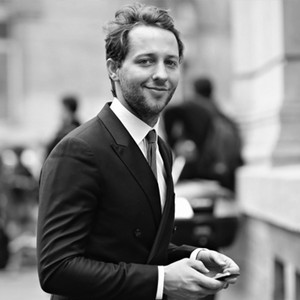
Derek C. Blasberg is a writer, fashion editor, and New York Times best-selling author. He has been with Gagosian since 2014, and is currently the executive editor of Gagosian Quarterly.
Jean Dykstra reports on Vera Lutter’s new series, produced on the occasion of a commission to photograph Athens.
The Summer 2022 issue of Gagosian Quarterly is now available, with two different covers—featuring Takashi Murakami’s 108 Bonnō MURAKAMI.FLOWERS (2022) and Andreas Gursky’s V & R II (2022).
During a two-year residency at the Los Angeles County Museum of Art, from 2017 to 2019, Vera Lutter documented the museum’s changing campus and permanent collection, using her distinctive photographic technique. Here, she speaks about the experience with the museum’s director, Michael Govan.
The Spring 2020 issue of Gagosian Quarterly is now available, featuring Cindy Sherman’s Untitled #412 (2003) on its cover.
Vera Lutter sat down with Marvin Heiferman, an independent curator and expert in photography, to discuss her latest New York exhibition.

Ahead of Persephone, an exhibition of new paintings by Mary Weatherford inside Hong Kong’s historic Pedder Building, the Quarterly’s Wyatt Allgeier met with Weatherford and the architect Mark Lee to talk about their collaboration. Here, they discuss how custom architectural interventions—from mirrored columns to strategic light play—transform the gallery, evoking Persephone’s mythic journey through the underworld and back into the light of spring.

Ahead of her exhibition over the summer at the National Portrait Gallery, London, Jenny Saville met with the novelist Douglas Stuart to discuss Glasgow, the beauty and blemishes of bodies, and their respective creative processes.

Join Gagosian for a conversation between Derrick Adams and Ekow Eshun, author, curator, and chair of the commissioning group for the Fourth Plinth in Trafalgar Square, London. The pair discuss Adams’s latest paintings depicting visions of Black Americana—featured in the exhibition Situation Comedy at Gagosian, Davies Street, London—within the context of British contemporary culture.

To coincide with her exhibition Setsuko: Kingdom of Cats, at Gagosian, New York, the artist speaks with architect Peter Marino about her recent sculptures, paintings, and works on paper.

In conjunction with the exhibition Japanese Art History à la Takashi Murakami at Gagosian, London, Takashi Murakami and Hans Ulrich Obrist, curator and artistic director of Serpentine, London, sit down to discuss the artist’s exploration and contemporizing of ancient Japanese artworks and movements. The two delve into Murakami’s investigation of Iwasa Matabei’s seventeenth-century masterwork Rakuchū-Rakugai-zu (Scenes in and around Kyoto) and the Kyoto-based style of Rinpa painting, among other examples.

Join Gagosian for a conversation between Julian Rose, historian and critic of art and architecture, and Nicholas Serota, chair of Arts Council England and senior independent director on the BBC board, to celebrate the publication of Building Culture (2024), Rose’s new book about museum architecture. Rose and Serota discuss the ways in which museums are shaping the future of art, architecture, and public space.

Gagosian and Sadie Coles HQ hosted a conversation between Urs Fischer and film curator and writer Róisín Tapponi about fearless creativity and the artist’s most recent monograph, Urs Fischer: Monumental Sculpture.