
Theaster Gates: Dave, All My Relations
A conversation between Theaster Gates and Jessica Bell Brown, with an introduction by Sydney Stutterheim.
Summer 2022 Issue
The Summer 2022 issue of Gagosian Quarterly is now available, with two different covers—featuring Takashi Murakami’s 108 Bonnō MURAKAMI.FLOWERS (2022) and Andreas Gursky’s V & R II (2022).
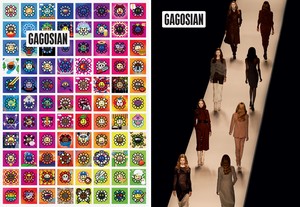
Left: Takashi Murakami’s 108 Bonnō MURAKAMI.FLOWERS (2022) on the cover of Gagosian Quarterly, Summer 2022; right: Andreas Gursky’s V & R II (2022) on the cover of Gagosian Quarterly, Summer 2022
Left: Takashi Murakami’s 108 Bonnō MURAKAMI.FLOWERS (2022) on the cover of Gagosian Quarterly, Summer 2022; right: Andreas Gursky’s V & R II (2022) on the cover of Gagosian Quarterly, Summer 2022
The Summer 2022 issue of Gagosian Quarterly is now available, with two different covers featuring Takashi Murakami’s 108 Bonnō MURAKAMI.FLOWERS (2022) and Andreas Gursky’s V & R II (2022).
Inside this issue, you will find a conversation with Murakami and RTFKT about the future of art, the metaverse, and a series of recent shared projects. We also present Andreas Gursky’s latest photographs alongside an interview with the artist by Max Dax, in which they discuss the influence of techno music and art history in Gursky’s creative process.
Also in the issue, Michael Auping inaugurates At the Edge—a new series of stories from the sidelines of art history—with his first-hand perspective on the tense preparations for a Chris Burden performance. Julian Rose delves into the architecture of Donald Judd. We share a number of dialogues between novelists and painters: Francine Prose with Mary Weatherford; Dodie Bellamy with Louise Bonnet; and Nalo Hopkinson with Alexandria Smith. Fiona Alison Duncan takes us deeper into the world of literature with profiles of six book editors changing the standards of publishing.
Elsewhere, Salomé Gomez-Upegui sheds light on sculptor Feliza Bursztyn; Richard Calvocoressi tells the story of Francis Bacon’s creation of his first image of the pope; Jean Dykstra reports on Vera Lutter’s new series of photographs from Athens; and Carlos Valladares interviews documentary filmmaker Rebecca Cammisa.
For all of this and more, order your copy or subscribe at the Gagosian Shop, or read the issue online.
Takashi Murakami cover artwork © 2022 Takashi Murakami/Kaikai Kiki Co., Ltd. All Rights Reserved
Andreas Gursky cover artwork © Andreas Gursky/Artists Rights Society (ARS), New York
A conversation between Theaster Gates and Jessica Bell Brown, with an introduction by Sydney Stutterheim.

Francis Bacon lived and worked in Paris for a decade starting in the mid-1970s. The city and the art he encountered there provided a profound backdrop for his austere late style, which often brings together smooth, colorful backgrounds, spare architectural signifiers, and sculptural human forms. Here, three striking paintings from that period are considered by Sebastian Smee.

Ahead of Persephone, an exhibition of new paintings by Mary Weatherford inside Hong Kong’s historic Pedder Building, the Quarterly’s Wyatt Allgeier met with Weatherford and the architect Mark Lee to talk about their collaboration. Here, they discuss how custom architectural interventions—from mirrored columns to strategic light play—transform the gallery, evoking Persephone’s mythic journey through the underworld and back into the light of spring.

Tracking works by Chris Burden, Bruce Nauman, Maria Nordman, and Eric Orr as outliers and outcroppings of the California Light and Space movement, Michael Auping argues that darkness—the absence of light and space—is a key element of the aesthetic.

At the center of Andreas Gursky’s new exhibition in Paris at Gagosian’s rue de Castiglione gallery is Paris, Montparnasse II (2025), a reengagement with his celebrated photograph from 1993 of the architect Jean Dubuisson’s iconic building in the capital city. In the new work, Gursky reexamines the subject, tracing the changes time has inscribed on the architecture and its occupants. Here, in conversation with the Quarterly’s Wyatt Allgeier and shown alongside behind-the-scenes images from the artwork’s making, the artist addresses his motivations and interests in this long-term project.

Swiss Institute, New York, is staging an exhibition that places the paintings of Louise Bonnet and the sculptures and videos of Elizabeth King in dialogue. Ahead of the exhibition’s opening this May, Stefanie Hessler—the show’s curator and the Institute’s director—met with the two artists to discuss animacy, gesture, and the liminal space between life and lifelikeness.

In conjunction with the exhibition Japanese Art History à la Takashi Murakami at Gagosian, London, Takashi Murakami and Hans Ulrich Obrist, curator and artistic director of Serpentine, London, sit down to discuss the artist’s exploration and contemporizing of ancient Japanese artworks and movements. The two delve into Murakami’s investigation of Iwasa Matabei’s seventeenth-century masterwork Rakuchū-Rakugai-zu (Scenes in and around Kyoto) and the Kyoto-based style of Rinpa painting, among other examples.

Ed Schad, curator and publications manager at the Broad, Los Angeles, examines Takashi Murakami’s prolonged engagement with the practice and concept of the copy. An exhibition of new paintings by the artist, Japanese Art History à la Takashi Murakami, opened at Gagosian, London, on December 10, 2024; Schad reflects on Murakami’s recent works in the wake of his visit to the artist’s 2024 exhibition at Kyoto City Kyocera Museum of Art.

As American identity once again comes into question during a politically charged election cycle, the Quarterly revisits the motif of the American flag in art. Here, John B. Ravenal contextualizes Robert Lazzarini’s new wall-based flag sculptures and elucidates the tensions they lay bare in the symbol of our nation.

Writer and curator Olivia Anani met Theaster Gates in his exhibition Black Mystic at Gagosian, Le Bourget, to discuss the importance of translation and relocation, the ever-expanding horizons of his practice, and his use of tar.
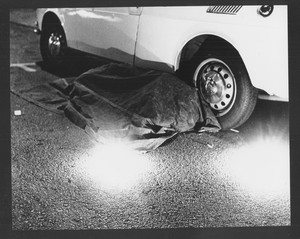
Sydney Stutterheim has published Artist, Audience, Accomplice: Ethics and Authorship in Art of the 1970s and 1980s (Duke University Press, 2024), a survey of performance art and related practices that involve, in various manners, the figure of the accomplice. To celebrate the publication, the Quarterly is publishing an excerpt that examines Chris Burden’s Deadman (1972).
In conjunction with her exhibition The Flaying of Marsyas at Museo di Palazzo Grimani, Venice, Mary Weatherford discusses the featured paintings, which are directly inspired by Titian’s late, eponymous masterpiece of circa 1570–76 and reflect her enduring fascination with the painting.