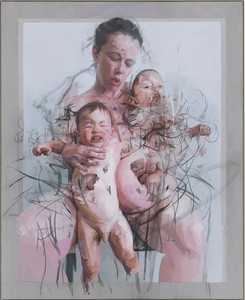
Egon Schiele—Jenny Saville
Lauren Mahony previews the Kunsthaus Zürich exhibition, which paired the works of Jenny Saville and Egon Schiele together.
May 5, 2016
Richard Calvocoressi discusses the inspiration behind a recent series of drawings by the artist that were on view in the Erota exhibition.
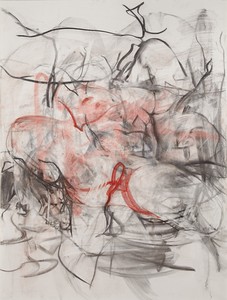
Jenny Saville, Reflective Flesh study (Red), charcoal and pastel on paper, mounted on board, 78 ¾ × 60 inches (200 × 152 cm)
Jenny Saville, Reflective Flesh study (Red), charcoal and pastel on paper, mounted on board, 78 ¾ × 60 inches (200 × 152 cm)
The principle of natural growth is fundamental to Jenny Saville’s art. Nowhere is this more evident than in her drawings, where a mark or line can appear to lead intuitively to another in a fluid process that suggests a growing organism. The forms that develop in this way seem dynamic and self-creative, emphasized by the memory traces they leave on the paper—selected by the artist because of its resistance to erasure. Some of her new, horizontal drawings of coupling nudes have an alloverness that at times undermines their focal point, usually the place of sexual contact. She cites the open-ended, “unfinished” look of one of Leonardo’s tiny sketches for The Virgin and Child with St Anne and the Infant at the British Museum, London, as an inspiration. When describing her drawings, Saville states that:
I wanted the eye to unconsciously slip from one form to another. I’ve been trying to find ways to stretch a feeling of time by layering realities. After working on an image for a while, building up different poses, bodies or limbs start to intertwine and unexpected forms emerge.
It is no accident that in the last few years Saville has become preoccupied with the theme of reproduction and motherhood. She had herself photographed giving birth, “the movement from one body into two.” Pregnancy made her look at her own body again:
I kept thinking of the formation of flesh and limbs inside my body, of regeneration. . . . My multiple drawings—one on top of another—are a way of communicating those feelings. You’re literally reproducing yourself when you’re pregnant, like the way the lines reproduce themselves.
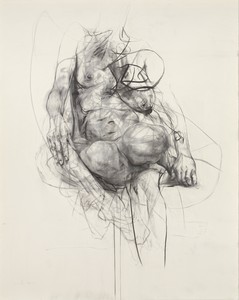
Jenny Saville, Muse on Stool (study), 2015, charcoal on watercolor paper, 74 ⅞ × 60 ¼ inches (190 × 153 cm)
In the atmospheric new drawings exhibited at Gagosian Davies Street this spring, Saville demonstrates a concern with tone rather than line, informed by her close study of Venetian drawings in the Ashmolean Museum, Oxford. Softer mediums such as pastel and charcoal predominate. Effects of what she calls “slatted light” are achieved by hoovering the pastel: “It gets shifted like paint.” The shifting shapes of Willem de Kooning’s great Woman series come to mind. It is not surprising to find that Saville rates de Kooning highly, especially the small pastels that preceded his large oils: “I don’t know any other painter who could paint flesh without literally painting the body like de Kooning did. . . . The struggle to find form and space. . . that visual wrestling.” In these exhilaratingly free drawings, Saville takes ambiguity to new heights.
When I’ve drawn a body or couple, if I then start to draw and layer other bodies on top, there’s a moment when your perception starts shifting and is in the balance between the two moments or sets of forms. Your eye yearns for wholeness and recognition of form. As I’m working, the previous bodies I’ve drawn visually collapse as they become buried, and the new bodies emerge as the dominant forms. I’m trying to see if it’s possible to hold that tipping moment of perception or have several moments coexist. As your eye moves around the drawing, you tune in and out of different realities or passages of time. Like looking at a memory.
If I draw through previous bodily forms in an arbitrary or contradictory way, unexpected forms emerge from the nature of the drawing and it gives a visual shock. I find it exciting creatively as it gives the work a kind of life force or eros. Destruction, regeneration, a cyclic rhythm of emerging forms—there’s a closer relationship with nature in this way of working that excites me, and it’s particular to drawing.
Writing about the image of woman in Saville’s nudes, Maria Becker suggests that “The feeling they leave the viewer with is borne of an understanding of what it means to be a body.” This ability to get inside her subjects is one of Saville’s strengths. Her new life-size drawings of intertwined bodies, with their erotic undertones, have a sculptural quality. Body forms coalesce and dissolve, as the eye wanders across the surface of the paper or canvas, in the same way that they do when we move around a multi-figure sculpture. Time becomes an important element in the composition. Saville says that she thinks a lot “about how film and music fold out in time compared to drawing or painting—how sensations in these mediums are developed through sequences.” The new drawings are an accumulation of the sensations experienced in making love—the fluctuations and changing dynamics, moments of ecstasy as well as of tenderness and composure.
Artwork © Jenny Saville. Photos by Ashmolean Museum Photo Studio
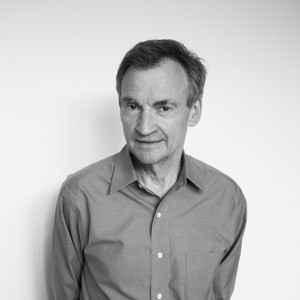
Richard Calvocoressi is a scholar and art historian. He has served as a curator at the Tate, London, director of the Scottish National Gallery of Modern Art, Edinburgh, and director of the Henry Moore Foundation. He joined Gagosian in 2015. Calvocoressi’s Georg Baselitz was published by Thames and Hudson in May 2021.
Lauren Mahony previews the Kunsthaus Zürich exhibition, which paired the works of Jenny Saville and Egon Schiele together.

In this video, Jenny Saville sits down inside her first major exhibition in Venice to discuss how the great Venetian artists of the past and the city’s heritage influence her work. The show brings together more than thirty canvases and works on paper from the 1990s to the present, tracing the development of her practice, which is deeply rooted in the history of painting.

On March 28, a major exhibition of Jenny Saville’s work opened at Ca’ Pesaro–Galleria Internazionale d’Arte Moderna in Venice, bringing together nearly thirty paintings from the 1990s to the present. The exhibition is curated by Elisabetta Barisoni, head of the museums division at Venice’s Ca’ Pesaro, Museo Fortuny, and head of MUVE in Mestre. Saville’s monumental canvases are set in dialogue with the great Venetian artists of the past, creating a unique encounter between contemporary painting and the city’s artistic heritage. Here, the artist speaks with Stefania Ventra, professor with Ca’ Foscari University of Venice, about her early trips to Venice, the radicality of Titian’s painting, and depicting emotional truth.

Ahead of her exhibition over the summer at the National Portrait Gallery, London, Jenny Saville met with the novelist Douglas Stuart to discuss Glasgow, the beauty and blemishes of bodies, and their respective creative processes.

Jenny Saville reflects on Cy Twombly’s poetic engagement with the world, with time and tension, and with growth in this excerpt from her Marion Barthelme Lecture, presented at the Menil Collection, Houston, in 2024.
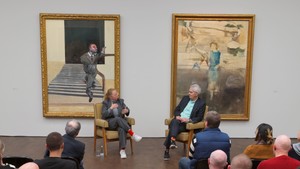
Gagosian hosted a conversation between Jenny Saville and Martin Gayford, art critic and author, in conjunction with the exhibition Friends and Relations: Lucian Freud, Francis Bacon, Frank Auerbach, Michael Andrews at Gagosian, Grosvenor Hill, London. Gayford also spoke with the artist about her works in the exhibition Jenny Saville: Latent at Gagosian, rue de Castiglione, Paris.
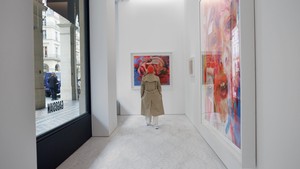
In this video, Jenny Saville describes the evolution of her practice inside her latest exhibition, Latent, at Gagosian, Paris. She addresses the genesis of the title and reflects on the anatomy of a painting.
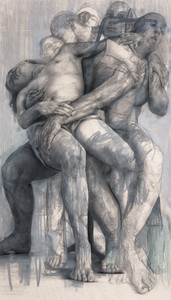
An exhibition curated by Sergio Risaliti, director of the Museo Novecento, Florence, pairs artworks by Jenny Saville with artists of the Italian Renaissance. On view across that city at the Museo Novecento, the Museo di Palazzo Vecchio, the Museo dell’Opera del Duomo, the Museo degli Innocenti, and the Museo di Casa Buonarroti through February 20, 2022, the presentation features paintings and drawings by Saville from the 1990s through to work made especially for the occasion. Here, Risaliti reflects on the resonances and reverberations brought about by these pairings.
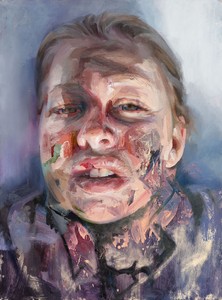
Jenny Saville speaks with Nicholas Cullinan, the director of the National Portrait Gallery, London, about her latest self-portrait, her studio practice, and the historical painters to whom she continually returns.
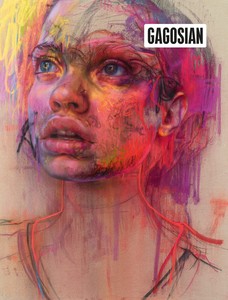
The Winter 2020 issue of Gagosian Quarterly is now available, featuring Jenny Saville’s Prism (2020) on its cover.
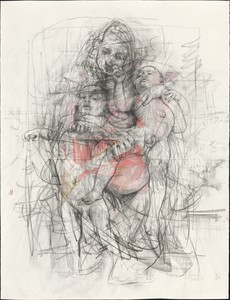
Jenny Saville shares a selection of the books, films, and more that have been her companions in the quiet of the shutdowns in recent months and as she looks ahead to a new exhibition next year.
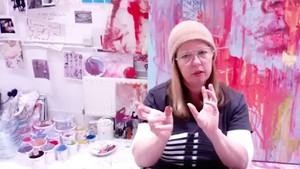
Jenny Saville speaks with Nicholas Cullinan, the director of the National Portrait Gallery, London, from her studio. They discuss portraiture, her latest work, and her art historical influences, as well as the shifting nature of perception in the age of digital communication.