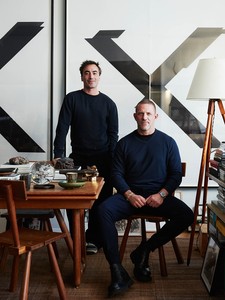
The celebrated interior designer Robert Stilin invited Fernando Garcia, the co-creative director of Oscar de la Renta and MONSE, to his home in New York to discuss their approaches to design, art, and their clientele.
Fernando Garcia and Robert Stilin, New York, 2024
Fernando Garcia and Robert Stilin, New York, 2024
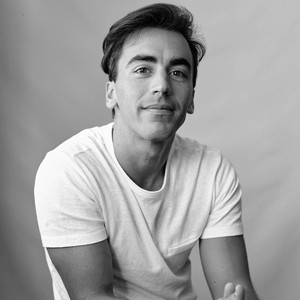
Fernando Garcia was born and raised in Santo Domingo, Dominican Republic, and studied architecture at Chicago University, Notre Dame. Garcia began his career at Oscar de la Renta and worked at the company until 2015, when he and fellow creative director, Laura Kim, left to found MONSE. Laura and Fernando later returned to the house as co-creative directors in February 2017.
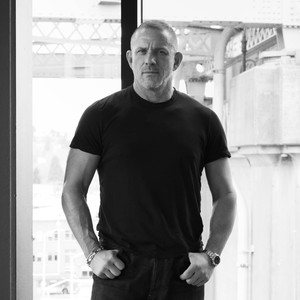
Robert Stilin is a New York–based interior designer. He is listed on the AD100, published annually by Architectural Digest, and is known for creating art-filled spaces that are chic, comfortably elegant, and expertly tailored to the needs and tastes of his clients. Stilin sits on the Artists Council at the Whitney Museum of American Art and the Leadership Council at the Dia Art Foundation.
Fernando GarciaWas there an early moment when you realized that art was something you cared about or wanted to know more about?
Robert StilinMy appreciation for art didn’t come about until I was a little bit older, quite frankly. When I was a kid, my parents were aspirational, children of immigrants, and they were all about getting an education, being an entrepreneur, making money, having a career, and making a better life. So when I was a kid, I liked to design cars and houses and do all these drawings, and if I’d been in a different family, maybe I’d have been an architect, like you, Fernando. But they were just like, “That’s so cute, Robert. You’re going to be a lawyer” [laughs]. I also grew up in a really small town in the middle of nowhere in Wisconsin, and art wasn’t such a big thing.
FGI had a similar upbringing. I was raised to think that art was secondary, that raising a family and building a business were first and foremost. Growing up in the Dominican Republic, if you had an affinity for the arts or liked film, like I did, you’d better have it backed up with really good grades in school or a college degree as a safety net before you tried anything “creative.” Had I not gotten into a good school and given my parents the reassurance of knowing that I earned a degree in architecture, and that I could be an architect in Chicago, I don’t know if they’d have given me the freedom of exploring my internship at Oscar [de la Renta].
RSDo you feel that education has served you in what you do?
FGYeah, I think so. One thing it certainly did was develop the skills necessary to navigate between a client’s goals and whatever the hell else I thought was necessary for their project. But beyond that, the architectural concerns around proportion, scale, and materiality translate to the work I do with clothing.
How did you get into design?
RSI met my now ex-wife when I was in college, and when we graduated we moved to Palm Beach, where she was from. I’d studied business and finance. I was meant to go into private equity, and I wanted to live in New York, but she didn’t. We bought this little house and we were renovating it, trying to find furniture, and there was no place to buy anything. Compared to what we know today, the world of design was closed. There was Bloomingdale’s and Ethan Allen. If you went to the Design Center they wouldn’t let you in the door if you weren’t an architect or a designer. So I thought, well, maybe I could create a lifestyle store that has everything somebody would want for a house and a life and make a prototype in Palm Beach, because I was living there, and then open one in New York, Chicago, Los Angeles, Atlanta, and so on, building a company, sell it for $20 million and move on to the next thing. That’s not what happened, obviously. I wish. But I did create this beautiful store, and somebody came in and bought a bunch of furniture and they met with me and said, “Hey, we just bought this house and we don’t have anything. We’re going to buy this stuff, but can you help us? Can you come over and look and help us figure this out?” I said, “Sure,” and that’s it, that’s how I got into it. And then the entrepreneur in me was like, Well, if you want to be in that business, how do you create a market? How do you create a name for yourself? How do you get clients?
FGIn my life, both professionally and personally, Oscar was a key mentor and advocate. Was there someone in your life who played that role?
RSI definitely had people I looked to who were inspiring. There was Michael Taylor, a famous designer from San Francisco, Rose Tarlow from Los Angeles, and Europeans like David Hicks. There was a designer named Kalef Alaton who died young of AIDS. But beyond those influences, my mother-in-law had a huge impact on me. She’s the person who opened me up to art and design and jewelry and fashion. We would go to exhibitions together, and she was an art collector.
Our work is collaborative: we’re working with clients to arrive at a final vision, be it for an interior or an ensemble. What’s that process like, and what do you hope they take away from the experience, spiritually, emotionally, intellectually?
FGMy first lesson in how to please a client came from Kate Young, a stylist whom I met early in my career at Oscar de la Renta. She needed help with a client for the Academy Awards and I had to figure out a way to make everybody happy. I owe a lot to her for that process, because it served as my blueprint for how I handled myself with the needs of my company and the needs of the clients and the stylists of the world. Chiefly: patience.
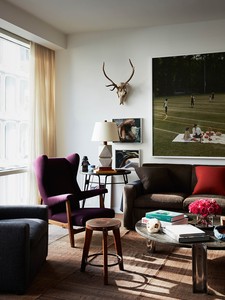
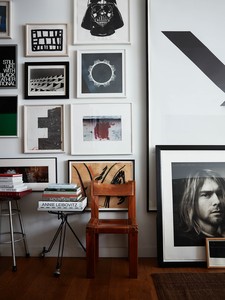
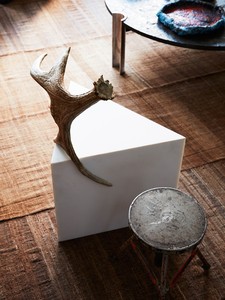
Interior of Robert Stilin’s New York apartment, 2024
RSMajor.
FGShe taught me to be able to suppress and discern and formulate the efficient response to any problem. At the end of the day, we’re just making dresses, but I learned it can be more than just that. We’re making clothes to make people feel good about themselves, and hopefully to inspire others to pay attention to our vision. But had I not had a Kate in my life during a very impressionable year, I don’t know if I’d have been this person you’re seeing in front of you.
RSAbsolutely. I’m creating homes, lifestyles for people that will be theirs. They’re not mine. And I’m not trying to impose my taste or my style.
FGWhen did you arrive at that conclusion?
RSI don’t really know. In the early days, when you’re trying to make a name for yourself, you have so much time and so many ideas, but you don’t have clients. Then you get the clients, you have all the work, and you have no time to be creative, right? And then you get to a point where somehow you figured out how to get through it and make it all work and make people happy. I think it was a process that evolved over time, but I also think it was an instinctual thing.
FGI do think that everybody has that detachment at some point in their career. Mine happened a couple of years after becoming co-creative director alongside Laura [Kim], learning that we had to let go of what we thought was right for the brand and believe in a good amalgamation of two ideas—what we lived and what we were taught the genetics of the house were.
RSAlso, I was exposed to art early on in my career. My first clients were major art collectors. It was 1989, 1990, and they were collecting Cindy Sherman, Nan Goldin, Frank Stella, Sam Francis, Les Lalanne. At the time in Palm Beach, people were like, Who are these weirdos? Everyone was still collecting [Henri] Matisse and [Pablo] Picasso and [Edgar] Degas. And my first client was like, you can come and see our houses and you can see our art, but I’m not really going to show you the art because I’m going to change it all the time.
FGSo when did you start to understand that you can’t think of furniture in a finite way, depending on what hangs above it?
RSI think very early. How you finish a project depends on the client. And for people who are serious collectors, who like nice things, it doesn’t really ever stop. When I meet a new client, what I say to them is, We’re going to work for the next two years on this while you’re building the house, we’re going to get everything ready, and when we install your house, we’re going to install 85 to 90 percent of the interior—all the carpets and the rugs and the curtains, lots of vintage and antique furniture, and the art that you have—and we’re going to create a house you can live in. And then we’re going to take three months, six months, nine months, a year, five or ten years, or forever, depending on your appetite, to put all the rest of it in. What I’ve learned in the thirty- three years I’ve been doing this is, that’s what makes it yours. That’s what makes it special, because you have something tangible now. You’ve been working for two or three years on this project that’s a dream. It’s an idea. It’s not tangible. And now you’ve taken all this stuff that you’ve accumulated, you’ve put it into a space, and you can sort of tweak it and edit it and try things out.
FGIn a way, I have the luxury of saying it’s done.
RSBecause they have to wear the dress.
FGFor VIP red carpet moments, at least. But I think that there’s something beautiful about the fact that your work could never be done. It has a therapeutic thing about it. For me, while an individual garment must be complete, there’s still an ongoing relationship with the client. Selena Gomez and Scarlett Johansson, for instance, to name a couple, have given me the ability to grow with them.
RSRight. People come back.
FGBut that isn’t the same for every artist. I have the privilege of continuing a relationship and expressing myself through it. After that dress was on the red carpet, she and I probably grew into different people, and she and I probably want different things, and we will meet in the middle again in the future.
RSIn your practice, what’s the intermediary step between having the idea and executing it with the final materials? You’re trained; I’m not! [laughs] So it fascinates me to know what might be the official way to do something.
FGWhen Laura and I work together, I’m more of the drawer, she’s more of the draper. But the drawing is just an initial thought. It doesn’t mean much in the beginning. It can inspire or take us somewhere at the end of the day.
Interior of Robert Stilin’s New York apartment, 2024
Interior of Robert Stilin’s New York apartment, 2024
RSI’m a very visual person, but inspiration can come from anywhere. It could be a song, it could be a rock, it could be some sand. It could be anything. You could notice the most obscure detail on a building and you’re like, Oh my God, I’m going to make a table of that.
FGYes, I saw the color of a building and thought, I haven’t seen that in a garment in a long time. What was the last thing that tickled your imagination walking through the streets of New York?
RSI came across a handrail in this beautiful stairway, so I took a quick photo. It’s bronze and beautiful, it’s classic, it’s sexy, it’s all these things. I don’t know where that’s going to present itself. It might come up in two years, like, Oh my God, remember that picture? And maybe I’ll actually do it as a handrail for some client, I don’t know, or maybe it will turn into a console or a table or some hardware. But the movement of the form just spoke to me. That happens to me a gazillion times a day, in New York and all over the world.
And sometimes we make stuff just for fun. I’m like, I don’t know what we’re going to do with it, but I want to make this light fixture inspired by a handrail [laughs]. You must have some unexpected sources of inspiration in your design practices?
FGWhat I saw John Galliano and other designers do with fashion shows—extrapolating a story through music and clothes—resonates with me a lot more than people realize, the music part in particular. I love watching films, but my mom had no idea that I was listening a lot more to the scores than I was focused on the narrative. The Philip Glasses of the world, the Hans Zimmers, the Trent Reznors—these people have inspired my work. Other than that, the artists Laura and I have always been inspired by are the very instinctual, clean-cut, aggressive ones—the Picassos, the Matisses.
RSI’m so inspired by what I see when I travel; you see beautiful ways of life, and interesting ways to treat a floor or a table, or a way to serve lunch or have a dinner party, that you hadn’t before. I try to absorb all that, so when I’m doing a project I can reference and incorporate all those things in a way that makes sense.
FGWhere do you hope to go from here, or what does it mean to evolve? I ask because I’m learning that every day. I think I’m a different person from what I thought I was going to be five years ago, so I have no parameters. I remember when they asked us in the beginning of MONSE, What does your five-year plan look like? And Laura and I were like, Oh, X Y and Z. And all of that has changed.
RSI think evolution is really a personal thing. It’s about owning and respecting yourself. I want to do things I love, that’s always been paramount in my life and my career. I’m lucky enough to be at a place in my life where I can sort of pick and choose clients and jobs. So that’s a luxury, and I’m super grateful for it. And there are new things I want to do, and I don’t know exactly what they’re going to be. I’ve always had this passion for hotels and doing a hotel brand. I might do that. I mean, I’m not going to die if I don’t do it, but I also think my fantasy and dreams around it could be amazing, and could be—almost a whole other life. And I think if that’s meant to happen, it’ll be a little bit of me and a little bit of the universe, and it will gel.
Photos: Tim Lenz
Fernando Garcia was born and raised in Santo Domingo, Dominican Republic, and studied architecture at Chicago University, Notre Dame. Garcia began his career at Oscar de la Renta and worked at the company until 2015, when he and fellow creative director, Laura Kim, left to found MONSE. Laura and Fernando later returned to the house as co-creative directors in February 2017.
Robert Stilin is a New York–based interior designer. He is listed on the AD100, published annually by Architectural Digest, and is known for creating art-filled spaces that are chic, comfortably elegant, and expertly tailored to the needs and tastes of his clients. Stilin sits on the Artists Council at the Whitney Museum of American Art and the Leadership Council at the Dia Art Foundation.