

Romuald Hazoumè and Harry G. David
A conversation between Harry G. David, collector of contemporary African art, and the artist Romuald Hazoumè ahead of his exhibition Les fleurs du mâle at Gagosian, Athens.
People have to know that they come from somewhere, that they have strong traditions, they have a strong culture.
—Romuald Hazoumè
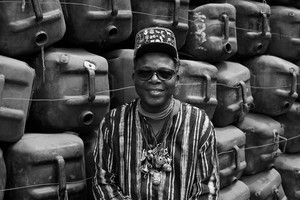
Romuald Hazoumè’s art critically reflects on the legacies of colonialism and the realities of contemporary Africa. Born in 1962 in Porto-Novo, Benin, where he still lives and works, Hazoumè is from a Catholic family of Yoruba origin. He carries on the tradition of the arè—an itinerant artist of Benin’s past who transmitted its culture to other realms.
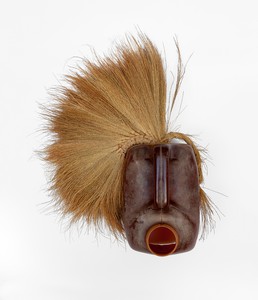
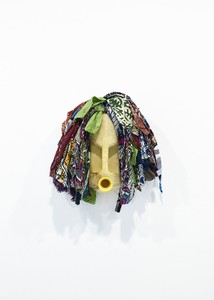
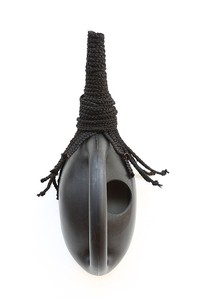
Hazoumè works in a diverse range of mediums, including sculpture, painting, photography, and video. An accomplished bricoleur, he assembles much of his work from cast-off industrial materials such as plastic and glass containers, fragments of appliances, metal, fishing nets, feathers, and cloth. “I send back to the West that which belongs to them,” the artist explains, “the refuse of consumer society that invades us every day.”
In the 1980s, Hazoumè began incorporating bidons—plastic jerricans that are used to traffic contraband gasoline from neighboring Nigeria—into his work. Precariously balancing these containers on overburdened bicycles and scooters, those who are compelled to pursue this trade face considerable danger. The artist’s incorporation of these objects of survival, transportation, and exchange addresses global economic and ecological concerns.
A conversation between Harry G. David, collector of contemporary African art, and the artist Romuald Hazoumè ahead of his exhibition Les fleurs du mâle at Gagosian, Athens.

Join Romuald Hazoumè and Manuel Mathieu for a conversation about the ongoing exploration of identity, tradition, ancestry, and sociopolitical considerations in their practices. Both artists are from the African diaspora: Hazoumè was born in Benin, where he currently lives and works, and Mathieu was born in Haiti and is now based in Montreal. The pair reflect on how their personal histories and significant ancestral visual cultures remain central in their art.

Romuald Hazoumè’s masks are deeply rooted in the cultural, social, and political context of Benin. His masks, which use salvaged materials and bidons, or plastic jerry cans, comment on pan-African politics and culture. Text by André Magnin.


