A conversation between Harry G. David, collector of contemporary African art, and the artist Romuald Hazoumè ahead of his exhibition Les fleurs du mâle at Gagosian, Athens.
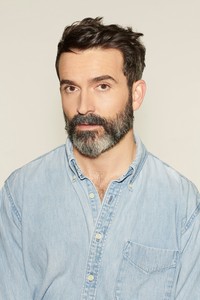
Harry G. David grew up in Nigeria and Greece and now lives between Nicosia, Lagos, and Athens. He has been collecting contemporary art for the past thirty years. For the past fifteen years, he and his wife Lana have focused their collecting on art and artists from Africa and its diaspora.
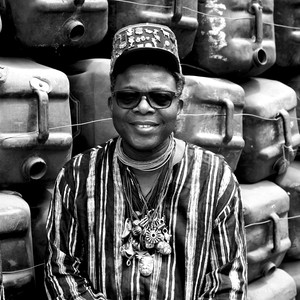
Romuald Hazoumè’s art reflects on the legacies of colonialism and the realities of contemporary Africa. Born in 1962 in Porto-Novo, Benin, where he still lives and works, Hazoumè is from a Catholic family of Yoruba origin. He carries on the historical Benin tradition of the arè, an itinerant artist who transmitted the country’s culture to other realms. Drawing from Yoruba traditions and global histories, Hazoumè reflects on themes of survival, migration, and cultural identity, using symbolic reinterpretations and social commentary to explore the lasting effects of historical and economic change. Photo: Charles Placide Tossou
Harry G. DavidI’d love to share a little bit about my experience with your work. I was born and raised in Nigeria and spent a big part of my childhood in Lagos, and I continue to go to Nigeria for business quite a few times a year. I’ve been collecting art from very early on and I made the switch to collect exclusively African contemporary art in the diaspora about fourteen years ago. I first came across your work around that time, and I was struck by how tactile it was. I found it very interesting that I was handed the art, which usually doesn’t happen. I loved the simplicity and the immediacy of these everyday materials that you turned into something extraordinary. Even today, fourteen years later, when I see the work, which I live with as well, it still creates the same sensation.
I’m curious to hear more about your upcoming show. I was intrigued by the title Les fleurs du mâle, which echoes Baudelaire’s Les Fleurs du mal [1857], but you’re playing on words: mâle as in “male” rather than mal as in “evil.”
Romuald HazoumèYes, I don’t know Baudelaire well but the title has stayed with me. And for me, right now, we’re in a bad situation in terms of war and global conflict. My English will not be perfect to say deeply what I want to say, you know? But I will try. The problem we have right now is, a few men who decided to make war think the war they’re waging is against another people, or another country. But I’m not sure it’s against only another country, it’s also against their own country too; their people are in danger too. These men decide to make war because they want to stay in power, and to do so they think they need to create a situation of instability, where people depend on them for protection. But it’s not true. When you kill people outside your country, you kill people inside your country too. You kill everybody.
I decided in my work to reflect the real faces of people I meet. I was in Serbia for a big show and went to a place where many minority Romani people live. I was inspired by their stories and faces. Then I also made works inspired by Senegal, near Dakar. I burned the masks with fire. And for me it means, Okay, we bombed you, we tried to kill you, and although you survived, you can’t talk anymore. We don’t want you to talk; we don’t want you to say “Help me,” no. We send you bombs like flowers, and after we say to you “Don’t talk.” This is exactly what’s happening in Congo right now. In Congo, they kill people and they think what they’re doing is right. But it’s not right. They send bombs to kill people only for energy, for mineral resources, for greed. Exactly like what Putin is doing right now in Ukraine. It’s been dangerous for Putin’s people in Russia, too, not only for Ukrainian people. Don’t make a war. Talk. It’s these men who make trouble for other humans. And that’s why I say les fleurs du mâle.
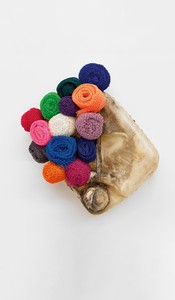
Romuald Hazoumè, Les fleurs du mâle, 2024, plastic, fishing nets, and copper, 14 ¼ × 14 ¼ × 7 ⅞ inches (36.2 × 36.2 × 20 cm). Photo: Thomas Lannes
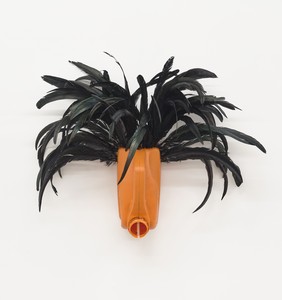
HDIt’s very deep material, yet interestingly enough, many of your titles are quite humorous, I find. They’re tongue-in-cheek. You use titles like Afro-dite [2024]. You use titles like Moustache [2023]. Your thoughts are quite complex. Could you elaborate a little bit on your use of dark humor?
RHWe need hope in our lives right now. You living in Greece, me in Africa, people in America, all around the world, we need hope. I’m afraid of artificial intelligence. I’m afraid of war. Many people want peace. And with a lot of people who are very depressed right now, I ask, “What can I do for them?” My answer is just to give them a little humor, to still have a little hope. I don’t make masks because people ask me to make masks for a gallery or for a collector; I make masks because I need to express something inside me. I make a mask because the mask is necessary to help people. And how to help people today? Not everybody can collect my works. But they can look at them and read their titles. And if they smile when they read it, I’ve given them something in a way.
You know, I travel a lot; I’m just coming from three days in Cairo. And I hope one day a few masks will come from the many teachers I met there, the way I did with the mask titled Moustache—it’s somebody. It’s somebody at least seventy years old. But inside his head he’s about forty years old. He has very white hair on his head but his moustache is very black, like somebody of twenty-five or thirty. It’s so remarkable; it means this guy, inside his head, is still new. That’s full of hope. He’s still fighting. He’s saying to people, “No, don’t think I’m old.” And we must take this example. We’ll still be strong, moving, walking. When inside your head everything is perfect, your body can be perfect. And remember to smile a little bit, it’s good for life.
Romuald Hazoumè, Peut-être, 2004, inkjet print on baryta paper mounted on Dibond, 47 ¼ × 31 ½ inches (120 × 80 cm), edition of 6 + 2 AP
HDSo this person who looks seventy and is forty inside, who is that person?
RHIt’s somebody I met when I was walking outside. I don’t want to say his name because his name is not necessary.
HDOkay. But it’s a person, it’s somebody who has influenced your work?
RHYes. You know, the Harry David in his bed has a mask, okay? When Harry David gets outside the house he has a different mask. When he’s in Lagos as a businessman, he has yet another mask. That’s three masks in one day. It’s exactly like me, exactly like everybody. We have our real faces, and what I try to do is make the real faces for the people I meet. I make these works true.
HDDo you start with your concept or your vision of the person behind the mask? Or do you start with the material first? What’s your process?
RHNormally I collect all the materials first. I then develop the plans inside my head, but they change every thirty minutes. When I find materials that fit these pieces, I put them in my studio to use in maybe ten years or maybe ten minutes. If you were in my studio right now, you’d see I have about a hundred pieces. And they will not get out. People come and say, “Ah, this is finished.” I say, “No, no, it’s not finished.” If it’s finished, it’ll get out. If not, it’ll stay there for many months or years.
The material is very important to me. When I walk in Brazil or Cairo or Paris, anywhere, I try to find materials. When I find a material, I put it in my studio so I can look at it every day.
HDIt’ll find its life at some point in your process.
RHYes.
HDWe have seen your art touch upon big questions: slavery—
RHYes.
HDThe legacy of colonialism—
RHYes.
HDThe uneven distribution of resources around the world—
RHYes.
HDPollution—
RHYes.
HDAnd waste. Do these concerns remain constant in your current and future work?
Installation view, Romuald Hazoumè: Les fleurs du mâle, Gagosian, Athens, March 11–April 26, 2025. Photo: Stathis Mamalakis
RHYes. But they evolve. The themes remain constant because they have new iterations and evolutions. The slavery you mentioned, I’m not talking about the old slavery; I’m talking about our reality today, everywhere—in Europe, in America, everywhere. Because in a few years we’ll have a new kind of slavery. With artificial intelligence, many people will become new slaves. New slaves? How? They’ll have no jobs and those in power can use them as they want. It will be very dangerous. I put these ideas in a corner in my head and I continue to work to say what I want to say to the world, what I want to say to my people. We as African artists, we work for community. What we’re doing is calling attention to themes people may not have thought about before. And for me, I will continue to work on new themes and develop new ways of working. I’m never satisfied by what I’ve made. I’m continually questioning my work and doubting. So I tune it, I tune it, I tune it, I tune it.
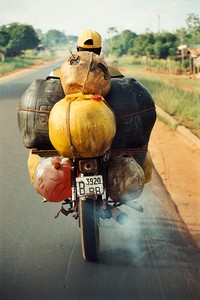
One example are my works about immigration. I made pieces for the Musée du quai Branly in Paris. The name is No Return. It’s made with flip-flop sandals, like what people wear on the beach. These flip-flops are used by immigrant people from Africa because when they jump from the boat, the shoes won’t go underwater, won’t sink. They’re not heavy, they’re floating. For me, it’s necessary to continue to call attention to people and their plights through my work, to help people. And my community right now is not only my people in Benin, it’s not only my people in Africa, it’s all people who are suffering everywhere, who might have no hope.
HDThe previous work you showed us, Les fleurs du mâle—I found that very touching. It lends the exhibition its name. I’d be curious to hear a bit more about its making and materials.
RHIn Benin many people use fishnet. There’s an old fishnet and a new kind. In these kinds of pieces I use the new fishnet, because that fishnet is not for catching fish, it’s just to clean the body. People sell it at the market. You put soap on it and use it as a sort of washcloth. It was so interesting to find all the colors together like that, and I used it to make the flowers in the piece. Those flowers are in several colors to represent several people. It’s what we call in our culture la multitude. La multitude is when you show you’re not alone. When you put a sign with several colors and disparate things together like that, it means, I’m not alone. The fishermen in our country, for example—they’ll never go fishing by themselves. We’re several people, very different, but we’re a group.
HDThank you, I didn’t quite realize that this was a fisherman’s net. The vibrant colors remind me of one of your paintings, Homme vivant [Living man, 2009], with its bright pink. Your paintings aren’t shown as often but I believe that one will be part of the Athens exhibition, along with some others?
RHYes, yes. I’ll give some background to that painting: in our country we have something we call very simply Fa. It’s our divination system, a big cosmology. This divination comes from a small village in Nigeria, in Yorubaland, that we call Ife. It came from Nigeria to Benin, Togo, and Ghana. We use it to think about life’s big questions. We’ve found solutions for everything in our bible, what we can call our bible, which is the Fa.
We used symbols at the beginning, when we didn’t know how to write because we had had no contact yet with white people and their alphabets, Greco-Roman or Latin. People have said we have no history; no. We’ve been thinking about life and documenting its big topics before many people in this world. In our symbology we designed life like a circle. And we give that circle a word, a word we call a proverb or a device, and we associate a word with particular colors and particular plants. When you know the colors, the symbol, the plants, and the word, you know how to read the problem. There are sixteen symbols and each is very, very strong. And we say our life is a combination of four elements: water, wind, fire, and earth. Every country in Africa, every tribe in Africa, used symbols at the beginning. But don’t think it’s only in Africa. It was everywhere. Whether you go to Greece or Egypt, whether you go to Mexico, whether you go to South America where the Incas were, everybody at the beginning of history used symbols. The symbols mean something to the Incas. They mean another thing to Benin people, to people in Zaire or in South Africa. In each place it means something different. And that symbol in the painting I call Un Vivant. It’s representing a person in life. It’s just a line, a vertical line. But when it’s horizontal like that, it means a dead person. And the dark color represents the earth. The earth is our world when the guy’s still in life.
Harry G. David grew up in Nigeria and Greece and now lives between Nicosia, Lagos, and Athens. He has been collecting contemporary art for the past thirty years. For the past fifteen years, he and his wife Lana have focused their collecting on art and artists from Africa and its diaspora.
Romuald Hazoumè’s art reflects on the legacies of colonialism and the realities of contemporary Africa. Born in 1962 in Porto-Novo, Benin, where he still lives and works, Hazoumè is from a Catholic family of Yoruba origin. He carries on the historical Benin tradition of the arè, an itinerant artist who transmitted the country’s culture to other realms. Drawing from Yoruba traditions and global histories, Hazoumè reflects on themes of survival, migration, and cultural identity, using symbolic reinterpretations and social commentary to explore the lasting effects of historical and economic change. Photo: Charles Placide Tossou