July 1, 2015

In Conversation

Richard Phillips

Richard Phillips talks to Gagosian’s Derek Blasberg about the new direction of his works, the influence of 1960s zine culture and the double-edged fascination of Sharon Tate.

Richard Phillips, Blue Sector Medium, 2015, oil and wax emulsion on linen, 72 × 44 ½ inches (182.9 × 113 cm). Photo by Rob McKeever

Richard Phillips, Blue Sector Medium, 2015, oil and wax emulsion on linen, 72 × 44 ½ inches (182.9 × 113 cm). Photo by Rob McKeever

Richard Phillips, Blue Sector Medium, 2015, oil and wax emulsion on linen, 72 × 44 ½ inches (182.9 × 113 cm). Photo by Rob McKeever

Derek BlasbergYour new show of paintings opened on June 11 at Gagosian Athens. What are we seeing in the Athens show?

Richard PhillipsIt’s a group of paintings that I have worked on for the past year. They represent an evolution away from the ultra-real paintings and a turn toward graphic images. By that I mean less dimensional reality and more two dimensional, and a more luminous quality. The paintings are smaller too, they’re portrait-sized paintings.

DBWhy do you think you’ve veered more toward this work?

RPThe graphic quality of the imagery combined with the physical emphasis of the painting process opens up a different way to experience content. It effects the senses in a way that is less focused on the assessment of mimetic description and more on how color and surface generate an emotional response.

DBAnd technically speaking, how did you achieve this?

RPI used a lot of fluorescent pigment and wax emulsion. It’s a very traditional medium, it gives a smooth and beautiful surface. It relies more on the palette knife, as opposed to brushstrokes. They appear thickly painted even though they’re flat.

DBLet’s speak about the subjects, which I know has been a big part of your work in the past. Who are the subjects of these works?

RPThe subjects represent a shift in perspective to a radicalized counterculture avant-garde, moving away from photo-based documentation or propaganda media to graphic coefficients of this imagery. In this exhibition, the two recognizable subjects are Jim Morrison and Sharon Tate. Both are icons of ’60s pop and counterculture, but for different reasons. Jim is a cult figure of divine proportion who channeled a collective response to forces beyond control, and Sharon who simultaneously became an icon and a martyr to both positive and negative poles of the very same forces.

DBI know that “zine” culture and psychedelic posters from the 1960s were an influence on this show. Why?

RPI may be dating myself when I say this, but that’s the time I grew up in. It’s mainly the counterculture that interested me, both in music and in graphic presentation of it, too. A really important part of this came from my friend John McWhinnie, who put aside a group of magazines for me from the Process Church, which was one of the zines that was used as evidence in the Charles Manson case.

Gagosian quarterly weekend reads

Get the best of the Quarterly in your inbox twice a month.

By subscribing you agree to our Privacy Policy.

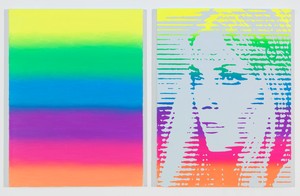
Richard Phillips, The Venice Beach Solution II, 2015, oil and wax emulsion on linen, diptych: 24 × 18 inches (61 × 45.7 cm). Photo by Rob McKeever

DBFor you, is there a line between movie stars and politicians, or is celebrity a celebrity?

RPThere is a distinct difference in how illusion is used that effects realities. The movie star uses media to create an illusion to point toward a fictitious reality that has a bearing on one’s life, in expanding one’s fantastic relationships to ideas, which are far beyond that which will effect one’s personal life. The politician uses media to create an illusion of reality that points away from and obscures policies that, by contrast, have a direct impact on one’s life.

DBWho was the first “famous” subject that you were inspired by?

RPMy first “famous subject” that I painted in 1995/96 for my first solo show was actually Sharon Tate. Her fame embraces the complexity of the 1960s idealism and the undercurrent of violence and extremism, which was a cohabitant of this revolutionary mindset. Her position as an actor, model, and icon of celebrity culture amplified the tragedy of the loss collectively felt by her senseless murder at the hands of Manson’s followers.

DBI read somewhere that you like dlisted.com, which is about the only website I read regularly.

RPI visit that site less frequently, but dlisted is an excellent portal into an unvarnished view of celebrity critique that accepts the necessary paring of the production of purposeless media and societal degradation as entertainment.

DBYou once mentioned that the art world has a red carpet and that you’re inspired by that.

RPIn 2009 and 2010, I created two exhibitions, New Museum and Most Wanted, that took on the relationships of the art world’s institutions and their need for celebrity endorsement and luxury goods based sponsorship. The abstraction that was being created was that there was somehow a division between the art produced and the necessary financing and verification. My exhibitions served to establish the reality that the art was located precisely in this necessary constellation. While my new exhibition accepts this fact, it is free to address the ideologies at work beyond the diagnostics of pure production and sustainability of culture, and enters into a sensory-based realm of irrationality, emotional resonance, and psychological unpredictability, or to use a ’60s lyric “the other side of this life.”
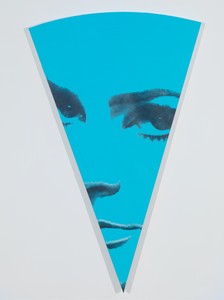
Artwork © Richard Phillips. Richard Phillips at Gagosian Athens, Greece, June 11–August 1, 2015.

Black-and-white portrait of Derek C. Blasberg

Derek C. Blasberg is a writer, fashion editor, and New York Times best-selling author. He has been with Gagosian since 2014, and is currently the executive editor of Gagosian Quarterly.

See all Articles

Mary Weatherford and Mark Lee: Persephone

In Conversation
Mary Weatherford and Mark Lee: Persephone

Ahead of Persephone, an exhibition of new paintings by Mary Weatherford inside Hong Kong’s historic Pedder Building, the Quarterly’s Wyatt Allgeier met with Weatherford and the architect Mark Lee to talk about their collaboration. Here, they discuss how custom architectural interventions—from mirrored columns to strategic light play—transform the gallery, evoking Persephone’s mythic journey through the underworld and back into the light of spring.

Jenny Saville and Douglas Stuart

In Conversation
Jenny Saville and Douglas Stuart

Ahead of her exhibition over the summer at the National Portrait Gallery, London, Jenny Saville met with the novelist Douglas Stuart to discuss Glasgow, the beauty and blemishes of bodies, and their respective creative processes.

Derrick Adams and Ekow Eshun

In Conversation
Derrick Adams and Ekow Eshun

Join Gagosian for a conversation between Derrick Adams and Ekow Eshun, author, curator, and chair of the commissioning group for the Fourth Plinth in Trafalgar Square, London. The pair discuss Adams’s latest paintings depicting visions of Black Americana—featured in the exhibition Situation Comedy at Gagosian, Davies Street, London—within the context of British contemporary culture.

Setsuko and Peter Marino

In Conversation
Setsuko and Peter Marino

To coincide with her exhibition SetsukoKingdom of Cats, at Gagosian, New York, the artist speaks with architect Peter Marino about her recent sculptures, paintings, and works on paper.

Takashi Murakami and Hans Ulrich Obrist

In Conversation
Takashi Murakami and Hans Ulrich Obrist

In conjunction with the exhibition Japanese Art History à la Takashi Murakami at Gagosian, London, Takashi Murakami and Hans Ulrich Obrist, curator and artistic director of Serpentine, London, sit down to discuss the artist’s exploration and contemporizing of ancient Japanese artworks and movements. The two delve into Murakami’s investigation of Iwasa Matabei’s seventeenth-century masterwork Rakuchū-Rakugai-zu (Scenes in and around Kyoto) and the Kyoto-based style of Rinpa painting, among other examples.

Julian Rose and Nicholas Serota

In Conversation
Julian Rose and Nicholas Serota

Join Gagosian for a conversation between Julian Rose, historian and critic of art and architecture, and Nicholas Serota, chair of Arts Council England and senior independent director on the BBC board, to celebrate the publication of Building Culture (2024), Rose’s new book about museum architecture. Rose and Serota discuss the ways in which museums are shaping the future of art, architecture, and public space.

Urs Fischer and Róisín Tapponi

In Conversation
Urs Fischer and Róisín Tapponi

Gagosian and Sadie Coles HQ hosted a conversation between Urs Fischer and film curator and writer Róisín Tapponi about fearless creativity and the artist’s most recent monograph, Urs Fischer: Monumental Sculpture.

Robert Stilin & Fernando Garcia

In Conversation
Robert Stilin & Fernando Garcia

The celebrated interior designer Robert Stilin invited Fernando Garcia, the co-creative director of Oscar de la Renta and MONSE, to his home in New York to discuss their approaches to design, art, and their clientele.

Rick Lowe, Dieter Roelstraete, Abigail Winograd

In Conversation
Rick Lowe, Dieter Roelstraete, Abigail Winograd

Gagosian and Museo di Palazzo Grimani, Venice, hosted a conversation between Rick Lowe; Dieter Roelstraete, curator of Neubauer Collegium for Culture and Society at the University of Chicago; and Abigail Winograd, commissioner and curator of the United States Pavilion at the 60th Biennale di Venezia. The trio discuss the exhibition The Arch within the Arc in the context of Lowe’s overall practice, as well as Gagosian’s recently published monograph on the artist.

Bennett Miller and Michael Govan

In Conversation
Bennett Miller and Michael Govan

Join Bennett Miller and Michael Govan, CEO and Wallis Annenberg Director of the Los Angeles County Museum of Art, inside the artist’s exhibition at Gagosian, Beverly Hills. The pair explores the emergence of artificial intelligence within the history of the photographic image, as well as the inspiration and process behind Miller’s AI-generated prints and their dialogue with the contemporary landscape.

Sophia Heriveaux and Roger Guenveur Smith on Jean-Michel Basquiat

In Conversation
Sophia Heriveaux and Roger Guenveur Smith on Jean-Michel Basquiat

Join Gagosian for a conversation between director, producer, and writer Sophia Heriveaux and actor, director, and writer Roger Guenveur Smith inside the exhibition Jean-Michel Basquiat: Made on Market Street, at Gagosian, Beverly Hills. Heriveaux and Guenveur Smith both share a personal connection to Basquiat: Heriveaux is the artist’s niece and Guenveur Smith was one of his friends and collaborators. The pair discuss Basquiat’s work and legacy, as well as his lasting impact on contemporary art and culture.

Brooke Holmes, Katarina Jerinic, and Lissa McClure on Francesca Woodman

In Conversation
Brooke Holmes, Katarina Jerinic, and Lissa McClure on Francesca Woodman

Join Brooke Holmes, professor of Classics at Princeton University, and Lissa McClure and Katarina Jerinic, executive director and collections curator, respectively, at the Woodman Family Foundation, as they discuss Francesca Woodman’s preoccupation with classical themes and archetypes, her exploration of the body as sculpture, and her engagement with allegory and metaphor in photography.