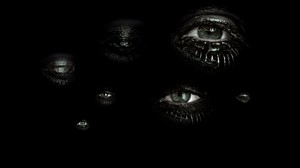
Making Eyes: Douglas Gordon
Douglas Gordon and Rufus Wainwright collaborated to produce afflictive, slow-motion projections to accompany Wainwright’s performances during his 2010 All Days Are Nights: Songs for Lulu tour.
October 2, 2017
Featuring an extensive interview with Douglas Gordon on the process of making his 2016 film I had nowhere to go: Portrait of a displaced person, this video, produced by Berlin Art Link, includes clips of Jonas Mekas and revealing anecdotes about the creation of the film.
Douglas Gordon’s 2016 film, I had nowhere to go: Portrait of a displaced person has been hailed by critics and viewers alike for its revelatory treatment of history and innovative approach to the biographical genre. As the subject of the film, Jonas Mekas, states, “Long before I met Douglas I met his films and they were exciting. I like them because they are so different from what I or anyone else is doing. His films open a totally new invisible window full of visual excitement.”
Berlin Art Link Productions has created an interview video (above) with Douglas Gordon on the process of making the film and how his artistic relationship with Jonas Mekas has continued to inspire him.
Video by Berlin Art Link Productions; Videographer/Editor: Peter Cairns; Producer/Interviewer: Monica Salazar
Douglas Gordon and Rufus Wainwright collaborated to produce afflictive, slow-motion projections to accompany Wainwright’s performances during his 2010 All Days Are Nights: Songs for Lulu tour.
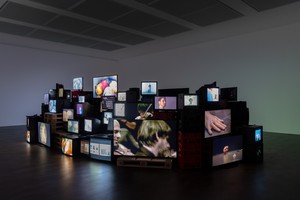
On the occasion of Douglas Gordon: All I need is a little bit of everything, an exhibition in London, curator Adam Szymczyk recounts his experiences with Gordon’s work across nearly three decades, noting the continuities and evolutions.
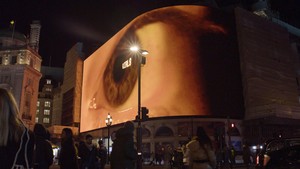
Douglas Gordon took over the Piccadilly Lights advertising screen in London’s Piccadilly Circus, as well as a global network of screens in cities including Berlin, Melbourne, Milan, New York, and Seoul, nightly for three minutes at 20:22 (8:22pm) throughout December 2022, with his new film, if when why what (2018–22). The project was presented by the Cultural Institute of Radical Contemporary Art (CIRCA) in conjunction with the exhibition Douglas Gordon: Neon Ark at Gagosian, Davies Street, London.
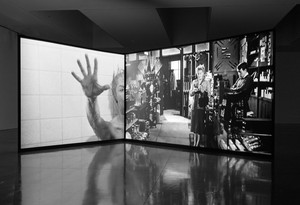
Katrina Brown discusses the importance of Douglas Gordon’s 24 Hour Psycho (1993) and some of the films that followed, touching on threads that run throughout the artist’s career.
The Spring 2018 Gagosian Quarterly with a cover by Ed Ruscha is now available for order.
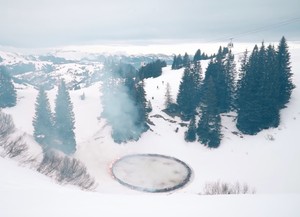
Douglas Gordon and Morgane Tschiember’s installation As close as you can for as long as it lasts, presented during Elevation 1049: Avalanche in Gstaad, Switzerland.

In this video, Jenny Saville sits down inside her first major exhibition in Venice to discuss how the great Venetian artists of the past and the city’s heritage influence her work. The show brings together more than thirty canvases and works on paper from the 1990s to the present, tracing the development of her practice, which is deeply rooted in the history of painting.
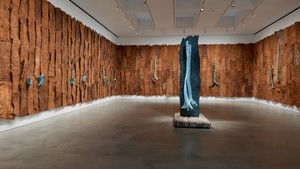
On the occasion of his exhibition The Reflection of Bronze at Gagosian, New York, Giuseppe Penone and curator Adam D. Weinberg sit down to discuss the genesis of, and their collaboration on, the show.

On the occasion of his exhibition The Fire This Time at Gagosian, Paris, Titus Kaphar discusses themes of history, representation, and collective memory in his recent paintings and hand-carved wood sculptures.

Join the artist inside Carol Bove: Nights of Cabiria, her recent exhibition at Gagosian, Beverly Hills, as she considers the power of illusion, the histories of her materials, and the philosophical lessons at the heart of Federico Fellini’s films.

In this video, musical ensemble Sō Percussion performs Steve Reich’s “Music for Pieces of Wood” inside the exhibition Richard Serra: Running Arcs (For John Cage), 1992, at Gagosian, New York.

The House on Utopia Parkway: Joseph Cornell’s Studio Re-Created by Wes Anderson is an exhibition conceived by curator Jasper Sharp and the acclaimed American filmmaker. The show brings Cornell’s New York studio to the heart of Paris, transforming Gagosian’s storefront gallery into a meticulously staged tableau—part time capsule, part life-size shadow box—for the first solo presentation of the artist’s work in Paris in more than four decades. In this video, Anderson discusses the genesis of the exhibition and the process by which it came together.