Janne Sirén considers Anselm Kiefer’s new paintings, the subject of an exhibition at Gagosian, New York, entitled Seal My Ears Shut and I Shall Hear You Still.
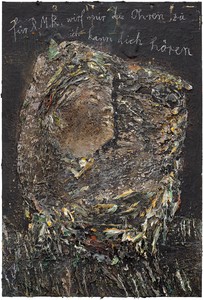
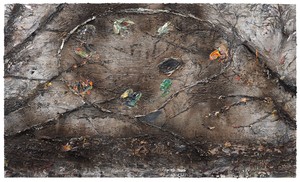
Anselm Kiefer, Für R.M.R. wirf mir die Ohren zu: ich kann dich hören (For R.M.R. seal my ears shut and I shall hear you still), 2023–25, emulsion, oil, acrylic, shellac, gold leaf, sediment of electrolysis, chalk, and canvas collage on canvas, 110 ¼ × 74 ⅞ inches (280 × 190 cm)
Anselm Kiefer, Für R.M.R. wirf mir die Ohren zu: ich kann dich hören (For R.M.R. seal my ears shut and I shall hear you still), 2023–25, emulsion, oil, acrylic, shellac, gold leaf, sediment of electrolysis, chalk, and canvas collage on canvas, 110 ¼ × 74 ⅞ inches (280 × 190 cm)
Dr. Janne Sirén joined the Buffalo AKG Art Museum as the Peggy Pierce Elfvin Director in April 2013. He has published widely on modern and contemporary art, including the book The Impressionist Revolution and the Advent of Abstract Art (2016). Sirén is the president of Eschaton—Anselm Kiefer Foundation.
The visible is simply a support for the invisible, the emanation of a divine mystery.
—Anselm Kiefer, Art Will Survive Its Ruins, 2011
Anselm Kiefer is a virtuoso at combining phenomenology and metaphysics, the lenses through which we experience life and make sense of the world. His works converge these epistemological filters into compelling images that evoke realities at once both material and transcendent. With Kiefer’s works we are always confronted both with what our senses receive and transmit—the here-and-nowness of existence—and with what lies beyond human comprehension and the grasp of sensory perception. Perhaps this is why art is Kiefer’s only reality, his vocation and religion. He has made this point repeatedly: “Art is the only reality I can envisage. . . . The real world does not exist for me unless it is through an artwork or a poem categorically distinct from life.”1 The artist, we might say, stands behind a veil: He breathes the same air that you and I breathe but conceptually and metaphysically he exists elsewhere, concealed somewhere behind the shroud of art, but also revealed through it. Kiefer lives in and through art so unconditionally and irrevocably that the poetry of his way of being is difficult for mere mortals to understand. Interpreting his artworks is equally challenging because within them we find seamlessly collaged layers of history, religion, and myth that can’t be peeled apart for the benefit of rational analysis. And yet, despite its impenetrable poetry, Kiefer’s art speaks to people meaningfully, universally, and with a profound human sensibility.
In the series of eight paintings presented in his exhibition Seal My Ears Shut and I Shall Hear You Still, Kiefer evokes the weight of history, the fickleness of human relations, and the emotions that love, longing, and desire can spawn: envy, jealousy, joy, passion, anxiety, vulnerability. These works speak of a timeless need that is both ancient and contemporary, mythic and actual—namely, the human longing for true love, our desire to be with other beings, and the agony we feel in the absence of this meaningful togetherness. These works also speak of women whom history has shunned, discarded, ignored, forgotten, or simply never acknowledged.
Six of the eight works—Claea, Clytie and Leucothoe, Dryope, Electra, Neaera, and Tyche—draw their subject matter from ancient Greek myth, while the other two evoke a more personal, perhaps even autobiographical line of thought. The characters featured in the first six are all women, most of them nymphs, and each has a unique story to tell. Kiefer “follows women in his work,” Petra Giloy-Hirtz writes; “they inspire him, and he struggles with them. They are his interlocutors . . . they are friends, kindred spirits.”2 In his own words, “Women are omnipresent in my work.”3
Subject matter aside, in this group of eight large canvases Kiefer conjures a playful tension between representation and abstraction, a prominent tenet in his recent practice. Viewing them as an ensemble, it is fascinating to observe the gradual vanishing of the human figure into the depths of rugged and shimmering surfaces composed of oil and acrylic, shellac, gold leaf, and collaged elements of canvas. The art-historical polarity between representation and abstraction as such, though, is not Kiefer’s focus here; subject matter matters to him, but he also resists the banality of literal descriptiveness, the enemy of all poetry, whether written or painted. “The most interesting passage in an abstract painting,” he writes, “is the one in which the subject moves towards abstraction. It is that indescribable moment in which the subject, still visible, is on the brink of slipping into abstraction. A moment that sits on an intangible frontier, that expresses the struggle against the representation of nothingness and of nothingness in itself. . . . My theory is this: Art intervenes only where the subject can still be divined, where ‘debate’ still seems open to differences of opinion and conception.”4 The paintings in Seal My Ears Shut and I Shall Hear You Still bear witness to Kiefer’s adherence to his theory.
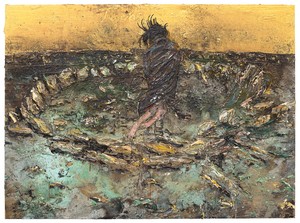
Anselm Kiefer, Tyche, 2024, emulsion, oil, acrylic, shellac, gold leaf, sediment of electrolysis, charcoal, and canvas collage on canvas, 110 ¼ × 149 ⅝ inches (280 × 380 cm)
In Tyche (2024) we encounter the ancient Greek goddess of fortune, chance, providence, and luck, swirling with her back to us toward a circular pit framed by what appear to be boulders. The mythological specificity of this ring of stones, recalling the neolithic stone circles of Northern Europe, is unclear—perhaps a function of my lack of knowledge of ancient myths—but it appears manmade, suggesting some form of interaction between humans and the gods they believe in. Spinning like the wheel of fortune that she symbolizes, Tyche’s centrally positioned figure draws the viewer into the composition, to the very edge of the pit into which she seems to be casting herself with reckless abandon. Kiefer has captured the goddess in mid-action, leading us to wonder about the picture’s narrative intent. The painting’s kinetic energy is accentuated by the disheveled locks of Tyche’s dark hair, silhouetted against a luminous background. What is she up to? What is happening? In the absence of a key to unlock the narrative cipher, as viewers we are compelled to lean on the picture’s formal poetry. The painting pulsates with urgent brushstrokes, and as the focus of our gaze glides across the canvas, the only respite we are given is the irregular line of the horizon, which divides the canvas into two domains, one serene and timeless (the calm golden sky), the other embodying frenetic earthly action (the world in which the goddess of fortune rolls her dice at humanity’s behest).
We next encounter Claea (2025), its heroine an oread or mountain nymph whose home is a sacred cave on Mount Calathium in Messenia in southern Greece. Nymphs are female nature spirits, typically associated with a specific kind of locale, and their number in Greek mythology is nearly infinite. They are classified into categories based on their habitats, and the most common are naiads (freshwater nymphs), Nereids (sea nymphs), dryads (tree nymphs), and oreads (mountain nymphs). Nymphs are typically described as companions of Artemis, the goddess of hunting, animals, and nature in general. We also find them in the company of gods such as Pan and Dionysus. Various nymphlike deities and female spirits have a long history in Kiefer’s art, and in recent years he has focused increasingly on this Greco-Roman genus. Their presence in his art is a part of a broader epistemological endeavor, a focused effort to move women—perhaps even the feminine life-force—from the shadows of myth and history into the center of both. In Claea, the mountain nymph’s larger-than-life-size portrait emerges in the center of the canvas from within a grotto of thick paint and shellac. She stares intently at the viewer, unapproachable yet vigilant. Her natural mountain habitat, with its flowers and greenery, forms her organic veil. Claea is nature and nature is Claea; the two are one, indivisible prisoners of each other.
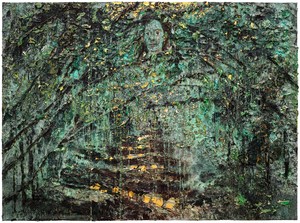
The next heroine we encounter is Dryope, whom the Romans called “Fauna.” Depending on which ancient source one consults, she is described as the wife, sister, or daughter of Pan, the god of nature, shepherds and their flocks, as well as of rustic music. Unlike Tyche, who symbolizes fortune, chance, and the unpredictable turns of fate, Dryope has the capacity to foretell the future. In Kiefer’s painting (2025), her visage nestles within a canopy of tree branches that form a mysterious archway above a path, speckled with touches of gold, that recedes into an unknown distance. Only Mother Nature knows where this path leads. As in the depiction of Claea, the landscape shimmers with kinetic energy—observe the expressive brushstrokes accentuated by the sediment of electrolysis—while the painting’s female subject is presented as a stoic, indomitable observer of all that unfolds around her.
Anselm Kiefer, Dryope, 2025, emulsion, oil, acrylic, shellac, gold leaf, sediment of electrolysis, and canvas collage on canvas, 110 ¼ × 149 ⅝ inches (280 × 380 cm)
In Greek mythology, which Kiefer has spent a lifetime studying, there are multiple nymphs by the name of “Neaera,” and because the artist rarely reveals his specific sources, it is impossible to identify exactly the nymph we encounter in the painting of that title (2025). Could she be one of the 3,000 Oceanids? Or the nymph Neaera who became the mother of Aegle by Zeus? Or the nymph Neaera who had two daughters, Lampetia and Phaethusa, by the sun god Helios? Perhaps her identity doesn’t matter but instead what matters is that Kiefer has chosen to position neglected women of the past center stage of his work, and by extension center stage in the international world of contemporary art. The attention his art commands among museums, galleries, collectors, and publications compels people to consider those we have forgotten or never even heard of. And thus, in his rendering of Neaera, we find a neglected nymph of indeterminate identity nestled amid thick vegetation, raising up her arms in a gesture evocative of ecstatic abandon. Her presence in the painting is hard to make out, but Neaera doesn’t seem to care whether we see her or not. This is one of those artworks that, in Kiefer’s words, captures “a moment that sits on an intangible frontier, that expresses the struggle against the representation of nothingness and of nothingness in itself.”5
In two other nymph paintings in this exhibition—Clytie and Leucothoe and Electra (both 2025)—the convergence of figure and ground is all but total. As recounted by Ovid in Metamorphoses (c. 8 CE), the story of Clytie and Leucothoe concerns a love triangle. Leucothoe was a mortal woman, a princess, daughter of Orchamus, a king of Persia. She was either a lover of the sun god Helios or, in Ovid’s telling, was raped by him. Clytie, a nymph (or, in some accounts, sister of Leucothoe), became jealous of the affair and told Orchamus that Leucothoe, an unmarried woman, was no longer a virgin. Enraged, Orchamus buried his daughter alive. Helios then turned Leucothoe’s corpse into a frankincense tree. This is the scene Kiefer depicts. Look carefully, and in the upper left-hand corner of this monumental painting you see Leucothoe’s face, eyes closed, amid the branches and foliage of a frankincense tree.
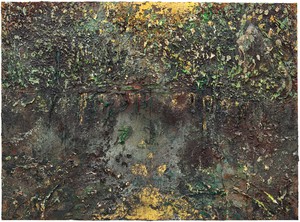
And finally there is Electra, an Oceanid, or sea nymph, who was the daughter of the Titans Oceanus and Tethys. She married Thaumas, a primordial god who personified the wonders of the sea. Electra was the mother of the Harpies and of Iris, the messenger goddesses symbolized by the rainbow. She and Thaumas were often regarded as the harbingers of storms, clouds, rain, and other swift atmospheric phenomena. We find her likeness in the upper right-hand corner of Kiefer’s painting, her mouth wide open, suggesting that she can transform the weather in an instant with voice and breath. The suggestion of Electra’s supernatural powers is evoked through impastoed leaves that appear to quiver in a gust of wind that thrusts them from right to left. Below the canopy of vegetation in the painting’s upper register is a body of water upon which we see reflections of the surrounding nature and the golden sky above. In this painting, nature folds upon itself, earth, water, and sky becoming one, indivisible and infinite in a manner conceptually reminiscent of some of Claude Monet’s late waterlily paintings.
Anselm Kiefer, Elektra (Electra), 2025, emulsion, oil, acrylic, shellac, gold leaf, sediment of electrolysis, and canvas collage on canvas, 110 ¼ × 149 ⅝ inches (280 × 380 cm)
Claea, Dryope, Neaera, Clytie, and Electra—these are just some of the localized nature spirits whom Kiefer has painted during the last decade. Around 2015, for example, he made a series of paintings inspired by the Kalevala, the national epic of Finland, in which we encounter Nordic variants of the Greco-Roman nymphs. When a new motif appears in Kiefer’s art, he doesn’t easily abandon it, and for him the cultural, geographic, and temporal distance between an ancient Finnish nature goddess and a Greek one is not as great or as significant as it is to diligent historians. And as it happens, nature spirits—that’s what nymphs are, guardians and custodians of places in the natural world—are ultimately universal beings and we encounter them across a broad range of world cultures, from Norse legends to ancient Greco-Roman mythology, as well as in the faith systems of various Indigenous populations globally. The universality as well as the specificity of the nymph-nature-goddess motif appeals to Kiefer, amplifying his aspiration to paint into being forgotten or neglected feminine theologies.
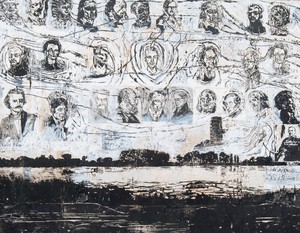
Two paintings in the exhibition stand apart from the six goddess and nymph paintings discussed above, differing in subject matter and visual language—a reminder that Kiefer’s art is a visual galaxy composed of a broad array of themes, motifs, and formal approaches. Naturwirklichkeit und Kunstwahrheit (Natural Reality and Artistic Truth, 2005–25) borrows its title from the German art historian Werner Hoffmann’s monograph Caspar David Friedrich. Naturwirklichkeit und Kunstwahrheit, published in German and English in 2000.6 Hoffman’s book explores Friedrich’s extraordinary ability to charge highly precise renderings of landscape in specific atmospheric conditions with spiritual, psychological, and religious connotations. In Kiefer’s painting we observe in the immediate foreground a body of water (the Rhine, but it could be another river as well) and above it an archway formed of branches. Suspended in midair in the middle of the canvas is a large painter’s palette decked with blotches of vibrant paint. Both the palette and the river are recurring motifs in Kiefer’s art—he was born in Donaueschingen, site of the spring that is the source of the Danube—and grew up in Ottersdorf, a small village near the Rhine, which there marks the border between Germany and France.
The contingent river that connects people and places as well as the past, the present, and the future; the natural world that surrounds us and provides our sustenance; and the palette that is both the womb and the tomb of painting—womb, because from the palette a painting is born; tomb, because Kiefer believes that his paintings stop living once they leave his studio—evoke the painter’s credo: “Art will always outlive its ruins.”7Natural Reality and Artistic Truth is a painting rich in meaning and autobiographical innuendos, and it evokes themes and motifs that Kiefer has explored and committed himself to since the 1960s. It is also an homage to past painters and philosophers, and a declaration that knowing thyself requires knowing and being with others.
Anselm Kiefer, Naturwirklichkeit und Kunstwahrheit (Natural Reality and Artistic Truth), 2005–25, emulsion, oil, acrylic, shellac, ash, chalk, and charcoal on canvas, 110 ¼ × 185 ⅛ inches (280 × 470 cm)
The most cryptic painting in the exhibition is Für R.M.R. wirf mir die Ohren zu: ich kann dich hören (For R.M.R. seal my ears shut: I can hear you, 2023–25). It is dedicated to the poet Rainer Maria Rilke and borrows its title from a line in one of the poems in Rilke’s “Book of Pilgrimage” (1901), the second section of his magisterial Book of Hours, published in 1905:
Put my eyes out: I can see you; seal my ears shut: I can hear you; and without feet I can walk toward you, and without a mouth I can still beseech you. Break my arms off, I will seize you with my heart as with a hand, make my heart stop, and my brain will beat, and if you put a torch to my brain I will bear you on my blood.8
This poem—and more broadly, Rilke’s poetry in general—is the backdrop against which we must approach and see Kiefer’s painting. It depicts a large boulder standing on a nondescript dark field, and against a dim background that could denote the night sky or simply nothingness, a void, an ominous backdrop without clear meaning or substance. From the boulder—perhaps inspired by photographs of rock formations Kiefer took during recent voyages in the Greek archipelago—protrudes a three-quarter portrait of an unknown woman, whose eyes—or at least the right one, the only one visible—appear closed. The woman seems to wear a wreath of some sort, suggested by colorful strands of thick paint that trace the line of her forehead to where her right ear would be. Specks of yellow and white paint indicate her lips and right eye. The boulder of which the unnamed woman is a part is oversized for the composition, pushing uncomfortably close to the painting’s edges. And yet, within her lithic podium and prison, the woman appears serene. She is one with the rock, like the nymphs we have seen who are one with nature—a divine togetherness.
But what is the connection between Rilke’s poem and Kiefer’s painting? Commentators tend to agree that the poem is the author’s expression of his profound love for his mistress Lou Andreas-Salomé, with whom he made two trips to Russia, first in 1899 and again in 1900. The two met in 1897 and their romantic engagement ended after their second Russian sojourn, evolving over time into a lifelong friendship. In short, one could read Kiefer’s painting as a love letter. There is another avenue of interpretation as well, and one does not discredit the other. Paradoxes abound in Kiefer’s art, and the very concept of meaning in his visual world is almost by default layered, contingent, complex, and often contradictory. This other path of interpretation takes us into contemporary affairs and the politics of war and aggression unfolding around the world. We know that Kiefer is an astute student of both history and politics, and he has often commented on the occasions during the Cold War when the world came close to nuclear annihilation. Today we again bear witness to bellicose rhetoric and actions emerging from various powerful quarters of the world. At the time of writing, there are wars underway in Ukraine and the Middle East. It might not be outlandish to think that Kiefer’s painting, inscribed with the words “wirf mir die Ohren zu: ich kann dich hören” (seal my ears shut: I can hear you), is not just a lover’s proclamation but also a painter’s declaration that “we, the people of the world” are not deaf to what is happening around us.
Through Kiefer’s art we step into a world in which human time and geological time converge and multiple realities coexist. The meanings of his works can never be pinned down, and interpreting them is fraught with challenges. As Kiefer notes, “Like a snake seized by the tip of its tail, twisting around to try and free itself, art cannot possibly be grasped by words.”9 Acknowledging this relieves the viewer from the pressure of finding finite answers to pictorial puzzles. Coming to terms with the undecipherability of Kiefer’s art also allows us to step wholeheartedly and poetically into an expansive galaxy of nymphs, divinities, lovers, poets, and other beings in which the rules of Cartesian logic don’t apply. Welcome to the free world!
1 Anselm Kiefer, Anselm Kiefer au Collège de France. L’Art Survivra à ses Ruines. Art Will Survive Its Ruins (Paris: Éditions du Regard, 2011), p. 244, p. 258.
2 Petra Giloy-Hirtz, Anselm Kiefer: The Women (Munich, London, and New York: Prestel, 2025), p. 6.
6 The English translation of Hoffmann’s book was published under the abbreviated title Caspar David Friedrich, trans. Mary Whittall (London: Thames & Hudson, 2000).
Dr. Janne Sirén joined the Buffalo AKG Art Museum as the Peggy Pierce Elfvin Director in April 2013. He has published widely on modern and contemporary art, including the book The Impressionist Revolution and the Advent of Abstract Art (2016). Sirén is the president of Eschaton—Anselm Kiefer Foundation.