Gagosian is pleased to present an exhibition of important sculpture by Walter De Maria. Each of the three works on view, The 5-7-9 Series (1992/1996), the Large Rod Series: Circle/Rectangle 11 (1986), and The 13-Sided Open Polygon (1984), represents a major series for De Maria during the last fifty years. Although the works engage geometric and numerical progression, they balance stark mathematical fact with the more intangible qualities of the sublime.
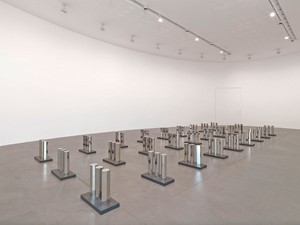
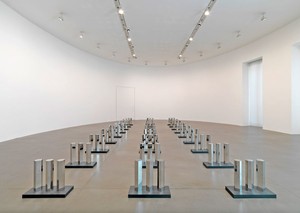
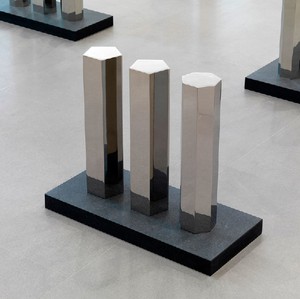
The 5-7-9 Series is the second of three related, large-scale 27-part installation sculptures. The Rome presentation is edition 2/2; the first edition is on permanent view at the Gemäldegalerie, Berlin. The work is preceded by The 4-6-8 Series (1966) and followed by Time/Timeless/No Time (2004, from the 3-4-5 Series), on permanent view at the Chichu Art Museum, Naoshima Island, Japan. All works in each series consist of 27 unique sculptural variations, each made of three vertical rods affixed to a horizontal base.
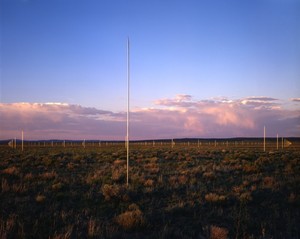
Each of the shaped solid stainless-steel rods in The 5-7-9 Series has five, seven, or nine sides, and the order of these three rods is presented in 27 unique presentations. Every possible combination of vertical elements is realized. The installation of the sculptures is then determined by the given site, as they are often arranged in single or triple rows, and they may be ordered in a nearly infinite number of ways. In Rome, their arrangement will complement the oval shape of the main gallery, with a display of three rows of nine works. The vertical rod is an element that has recurred throughout De Maria’s oeuvre, with one of the earliest examples being Bed of Spikes (1968–69). This was followed by the outdoor installation, The Lightning Field (1977), in New Mexico. A large-scale photograph opens the exhibition, depicting this icon of land art against the panorama of the Western American landscape.
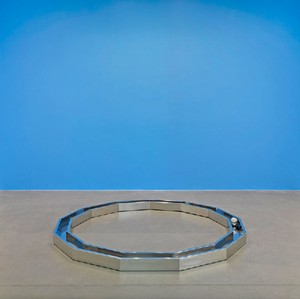
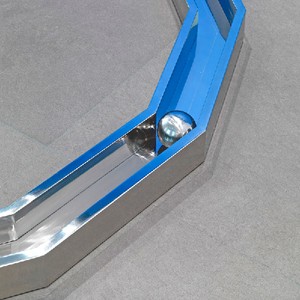
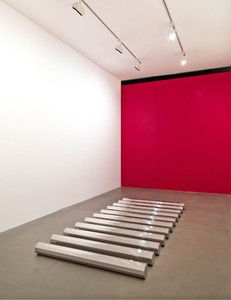
In counterpoint to the vertical structure of The 5-7-9 Series are two stainless-steel floor sculptures: Large Rod Series: Circle/Rectangle 11 and 13-Sided Open Polygon. Both are displayed in their own gallery spaces. Circle/Rectangle 11 consists of eleven eleven-sided rods. In Rome the work is displayed in a rectangular configuration, although displaying the eleven rods in a circular pattern is also an option. The eleven large rods share an affinity to the rows that form the 500-part Broken Kilometer (1979). The 13-Sided Open Polygon comes from a series of polygonal floor sculptures, created by the artist between 1973 and 1984, whose forms range from five to seventeen sides. Within the stainless-steel circumference of each polygon sits a solid stainless-steel ball whose many movements are confined by the limits of the interior track, emphasizing the artful combination of order and randomness that pervades De Maria’s work.
On the occasion of this exhibition, the original exhibition catalogue for The 5-7-9 Series published by Gagosian in 1992 will be reprinted and expanded, including a text by Lars Nittve.