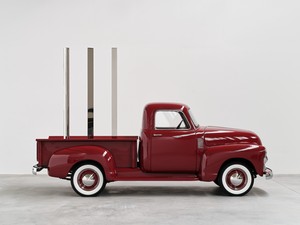
The Singular Experience atGagosian’s Le Bourget gallery is the largest exhibition of Walter De Maria’s work in France in several decades. Organized by Donna De Salvo, senior adjunct curator at Dia Art Foundation, the exhibition marks the first time De Maria’s final sculpture, Truck Trilogy(2011–17), is being shown outside of the United States. Here, De Salvo speaks with artist Lucy Raven about her evolving kinship with De Maria and more.
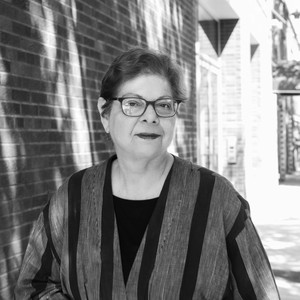
Donna De Salvo is a curator, writer, and senior adjunct curator at the Dia Art Foundation—where she first worked with Walter De Maria—known for her artist-centered approach and innovative exhibition practice. She previously served as inaugural chief curator and deputy director for programs at the Whitney Museum of American Art, New York, helping shape its new building and programmatic vision, and as senior curator at Tate Modern, London. Photo: Gabriela Herman
Donna De SalvoLucy, we first met in 2012, when you were in the Whitney Biennial and you had a series of works about test patterns called RP47. More recently, you opened the Dia Chelsea space with an extraordinary film called Ready Mix [2021]. Ready Mix was filmed in Idaho, and it looks at the manufacturing of concrete, one of the most ubiquitous building materials in the world. So much of your work has looked at systems and precision, as well as the idea of the American West. And so, in that sense, you have a kinship with De Maria. But you also bring ideas that reflect more contemporary concerns about industrialization. You have the capacity to look at that in a critical way, but still admire the beauty of the landscape. That duality is very compelling in how you approach your work.
Over the years, we’ve had an ongoing exchange about Walter De Maria. Now that you’ve seen the show, I’m curious how it’s impacted your thoughts about his work, if at all?
Lucy RavenMy first engagement with Dia, in 2017, was an Artist on Artist presentation on De Maria. I chose him because I love the work but also find it mysterious, and because I’d read that he was a drummer in a proto–Velvet Underground band with Lou Reed and John Cale called The Primitives, and I wanted to use the opportunity to think more about his work in relation to interval and rhythm. I’d recently seen the incredible percussionist Deantoni Parks perform in New York, and I felt a powerful connection to what he was doing. We’d never met, but I reached out to him to see if he might like to collaborate with me on my talk—which in short order ceased to be a talk and became a performance—and it turned out that quite aside from his own project, he’s John Cale’s drummer! So we were star-crossed, in a way. We’ve been working together ever since.
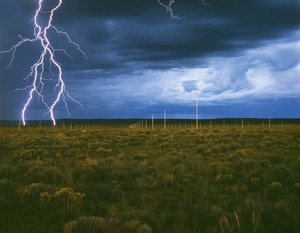
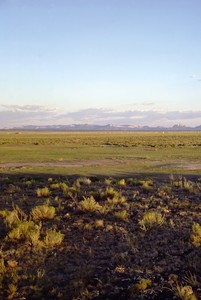
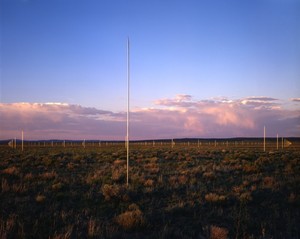
Thinking about De Maria as a drummer gave me another entry point into works like The Broken Kilometer [1979] and The Lightning Field [1977]. Percussion gave name to a latent violence through abstraction I’d always sensed there. In The Lightning Field, that’s overlaid with an inherent structural violence that runs deep through the American West. When you’re there, you’re presented with this Cartesian grid, a mile by a kilometer. You’ve got the European and the American, the metric system and the imperial, and their interpenetration in a dotted grid. Is it a critique, or a reiteration, of the demarcation of property? The immense physicality of the work is both blatant and fugitive.
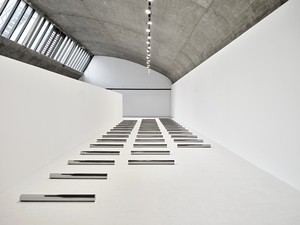
Another conundrum De Maria’s work confronts you with is a horizon without a vanishing point, a construct very present in this exhibition. I’m particularly thinking about 13, 14, 15 Meter Rows [1985], which is a work I hadn’t seen in person before, and how you can see it from both sides. The show you’ve put together, Donna, is revelatory in many ways, including so many drawings I hadn’t known of before.
DDSYou made a series of works called The Drumfire: the Dia project Ready Mix; the work that was at the 2022 Whitney Biennale, Demolition of a Wall(Album 1), and its companion, Demolition of a Wall (Album 2) [both 2022]; and the last one is Murderers Bar [2025]. Each of these addresses a kind of violence on the landscape. And I think what’s interesting about De Maria’s film Hard Core [1969] is this duality between violence and peace. It obviously quotes the American fascination with Westerns, but at the very end of the film is a picture of a young Vietnamese girl, because it was made at the height of the Vietnam War and it was really conceptualized as protest.
I remember the first time I went to The Lightning Field. I was a curator in the 1980s at Dia in New York, very young. And they very nicely, although I think somewhat perversely, arranged for me to be the only person in the cabin. It was a bit difficult, actually. I was a little scared being there, but I went through a process, which is why you stay for twenty-four hours. I thought, Are these poles an attack on the land? It’s such a beautiful landscape. Do we need them? Is this intervention an expression of dominance? But then, over the course of the day, I came to experience it in a very different way, seeing it go from this incredible bright light, then it gets silvery, and then at night the moon comes out and you have this whole other magical experience. And I just thought, well, there’s a communion with the land. So that’s another instance of duality in De Maria’s work.
LROne of the biggest surprises at The Lightning Field is the cabin you mention. I’d seen many photos of The Lightning Field, but I never realized that there was a frontier settler’s cabin right next to it. That’s where visitors stay, in a kind of mandatory embodiment of frontierism. From the front porch, you look onto that strange grid proposed over the landscape, which sometimes feels very light, almost ephemeral, and other times feels carceral. The structure of that dynamic felt a bit like a joke. On one hand, there’s the violence of radical imposition, and on the other, the setup is kind of absurd. I get that sense in Hard Core, too. That drawn-out shoot-out scene with Michael Heizer in jeans and cowboy boots—it’s cartoonish, like something out of Krazy Kat or Wile E. Coyote. And the cabin—how wild to be there alone. I stayed with a group, which is the usual scenario, and it forces you into a kind of familial relationship that I also figure must be intentionally part of it: There’s the bigger “parents’ bedroom,” a smaller one for the “kids,” and grandma had left enchiladas warming in the oven. That was an aspect I didn’t expect.
I had also never realized that the poles are pointed—sharply!—at their tops. And despite the uneven ground, they are slightly different heights such that you could lay an imaginary plane on top and they would all touch it, which is one of the most truly phenomenal things about the work when encountering it in person. Their precision contains a kind of horror, to me.
there’s an openness I feel toward the encounter, even while there’s extreme control in the making and the presentation of [De Maria’s] work. That’s something I relate to and really admire.
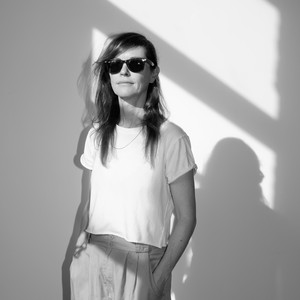
Lucy Raven
DDSWell, this duality between playful and dangerous appears in many works, like De Maria’s Bed of Spikes [1968–69], which was shown at Paula Cooper Gallery very early on. Literally, they were so sharp that when you entered, you had to sign a hold-harmless agreement. A review in Time magazine called him the “High Priest of Danger.” There’s this sense of precision in your work as well, but you also cannot control how the individual interacts with the work. I’m curious how you think about that.
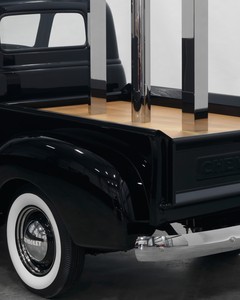
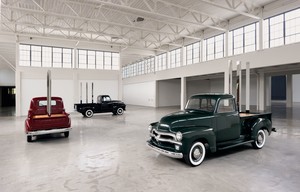
LR“Tolerance” is a word that comes to mind, with the Truck Trilogy for example: tolerance of the rods going into the wood, and the way everything’s so precisely fitted together. At the same time, there’s a kind of openness. It offers a way to use abstraction as a tool of open engagement, rather than a set of aesthetic conditions. So there’s an openness I feel toward the encounter, even while there’s extreme control in the making and the presentation of the work. That’s something I relate to and really admire in his work. You were talking a little bit about the trucks the other day, how it’s a Chevrolet truck, but it’s been reduced. A whole set of decisions took place that let you encounter it as a truck, but also encounter it as a form.
DDSYes, absolutely. The decisions were so specific. There are no windshield wipers. He removed those, and the side-view mirrors. There’s no gas cap. He very carefully stripped away certain elements to reveal the form. That kind of precision—whether it’s abstracting, I don’t know, but what’s fascinating about these works is that no matter how much is stripped away, you can’t get rid of the reference, unlike other works where you have geometric forms.
Another thing that De Maria was very precise about was both the display and the representation of his work. The Lightning Field, for example, has an approved set of photographs. They were made by John Cliett in the 1970s. There’s no photography allowed at The New York Earth Room [1977], The Broken Kilometer, or The Lightning Field. It’s about preserving the direct experience. De Maria didn’t want too much out in the world; he didn’t want the work to be overly interpreted. In a sense, it gives agency to the viewer.
LRI think that’s one reason why I feel I have a grounded entry point into his work. I never knew him or worked with him, but I feel that generosity. It’s agency for the viewer, but also for the work over time, and the way that shifts. I find it profound. In my own work, there’s always a conversation with the institution around how much language to give people. I think those expectations have evolved in the last decades. There’s a balance. For me, I think about staging my works in a way that allows for maximum reception and experience without needing a text other than the “text” that the work provides.
DDSDe Maria’s work doesn’t fit comfortably in movements or categories. Is he a Minimalist? Is he a Conceptual artist? Is he a Land artist? Not that I think he would’ve cared about labels, but art historians and museums like to categorize. He was all those things, essentially, which is why I think it was so important to show a range of works.
LRI’ve long thought about some of his work having a kind of setup of a lie, maybe in the most literal way exemplified by The Vertical Earth Kilometer [1977]. “Lie” isn’t quite the right word. Maybe it’s a provocation.
DDSThe Vertical Earth Kilometer is a permanent work in Kassel, Germany, that was installed during documenta 6. All you can see is a sandstone plate with a circle in the center, which is the top of a brass rod inserted one kilometer into the ground. You have to take it on faith that it’s there, because it’s invisible. It’s the idea of what we can and can’t see. I don’t know if it’s a lie, but yes, a provocation maybe, because so much of his work is about the visible and the invisible.
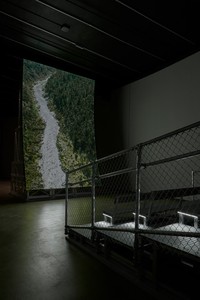
Your work Murderers Bar was included in a recent show at the Barbican in London. The title refers to a location connected to the largest dam removal and river restoration project in US history. The dam was called Copco 1, a massive concrete dam and one of the oldest in the United States, from 1918. As with Ready Mix, you worked with a camera to capture the landscape in flux—the release of water for the first time in a hundred years.
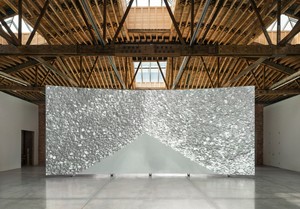
LRMurderers Bar is a vertical film, and it’s projected on a large, curved, vertical screen that’s a kind of sculpture. (Ready Mix at Dia had a curved screen that was horizontal.) Upon reviewing the footage after my first filming trip out to the river, I saw a rectangle with a small line running up and down the middle of it—the river. So I decided to turn the camera 90 degrees and work vertically as a way of foregrounding the river, and its relationship to the dam and the reservoir behind it. It has a 2:3 aspect ratio. I was thinking there about Ansel Adams, also certain paintings of the West and in the Asian tradition, and the compression of space that’s possible with a vertical format. The piece is the culmination of The Drumfire series, which has dealt with material transformation in the western United States. It explores how cycles of force and pressure can physically transform material, as well as the conditions—human-made and geological—around that material.
Here I was really interested in fluid dynamics and the role of water in the West. Ready Mix dealt with concrete. The second and third films, Demolition of a Wall (Album 1) and Demolition of a Wall (Album 2), I filmed at an explosives range in southern New Mexico near Los Alamos, where the atomic bomb tests were done and filmed at very high speed to capture the explosive shock waves. And this piece, Murderers Bar, contains elements of both of those. It’s centered upon a hundred-plus-year-old concrete dam that in some ways was easy to see as a kind of concrete monument to the idea of Manifest Destiny that I think De Maria was also really interested in. And behind it, you had a hundred years of water pressure built up, as well as sediment that wasn’t able to travel down the river. And then it gets cataclysmically released, and travels out to the ocean. In the film, you travel with it. We used many kinds of cameras, but mainly aerial: tiny little drones, bigger drones, a helicopter. And then you go out to the ocean and turn back and go against the current to reveal the empty reservoir with a river now finding its new way through it. Then the film loops.
DDSWe touched on what it meant for many of these artists to go out into the land and whether they were conquering it or enhancing it. I always think of De Maria’s work as on the enhancing end of the spectrum.
I haven’t seen it yet, but regarding Murderers Bar, you mentioned to me that prior to the dam being built, there were Indigenous communities in this area. And there still are. Today there’s a lot of discussion about the problematics of artistic interventions in places. It’s a different time, and we have a greater consciousness and sense of responsibility. In the context of Murderers Bar, what has been the impact on the people living there?
LRThe dam’s removal was instigated and led through decades of activism by a consortium of five tribes who live along the river—the Yurok, Karuk, Hoopa Valley, and Klamath Tribes, and the Shasta Indian Nation. One of the most inspiring aspects of this project was being able to collaborate with the fisheries department of the Yurok Tribe, who live right at the mouth of the river, at the ocean. They have been doing incredible work with lidar and sonar data collection to map the underwater topography of that region—both before the dam was released and after—to understand the changes. And already salmon have ventured back up past the former dam site, even earlier than expected, which is quite remarkable.
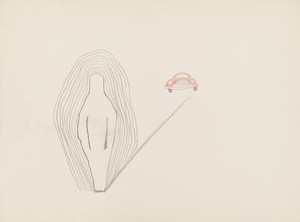
Just one last thing to say about conquering versus enhancing the landscape: I think drawing pervades so much of De Maria’s work. Not just in the actual drawings, but in the films and sculptures as well, and even to some extent in the Land art, the gesture often feels to me like one of drawing. Which seems different from a kind of imposition.
DDSYes, I don’t know why I never made this connection before: the fact that De Maria was making drawings about landscape, and then the first work he did in the desert, Mile Long Drawing [1968], was a drawn line. And it was chalk; it was ephemeral, eventually blown away.
Donna De Salvo is a curator, writer, and senior adjunct curator at the Dia Art Foundation—where she first worked with Walter De Maria—known for her artist-centered approach and innovative exhibition practice. She previously served as inaugural chief curator and deputy director for programs at the Whitney Museum of American Art, New York, helping shape its new building and programmatic vision, and as senior curator at Tate Modern, London. Photo: Gabriela Herman