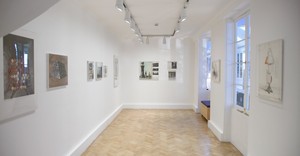
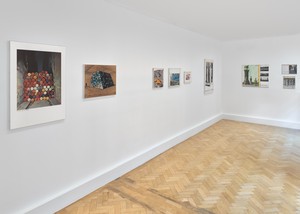
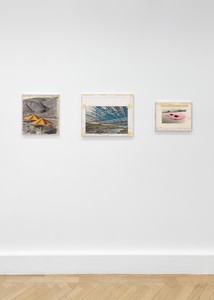
Gagosian is pleased to announce an exhibition in the Burlington Arcade gallery featuring original works by Christo related to site-specific projects—both realized and unrealized—by him and Jeanne-Claude. The presentation opens on the same day as Christo: Air, at the Grosvenor Hill gallery, which brings together rare early works by Christo with a large-scale indoor installation originally conceived by the artists in 1968 for the Institute of Contemporary Art, Philadelphia. Christo: Air remains on view until August 21.
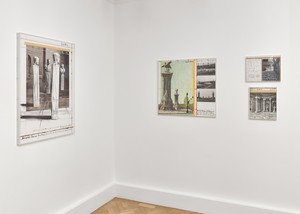
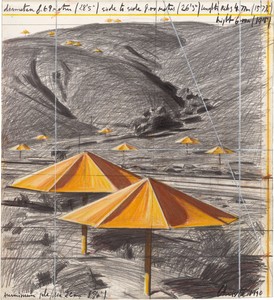
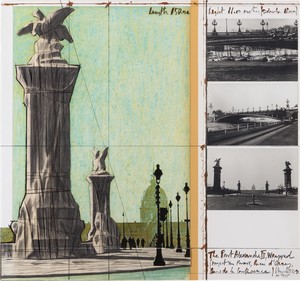
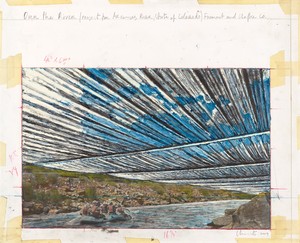
Christo’s drawings and collages were vital to the aesthetic and technical development of his and Jeanne-Claude’s many monumental installations, and he borrowed from the presentational style of architectural renderings to clarify how these undertakings would ultimately appear. These original works also have particular significance as documents of structures that only ever existed for brief periods and in specific, sometimes remote, locations. Once a given public work was realized, the artist made no further studies of it; he did, however, produce numerous silkscreen, offset, and digital prints detailing plans that remained unbuilt.
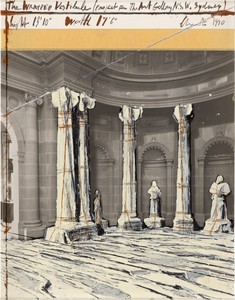
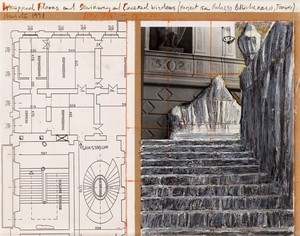
The drawings on view at Burlington Arcade include Wrapped Vestibule (Project for the Art Gallery of New South Wales, Sydney) (1990) and Wrapped Floors and Stairway and Covered Windows (Project for Palazzo Bricherasio, Turin) (1998). Wrapped Vestibule transformed its venue’s entrance into an arena of concealment and revelation by swathing its columns, sculptures, and floor in white fabric bound with rope. Introducing Christo and Jeanne-Claude’s long-standing use of wrapping into a neoclassical interior, it disrupted visitors’ experience of the museum’s institutional space, allowing its architecture, history, and function to reemerge as both forms and subjects. Wrapped Floors reconfigured the seventeenth-century wing of Palazzo Bricherasio in a similar way; here, the artists used approximately 1,188 square meters of cotton drop cloth to cover the parquet floors of five rooms and their connecting staircases. As visitors traversed the palazzo, the fabric’s shifting textures lent its architecture a destabilizing fluidity.