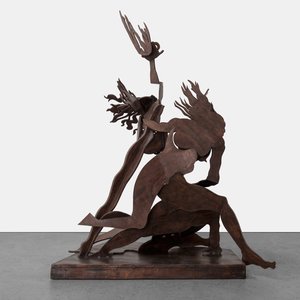
At Meridians, Art Basel Miami Beach’s section of large-scale projects that push the boundaries of the traditional art fair booth, which this year is curated by Yasmil Raymond, Gagosian is presenting Rachel Feinstein’s sculpture Metal Storm (2024).

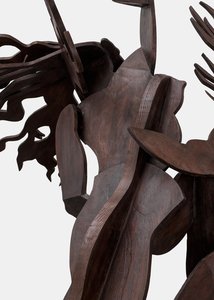
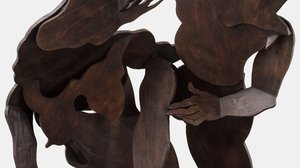
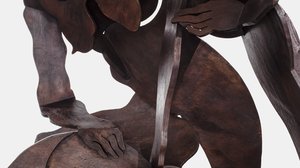
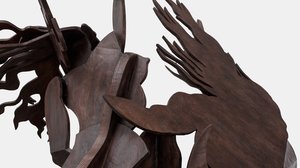
Rachel Feinstein’s sculpture Metal Storm (2024) is composed of interlocking bronze planes depicting three witches engaged in ecstatic ritual. The figures’ bodies tangle into a pyramidal formation: one witch lies on her knees with her arms extended before her and her head curling back between her legs, while her counterparts tower over her, pushing down on her back with their hands and feet. One of the standing witches holds a cauldron of fire, which she thrusts skyward above the group, its flames echoing the wild tendrils of the women’s hair.

<p data-block-key="i298q"><i>Metal Storm</i>, 2024</p>

Rachel Feinstein

Metal Storm, 2024

Cast bronze

93 × 69 ⅜ × 41 ⅞ inches (236.1 × 176.1 × 106.2 cm)

Edition 1/3 + 1 AP

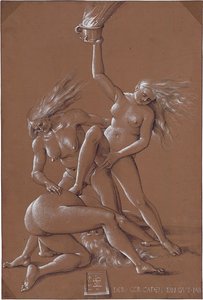
This remarkable three-dimensional tableau, which Feinstein first realized as a wooden sculpture with the same title in 2021, presents the artist’s interpretation of Hans Baldung Grien’s 1514 drawing New Year’s Greeting with Three Witches. Feinstein studied both studio art and religion and has long admired the work of fifteenth- and sixteenth-century German artists whose representations of Biblical imagery simultaneously alluded to the tumultuous social climate of the period. Among the most recognizable of these figures, Baldung Grien spent his early career studying under Northern Renaissance master Albrecht Dürer, from whom he inherited much of his visual language. Upon the onset of the Protestant Reformation, however, Baldung Grien’s style grew increasingly mannerist, and his work began to express a notable interest in Satanic themes of witchcraft and sorcery. “Baldung Grien used witches in his art to make money by selling titillation and the fear of loose women in a time when people were afraid because of world instability,” Feinstein explains. “I’m fascinated by that and the idea of witches because I am a woman and artist.” By casting the women from New Year’s Greeting with Three Witches in bronze—a material historically used to denote the heroism of figures in statue—Feinstein reimagines the witches as defiant symbols of feminine power, and in doing so, turns the drawing’s misogynistic symbolism on its head.

Beyond its engagement with problematic representations of women in medieval art, Metal Storm also responds to parallel circumstances of “world instability” within our contemporary moment. Notably, the artist conceived of this work form amid the COVID-19 pandemic—a period during which many people found themselves feeling restless, confined, and tethered to their phones and computers as a result of social distancing protocols. Feinstein’s life-size representation of the three witches physically communing in ritual and moving freely in space expresses a widely felt desire for social gathering and mobility at a time when both were severely limited. Moreover, as a freestanding three-dimensional object, Metal Storm directly engages viewers’ bodies; we are required to circumambulate the sculpture in order to grasp it in its entirety. As a result, the work encourages an active form of viewership that stands in refreshing contrast to the passive forms of spectatorship that digital technologies, which came to play a greater role in daily life during the pandemic, tend to promote.

Hans Baldung Grien, New Year’s Greeting with Three Witches, 1514, ink and wash on primed paper, 12 × 8 ¼ inches (30.5 × 21 cm), Albertina Museum, Vienna

Artists are witches. They can feel what is coming without even knowing it themselves.

Rachel Feinstein

While Metal Storm’s celebration of self-expression and bodily freedom is universally relatable to those who lived through pandemic lockdowns, Feinstein initially conceived of the sculpture as speaking most directly to the experiences of mothers during COVID-19. With schools transitioning from in-person to remote learning models, mothers—traditionally, the primary providers of childcare within families—were commonly freighted with even greater responsibility with regard to the education, supervision, and protection of children than their male partners. “I’ve spoken to a lot of women about it—they say it was like going back into the Middle Ages,” Feinstein, herself a mother of three, recounts in a 2023 interview. Within this atmosphere of uncertainty, Metal Storm’s witches presented a captivating model of vitality and confidence, reminding mothers of their strength. As Yvonne Owens writes in an essay published upon the exhibition of the wooden variation of the work, “The female figures’ swirling, dynamic motion is redemptive, somehow reassuring us that, at our deepest collective core, we are not just standing still in the face of massive survival challenges.”

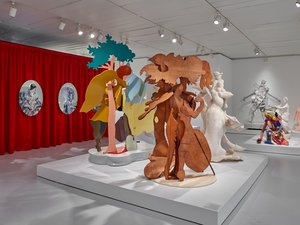
Installation view, Rachel Feinstein: Maiden, Mother, Crone, Jewish Museum, New York, November 1, 2019–January 17, 2021. Artwork © Rachel Feinstein

Since the 1990s, Feinstein’s sculptures and installations have examined such issues of female subjectivity and representation—probing, as Jewish Museum curator Kelly Taxter writes, the ways in which women “are described, seen, and embodied” in Western society at present. Taking up problematic histories, tropes, and archetypes, her work often calls attention to contradictory constructions of femininity and questions the realities that idealized visions of womanhood occlude and repress. Feinstein’s decadent visual language, influenced equally by third-wave feminist art, medievalism, fairy tales, folklore, theater, fashion, and advertising, revels in thematic contradictions.

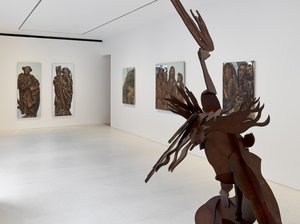
Feinstein conceived of Metal Storm in dialogue with a selection of her paintings on mirror that depicted Biblical themes and were made to appear as if they had been carved in wood. Just as these paintings reference historical three-dimensional wooden sculptures, Metal Storm (in both its wood and bronze variations) retains elements of two-dimensional representation through its use of interlocking planes in lieu of rounded sculptural figures. Exhibiting these paintings and the wooden variation of Metal Storm together in her solo exhibition at Gagosian in 2022, Feinstein provocatively asserted the co-constitutive nature of oppositional categories like good and evil, or painting and sculpture.

Installation view, Rachel Feinstein: Mirror, Gagosian, Davies Street, London, January 27–March 5, 2022. Artwork © Rachel Feinstein. Photo: Prudence Cuming Associates

Three years after the unveiling of its wooden counterpart, Feinstein’s bronze Metal Storm responds to the distinct circumstances of uncertainty and instability that define our present moment—its subversive model of feminine power and implicit critique of binary thinking proving itself evergreen. On the heels of major solo exhibitions at the Jewish Museum in New York and the Savannah College of Art and Design’s Museum of Art in Georgia, the work also arrives at a pivotal moment in Feinstein’s career. Just as it crystallizes the fundamental concerns of the artist’s thirty-year practice, Metal Storm also anticipates an important new chapter in her life and legacy; the work’s oracular subjects might provide an apt metaphor for its potential. “Artists are witches,” Feinstein has said, “they can feel what is coming without even knowing it themselves. My antennae are up and feeling vibrations.”

Rachel Feinstein’s Metal Storm (2024) at Art Basel Miami Beach Meridians 2024. Artwork © Rachel Feinstein. Video: Pushpin Films

Rachel Feinstein and Jack Pierson

Rachel Feinstein and Jack Pierson

The Bass Museum of Art, Miami Beach, is presenting Rachel Feinstein: The Miami Years (through August 17, 2025), an expansive exhibition of the artist’s multidisciplinary approach to sculpture. Ahead of the opening, Feinstein met with longtime friend and fellow artist Jack Pierson to reminisce about their years spent in Miami.
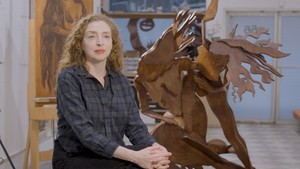
Rachel Feinstein: Mirror

Rachel Feinstein: Mirror

Join Rachel Feinstein in her New York studio as she addresses the genesis of her exhibition Mirror in London and the enduring power of religious iconography.

Jean Pigozzi:  An interview with Rachel Feinstein

Jean Pigozzi: An interview with Rachel Feinstein

Famed photographer of the famous, Jean Pigozzi speaks with artist Rachel Feinstein about the publication of his new book, The 213 Most Important Men in My Life, and provides a sneak peek at what’s coming up next. 

Gagosian Quarterly Summer 2021

Now available
Gagosian Quarterly Summer 2021

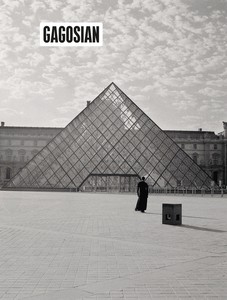
The Summer 2021 issue of Gagosian Quarterly is now available, featuring Carrie Mae Weems’s The Louvre (2006) on its cover.

Artist to Artist: Rachel Feinstein and Ewa Juszkiewicz

Artist to Artist: Rachel Feinstein and Ewa Juszkiewicz

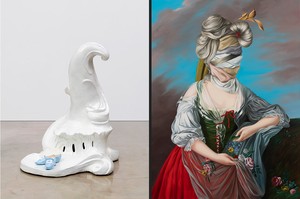
On the occasion of Frieze New York 2021, the two artists discuss remixing conventions, the allure of Rococo, and the importance of research and history within their respective practices.

Rachel Feinstein

Rachel Feinstein

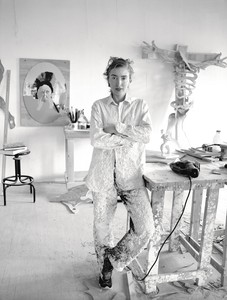
The artist discusses her life and work with Alan Yentob.

Gagosian Quarterly Winter 2019

Now available
Gagosian Quarterly Winter 2019

The Winter 2019 issue of Gagosian Quarterly is now available, featuring a selection from Christopher Wool’s Westtexaspsychosculpture series on its cover.

Rachel Feinstein at Chatsworth

Rachel Feinstein at Chatsworth

A new sculpture by Rachel Feinstein has been unveiled on the grounds of Chatsworth, the celebrated Derbyshire estate, where Feinstein recently spent time as Gucci’s inaugural artist in residence. Alice Godwin tells the story of how it came to be.

Rachel Feinstein: Frieze Sculpture

Rachel Feinstein: Frieze Sculpture

Rachel Feinstein speaks about her outdoor installation for Frieze Sculpture 2018—a set of four majolica sculptures, inspired by Franz Anton Bustelli’s Rococo commedia dell’arte figurines.

Rachel Feinstein Brings Rome to Paris

Rachel Feinstein Brings Rome to Paris

Rachel Feinstein speaks to Gagosian’s Angela Brown about “bringing Rome to Paris,” for her exhibition at Le Mur.

Gagosian Quarterly Summer 2026

Now available
Gagosian Quarterly Summer 2026

The Summer 2026 issue of Gagosian Quarterly is now available, featuring Ellen Gallagher’s Fast-Fish and Loose-Fish (2026) on the cover.

Jenny Saville a Ca’ Pesaro

Jenny Saville a Ca’ Pesaro

In this video, Jenny Saville sits down inside her first major exhibition in Venice to discuss how the great Venetian artists of the past and the city’s heritage influence her work. The show brings together more than thirty canvases and works on paper from the 1990s to the present, tracing the development of her practice, which is deeply rooted in the history of painting.