Now available
Gagosian Quarterly Summer 2026
The Summer 2026 issue of Gagosian Quarterly is now available, featuring Ellen Gallagher’s Fast-Fish and Loose-Fish (2026) on the cover.
Art Fair
December 4–8, 2024
Miami Beach Convention Center
Booth G8
www.artbasel.com
Gagosian is pleased to present an extensive selection of modern and contemporary works at Art Basel Miami Beach 2024. Many of the included works offer fresh perspectives on portraiture and figure painting, reimagining these longstanding disciplines across a variety of mediums and contexts. Others propose new ways of understanding the unique qualities and complex interactions of diverse spaces and sites.
In Ethel Scull (1963), Andy Warhol portrays the eponymous socialite and collector, printing snapshots of her taken in a 42nd Street photo booth on a silver spray-painted canvas and transforming his influential sitter into a Hollywood starlet. In his painting Ascension VI (2024), Titus Kaphar uses brass nails to interpolate a partial reproduction of the subject of Rogier van der Weyden’s 1435 painting The Descent from the Cross into a silhouetted image of basketball legend Michael Jordan, paralleling the martyrdom of Christ with the sacrifices made by athletes in the public eye. In Maurizio Cattelan’s provocative marble sculpture Untitled (2011), human presence is reduced to one giant hand from which four fingers appear to have been lopped off, leaving the single remaining digit making an inadvertent gesture of contempt.
Richard Avedon’s indelible photograph Jacqueline Kennedy in inaugural gown, West Palm Beach, Florida, January 3, 1961, pictures the then First Lady in a dress by Oleg Cassini and was taken as part of a formal session with the family for Harper’s Bazaar. Andreas Gursky’s photograph V & R II (2022 [2009])—a reworking of his V & R from 2011—offers an abstracted perspective on a Parisian catwalk, presenting unidentified fashion models marching along a pale stripe that appears adrift in a featureless black void. In Airplane (1990), Roy Lichtenstein merely alludes to the presence of a pilot, rendering a craft in flight, guns blazing, in painted and patinated bronze. Employing bold graphic strategies familiar from his paintings and prints, the Pop art pioneer turns a cartoonlike image into a dynamic “drawing in space.”
Other works in Miami explore aspects of place and position in figurative, abstract, and conceptual ways, often combining aspects of all three. In his slyly ironic painting Plenty Big Hotel Room (Painting for the American Indian) (1985), Ed Ruscha juxtaposes a fluttering American flag with four black strips suggestive of redacted text. The work turns the complex nationalistic resonance of the ubiquitous banner onto itself, the word hotel in its title signifying the imposition of exclusive luxury in a land taken over from its indigenous people. In his painting Urban Nature (2024), Urs Fischer adopts a fragmented, collage-like perspective on his Los Angeles milieu, wielding intense color and abstracted imagery to reflect the city’s blend of the natural, the artificial, and the wholly imagined as if moving through it at speed. Albert Oehlen also juxtaposes and blends a wide range of painterly modes and marks in Untitled (2022), shifting between the planned and the improvised to undermine any expectation of consistent form, stable meaning, or identifiable locale, while Helen Frankenthaler layers a passage of softly radiant acrylic color over a dark ground in Spellbound (1991), translating her experience of landscape into allusive, ethereal shape.
More purely abstract are works such as Katharina Grosse’s canvas Untitled (2024), with its looping pathways of vibrantly colored spray paint that intersect with one another like a highway junction. Donald Judd’s wall-mounted box form from 1988, constructed of clear anodized aluminum with red and chartreuse plexiglass, interacts with its surroundings by emphasizing relationships between part and whole alongside the interplay of space, light, and color. Richard Serra’s drawing Diptych #8 (2018), too, focuses on the inherent qualities of materials. Applying paintstick, etching ink, and silica to two sheets of handmade paper in two dense, dark, conjoined planes, Serra investigates the idea and experience of weight and transforms the work of art into a destination in its own right.
Featured artists include Derrick Adams, Richard Avedon, Georg Baselitz, Jean-Michel Basquiat, Amoako Boafo, Louise Bonnet, Carol Bove, Cecily Brown, Maurizio Cattelan, John Chamberlain, Christo, John Currin, Julie Curtiss, Edmund de Waal, Jadé Fadojutimi, Rachel Feinstein, Urs Fischer, Helen Frankenthaler, Theaster Gates, Cy Gavin, Nan Goldin, Katharina Grosse, Mark Grotjahn, Andreas Gursky, Duane Hanson, Simon Hantaï, Damien Hirst, Tetsuya Ishida, Donald Judd, Jamian Juliano-Villani, Ewa Juszkiewicz, Y.Z. Kami, Titus Kaphar, Jeff Koons, Roy Lichtenstein, Rick Lowe, Brice Marden, Helen Marden, Peter Marino, Agnes Martin, Adam McEwen, Tyler Mitchell, Sabine Moritz, Takashi Murakami, Oscar Murillo, Albert Oehlen, Nam June Paik, Giuseppe Penone, Pablo Picasso, Richard Prince, Nathaniel Mary Quinn, Sterling Ruby, Ed Ruscha, Jenny Saville, Richard Serra, Jim Shaw, Spencer Sweeney, Sarah Sze, Jeff Wall, Andy Warhol, Mary Weatherford, Tom Wesselman, Anna Weyant, Rachel Whiteread, Stanley Whitney, Jordan Wolfson, and Jonas Wood.
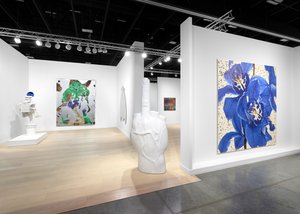
Gagosian’s booth at Art Basel Miami Beach 2024. Artwork, left to right: © Jeff Koons, © Maurizio Cattelan, © Gerhard Richter 2024 (04122024). Photo: Owen Conway
Gagosian’s booth at Art Basel Miami Beach 2024. Video: Pushpin Films
The Summer 2026 issue of Gagosian Quarterly is now available, featuring Ellen Gallagher’s Fast-Fish and Loose-Fish (2026) on the cover.

In this video, Jenny Saville sits down inside her first major exhibition in Venice to discuss how the great Venetian artists of the past and the city’s heritage influence her work. The show brings together more than thirty canvases and works on paper from the 1990s to the present, tracing the development of her practice, which is deeply rooted in the history of painting.
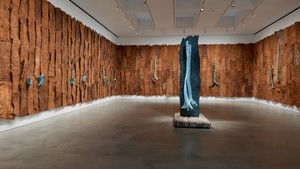
On the occasion of his exhibition The Reflection of Bronze at Gagosian, New York, Giuseppe Penone and curator Adam D. Weinberg sit down to discuss the genesis of, and their collaboration on, the show.
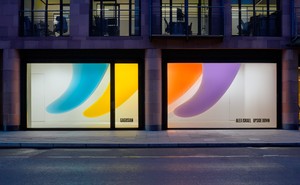
Ahead of Alex Israel’s exhibition of four new Fin sculptures at Gagosian, London, the artist spoke with Susan Casey, author of The Wave: In Pursuit of the Rogues, Freaks, and Giants of the Ocean (2010), about the ocean, surfing, and Los Angeles.
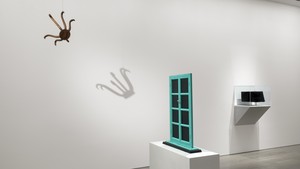
Marcel Duchamp is the inaugural exhibition of the gallery’s new ground-floor space in the historic building at 980 Madison Avenue. In this video, the Quarterly’s Alison McDonald discusses the artist’s most iconic readymades and their connection to New York City.
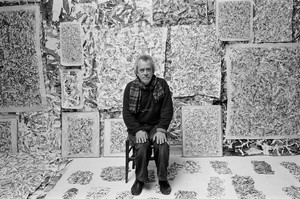
On July 9, Simon Hantaï: the last studio opens at Gagosian, Gstaad. Curated by Anne Baldassari, the show comprises sixteen of the artist’s dernier atelier (last studio) paintings of 1982–85. The exhibition is accompanied by an illustrated catalogue, copublished by Gagosian and Skira, which features an essay by Baldassari and an extensive portfolio of previously unpublished photographs by Édouard Boubat. Here, we share the introductory chapter from the publication.
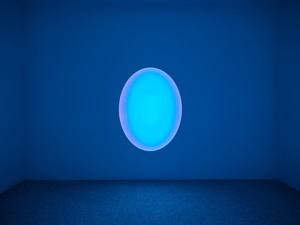
An exhibition at Gagosian, Hong Kong, brings together three of James Turrell’s Glasswork pieces along with site plans, photographs, and models of his Skyspaces and Roden Crater. Here, Alice Godwin explores the history of the Glassworks and their relationship to the artist’s wider practice.

On April 16, the Institute of Contemporary Art, Boston, opened the first midcareer survey of Derrick Adams’s multidisciplinary practice. Covering over twenty years of work, the exhibition, titled View Master, brings together the artist’s painting, sculpture, collage, performance, and video, as well as a vibrant new commission created for the museum’s façade. Ahead of the opening, Adams met with Tessa Bachi Haas, cocurator of the survey, to discuss his formative experiences with television, the impact of his work in arts education on his practice, and the importance of taking a more complex, more joyful, and more expansive approach to Black American life and culture.

Adam D. Weinberg has been working with Giuseppe Penone on an exhibition of the artist’s new sculptures, The Reflection of Bronze, that opens at Gagosian, New York, on April 22. The works explore the character and possibilities of bronze. Here, Weinberg considers Penone’s enduring engagement with the alloy and addresses the conceptual underpinnings of the exhibition’s three-room structure.

Jeff Koons tells Alison McDonald about his appreciation for the pioneering artist and thinker Marcel Duchamp.
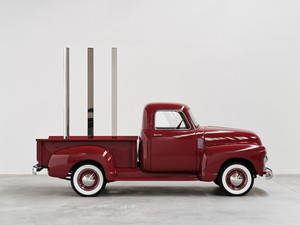
The Singular Experience at Gagosian’s Le Bourget gallery is the largest exhibition of Walter De Maria’s work in France in several decades. Organized by Donna De Salvo, senior adjunct curator at Dia Art Foundation, the exhibition marks the first time De Maria’s final sculpture, Truck Trilogy (2011–17), is being shown outside of the United States. Here, De Salvo speaks with artist Lucy Raven about her evolving kinship with De Maria and more.
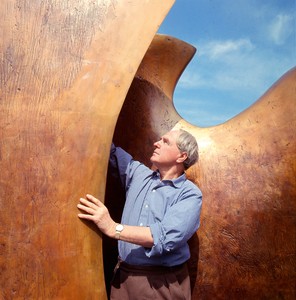
Laura Bruni writes about a major exhibition celebrating the work of the British sculptor Henry Moore at the Royal Botanic Gardens, Kew, London.