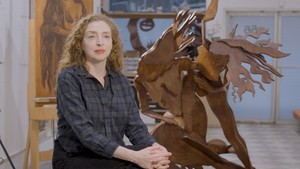
Rachel Feinstein: Mirror
Join Rachel Feinstein in her New York studio as she addresses the genesis of her exhibition Mirror in London and the enduring power of religious iconography.
November 11, 2024
The Bass Museum of Art, Miami Beach, is presenting Rachel Feinstein: The Miami Years (through August 17, 2025), an expansive exhibition of the artist’s multidisciplinary approach to sculpture. Ahead of the opening, Feinstein met with longtime friend and fellow artist Jack Pierson to reminisce about their years spent in Miami.
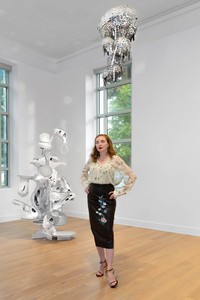
Rachel Feinstein, Miami Beach, Florida, 2024; installation view, Rachel Feinstein: The Miami Years, Bass Museum of Art, Miami Beach, Florida, September 25, 2024–August 17, 2025. Artwork © Rachel Feinstein. Photo: Zaire Aranguren, courtesy Bass Museum of Art
Rachel Feinstein, Miami Beach, Florida, 2024; installation view, Rachel Feinstein: The Miami Years, Bass Museum of Art, Miami Beach, Florida, September 25, 2024–August 17, 2025. Artwork © Rachel Feinstein. Photo: Zaire Aranguren, courtesy Bass Museum of Art
Rachel FeinsteinI want to hear about your connection with Miami. You spent time there when you were younger, right? I want to see if we overlapped.
Jack PiersonI first went there on a Christmas vacation, sometime around ’84.
RFI was there, but I was only thirteen. I was a young artist in the making.
JPI had moved to New York from Boston, where I’d been in art school. Soon after arriving I started working at Patrick Fox Gallery on Bleecker Street. Christmas came around, and I had this friend I was madly in love with. He was loose and free. He did stuff without anxiety—you know, “We should go to Miami for Christmas.” We didn’t have any money, but he had a plan. Do you know of the concept of a “drive-away car”?
RFNo.
JPYou would go to an office in the Empire State Building and find somebody who wanted their car driven down to North Miami for the winter. And they gave you the gas money!
RFWow. Snowbirds—that’s right.
JPYou had seven days to get to Miami. We were still two days late because the whole ride down was completely drug-fueled. Got to Miami Beach, crashed for two days in a little hotel on the beach, delivered the car to North Miami. We had to get the bus back to where we were staying on 1st Street and Washington. I’d been paid all this cash by Patrick Fox, so we thought it was dirt cheap, and it was like $50 a week! You could see the ocean. I think it’s a parking lot for Joe’s Stone Crab now.
RFThat’s amazing. That’s when Miami was wild.
JPAnd we just ended up staying in South Beach. I went to work at Wolfie’s.
RFI remember Wolfie’s: the delicatessen. It had the most amazing lettering. Beautiful, weird, freaky, ’60s or ’70s yellow lettering.
JPNeon letters. It was a classic deli. You got bagels and pickles, sauerkraut. Have as much as you want.
RFYou worked there?
JPYes, and that’s where I got the name Jack, because until that time people called me Jonathan. I was waiting there with my application, and this Cuban queen came up to me and was like, “What’s your name?” I said, “Jonathan.” He was like, “What? Honathan?” And when the manager came over, he said, “This is my friend, you should hire him, his name is Yack” [laughter]. So all of a sudden I was hired there—Jack.
RFJack Pierson. It’s a celebrity name. So how long did you end up staying there?
JPFrom December to May.
RFWhat made you come back?
JPIt started to rain a lot.
RFIt’s a beautiful place from November to early April, and then it’s a monsoon. So where did you end up?
JPI upgraded from busboy at Wolfie’s to waiter at the Olympic Flame Greek restaurant on Lincoln Road, which at that time was a ghost town.
RFI did some modeling jobs on Lincoln Road.
JPPeople would say, “Don’t go on Lincoln Road after dark.” People would warn you.
RFMy dad was a doctor at Mercy Hospital, and my mom was a nurse at South Miami Hospital. My dad was from Brooklyn, and my mom was from upstate, and the plan was that they were going to go to Miami for my dad to do a residency at the University of Miami, and then they were going back to New York. But that was in ’72, and they basically never left. I think that Miami was so fun and free at that time that you just got sucked in. It was incredible.
JPI loved it—it was the best part of my life at that point.
RFI loved it, too. It was so crazy, I miss it. The nightlife at that time! Scarface is all based on that era. There’s a scene in the movie where there’s a shootout, and there’s a weird guy in a fatsuit performing onstage? Those clubs looked like that. They had bizarre performances. There was the guy who was the smallest man in the world—he would come on the stage and do the moonwalk. And then a big topless woman would pick him up and take him off the stage. And then there was a guy who used to wear a G-string, and he had an S&M ball in his mouth. You would get on his back and ride him around the club. I met all those people by going out with the older models after photoshoots. That started around ’85—I was fourteen years old. You left about a year before?
JPI think I was there into ’85.
RFWho knows, we could have seen each other.
JPWe were not going to nightclubs.
RFBecause you had no money?
JPThere was no money, but it was still fun.
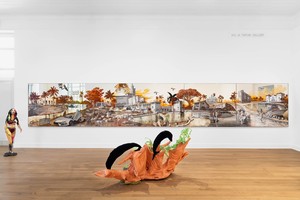
Installation view, Rachel Feinstein: The Miami Years, Bass Museum of Art, Miami Beach, Florida, September 25, 2024–August 17, 2025. Artwork © Rachel Feinstein. Photo: Zaire Aranguren, courtesy Bass Museum of Art
RFYou could get by with nothing. Do you remember the old people who lived in those totally cheap hotels along Ocean Drive? They would be outside all day. I remember going there with the models from the Calvin Klein Obsession ad to go swimming. Everyone would get robbed.
JPRobbed?
RFYeah. You would leave your stuff on the beach, and it would all disappear. When I was a little older, my bag was stolen with my car keys in it. My parents had to drive from South Florida in the middle of the night to give me another set of keys. It’s a good 40-minute drive each way. They were really angry.
That’s how I met Bruce Weber and all those guys. When I was growing up there, my mom and my dad worked all the time, so my grandmother was driving me around. She was a painter. She was the weirdo of the family. She would take me to painting lessons, and one day someone said: “Oh, your granddaughter’s pretty, and she’s tall. She’d be a good model.” So she started taking me to meet people. It was exciting. It was the first time I met people who made a living through being creative and not through medicine.
My whole life was doctors and nurses. Even though my parents are gone now, all their friends, the retired doctors, they’re all coming to my opening in Miami.
JPI can talk about my sciatica.
RFTotally you can. It’s going to be crazy. It’s a homecoming. It’s very emotional. I made this 30-foot mirror painting of the panorama of Miami. I included my parents’ house and the Serpentarium. Did you ever go off Miami Beach?
JPOccasionally.
RFThere was this place, the Serpentarium, that was started by a man who had been bit by so many venomous snakes that his blood was used as antivenom. He would fly to India and give blood for some kid who had been bit by something. Isn’t that crazy?
JPTotally.
RFThis guy started the Serpentarium in Miami. He could have started this anywhere in the world, but he chose Miami because . . . of course. It had a giant cobra and an alligator pit. Miami is very dark. The thing that makes it different is the dark side of nature: the alligators and pythons and this big rotting jungle that eats itself and is continually rebirthing itself.
JPIt’s chthonic.
RFIt’s like a fairy tale. There’s a good side, and there’s a bad side, and you have to be aware of both equally to get it. But LA has been able to retain its frayed edges; Miami is like, “Let’s bulldoze that old house and put up a brand new Mediterranean McMansion.” There’s no past, which makes me sad. They don’t embrace the weirdness as much.
JPDon’t they preserve the hotels and stuff?
RFBut they look fancy now. Our world has become so shiny and bright; it’s hard to maintain that dilapidated funk. Down south of Miami Beach, there’s more of that. Have you ever been to Kampong? It’s a house right on the bay that was built in the early 1900s. It’s the most beautiful organic place.
Did you ever know Robert Miller?
JPWell, do you want to hear the rest of my Miami story?
RFI would love to.
JPOne night I was walking home to the place that was $50 a week by the ocean, and all of a sudden there’s this huge—what’s the thing from Close Encounters of the Third Kind? Like a spaceship lands over the building?
RFI remember that movie.
JPSo there’s a vacant racetrack beyond my building, and as I was walking a spaceship lands on it and fireworks are going off. I’m like, what? I haven’t even smoked pot! And it turns out it was the groundbreaking for this place called South Pointe Towers—
RFWhich is where Robert Miller lived—I went there! Because Peter Miller, Robert Miller’s oldest son, went to college with me.
JPOh, you’re kidding.
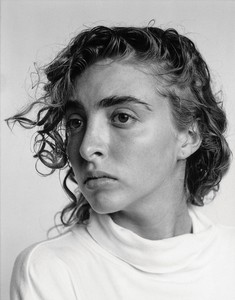
Rachel Feinstein, Miami, 1988. Photo: © Bruce Weber
RFIn 1989, during my first day of freshman orientation at Columbia University, this guy comes up to me and says: “Bruce Weber told me to look out for you. He said that there’s a girl that’s starting as a freshman like I am, and she’s a model.” But then he goes, “You don’t look like a model.” That was how I met Peter. Did you ever go to Robert Miller’s huge penthouse on South Beach?
JPWell, it’s a long story. I went with the artist Roberto Juarez to an opening at Miller Gallery on 57th Street—Miller was to me the chicest gallery that ever was—and he introduced me to Bob. I couldn’t believe it. But here’s the catch: Why were they so enthusiastic about me? At that time I had just started doing two-bit porno for money, taking the pictures. And this was fascinating to them, obviously, so I started getting invites. We became friendly, and he wanted to check out Miami. “I’ve been hearing about Miami. Would you come down, da da da, show us around?” So we go.
It’s been three years since I was in Miami at that point, and the big South Pointe Tower is being built. It was gross. Super-postmodern. But Bob makes an appointment, and we go to look at the penthouse together. Bob is like: “Could anything be done to make this cool? What about you? What are you doing in November?” So I became an interior designer.
RFThat’s amazing. I spent time there.
JPBob was divine to me. Everybody thought we were lovers—we weren’t. He just let me do whatever I wanted. I painted walls Day-Glo. I lined the whole downstairs area with coral from the beach—which was, I’m sure, wildly illegal.
So next, Bruce Weber comes over. He’s like, “Bob, who styled this place for you?” And I was like, “What do you mean ‘styled’?”
RF“I just lived here and did cool shit.”
JPHe was like, “Well, who painted that wall hot pink and put the big bowl of grapefruit in front of it?” And I was like, “Me.” And he said: “Bob, could I do a shoot here in January? And could you do even more?” So we do all this stuff, he comes in January, does the shoot. Grace Coddington is there from American Vogue, and I say to her, “Oh, you’re in charge of ironing the clothes and stuff?” [Laughs] I was trying to be all friendly. She was like, “Eh?”
RFI love this. That was not the right thing to say to Grace.
JPAt the end of the day he hands me $300 and says, “Will this be enough?” And I’m like, are you kidding me? But more importantly there were three pages of still lifes in the article. I was studio mates with this guy, Todd Eberle, back then. I always owed him money, so he was like: “You had three pages of Bruce Weber Vogue pictures. You can be a prop stylist.” I was like, “What?” But I did. I became a prop stylist for a minute.
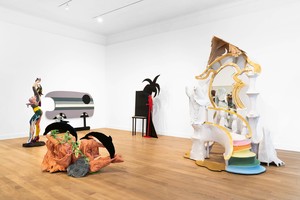
Installation view, Rachel Feinstein: The Miami Years, Bass Museum of Art, Miami Beach, Florida, September 25, 2024–August 17, 2025. Artwork © Rachel Feinstein. Photo: Zaire Aranguren, courtesy Bass Museum of Art
RFAll these people have been part of our lives at different times. They’re all connected. We didn’t come from anything in terms of this connection to art and to style and to chicness and to a Day-Glo wall. But you realize that somehow just having that in your eyes, knowing what looks right, connects you to this special tribe of people from all over the place.
There’s this Diane Arbus photo of a little girl and her brother called Girl in a watch cap, N.Y.C. [1965]. The brother isn’t aware of what’s going on, but the little girl is looking at Diane, and it’s like two witches recognizing each other. I don’t remember the scenario, but I remember the look of this girl and the idea that, as an artist, you just see another person and you know. Art is a strange thing. It’s a witch thing. You are born with it, and you have to go with it. You let whatever takes you take you.
My parents did not want me to be an artist. When I was like, “I’m going to apply to RISD,” they were like, “We’re not paying.” My dad was a first-generation American.
JPFrom where?
RFHis family was from Vilnius and Kiev. He was born here; his father came over when he was a little boy, but it’s kind of murky, my family history. He grew up with old men with long beards going to the 10th Street baths who spoke only Yiddish. That’s very Miami Beach.
JPThat book The Joys of Yiddish used to be everywhere. I haven’t seen it in years.
RFIt’s so true. My parents had a copy. It’s funny how Miami has always had this connection to New York Jews. My dad, after he did his residency in dermatology, became a skin cancer expert—
JPGood place to do that.
RF—and guess who his clients were? Manuel Noriega and Julio Iglesias. And it was all cash in those days. Everyone would come with these briefcases. It was wild. I worked for him sometimes during the summers. I worked at restaurants, but I never worked in Miami Beach. I tried out for Hooters [laughs] in high school thinking I’d make a lot of money. I showed up for training wearing the Hooters shirt, and I asked one of girls, “How much do you actually, really make?” She goes, “Like $60 a day.” I was like, “I’m out of here!” I was already modeling at that point. I wasn’t going to wear this stupid shirt for that.
So I came to New York in ’89 and on the first day met Peter Miller—but then I was also mugged. My parents gave me some money, and I think someone was watching all the dumb new freshman idiots. When my parents got in a cab to the airport, a guy came up behind me, pushed me down on the ground, pulled my bag off my shoulder, and took my bag.
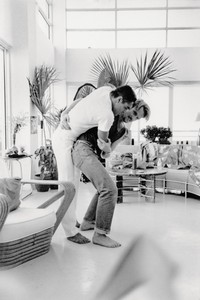
Rickson Gracie and Jack Pierson, Miami Beach, Florida, 1989. Photo: courtesy Jack Pierson
JPWell, welcome to the city.
RFYeah, in broad daylight. But I would go back to Miami all the time. There’s this street that my parents lived off of that has these incredible banyan trees. They’re so enormous that they have to cut their canopy down all the time to make a tunnel for the cars. And it’s so dark. It’s the middle of the day, but you’re in darkness. I have these dreams about going down this road, because when you’re closing your eyes it kind of feels like you’re going into your own unconscious, just like going down this road.
JPI haven’t been back in a long time. I sort of resented the boom.
RFYeah, I’m with you on that. The whole point of Miami was that it was undiscovered, and now that’s not the case, although there’s Kampong and there are certain areas. Do you remember the Coral Castle?
JPYeah.
RFI was up for Billy Idol’s “Sweet Sixteen” music video when I was sixteen, which was going to be filmed at the Coral Castle. I didn’t get it—I made it to the last two—and he ended up not doing it at all, but obviously someone knew about these places.
JPWell, Miami Vice was peaking.
RFI was on Miami Vice twice, because at that time it was what was happening! Don Johnson tried to hit on me! Around that time, I had a friend who got hired by some drug lord to go underneath a boat and remove some shit that had been welded. He got arrested in the middle of it, but the police said, “If you just tell us who hired you, we’re not after you.” That night, when he was in jail, someone came and let him know: “We know exactly where your sister goes to school.” He did the time, and I never saw him again.
JPDid you watch the miniseries recently about the woman who took over Miami? Griselda.
RFIs it any good?
JPNo, but you do see Miami in those days. The art direction is really good.
RFThere was the series about the murder of Gianni Versace. That was the craziest story. He moved there after I’d left, so I never met him, but I remember they said, “He had gone to get a coffee at News Cafe.” That’s what everyone would do.
JPAnd I remember thinking, Oh, even News Cafe is over.
RFIt is, you’re right.
JPYet at the same time, in ’86 or ’87, there was all this boosterism. Which was like, nice try, but it’s not going to happen. “We’re going to open an arts center on Lincoln Road.” “Oh good, how fun…”
RFAnd now Miami is an Art Mecca. I have this conversation in my family, because my husband, John, is not from a warm place—he’s from Connecticut. There’s this idea that different cultures come out of cold places and hot places. Hot places are about living for the moment: Let’s have sex, drink a lot, take a siesta. But colder places are all about, “We’re going to make our stamp on the world because we’re going to die and we want our stuff to be there after we die.” You know what I mean? And so whenever people say, “Miami is this amazing culture.” I’m like, “No, it’s not!” [Laughs] And it’s such a weird idea that, because of the heat and the bodies and the weird fakeness of it, I distrust this idea that Miami is a “cultural mecca.”
JPI don’t think it’s a cultural mecca…
RFI just doubt the validity of a hot place having culture. I’m sorry, I’m going to put it out there. Why can’t it just be a fun place? Why does it have to be a fucking cultural mecca? I think that embracing the roughness on the edges is better.
Rachel Feinstein: The Miami Years, The Bass Museum of Art, Miami Beach, Florida, September 25, 2024–August 17, 2025
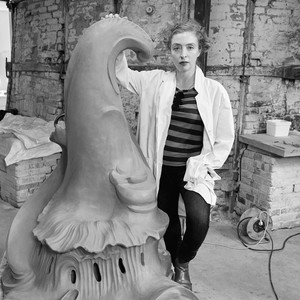
In richly detailed sculptures and multipart installations, Rachel Feinstein investigates and challenges the concept of luxury as expressed in eighteenth- and nineteenth-century Europe, in the context of contemporary parallels. By synthesizing visual and societal opposites such as romance and pornography, elegance and kitsch, and the marvelous and the banal, she explores issues of taste and desire. Photo: Markus Jans, Architectural Digest © Condé Nast
Join Rachel Feinstein in her New York studio as she addresses the genesis of her exhibition Mirror in London and the enduring power of religious iconography.
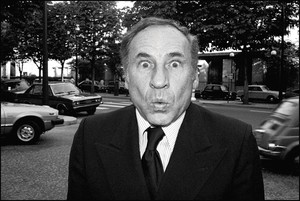
Famed photographer of the famous, Jean Pigozzi speaks with artist Rachel Feinstein about the publication of his new book, The 213 Most Important Men in My Life, and provides a sneak peek at what’s coming up next.
The Summer 2021 issue of Gagosian Quarterly is now available, featuring Carrie Mae Weems’s The Louvre (2006) on its cover.
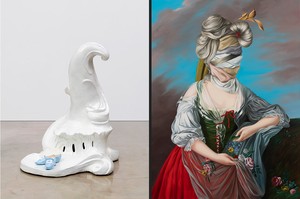
On the occasion of Frieze New York 2021, the two artists discuss remixing conventions, the allure of Rococo, and the importance of research and history within their respective practices.
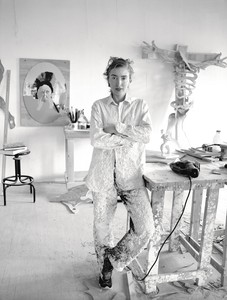
The artist discusses her life and work with Alan Yentob.
The Winter 2019 issue of Gagosian Quarterly is now available, featuring a selection from Christopher Wool’s Westtexaspsychosculpture series on its cover.
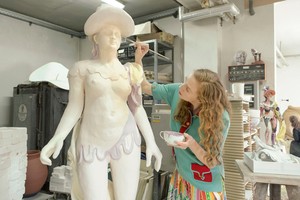
A new sculpture by Rachel Feinstein has been unveiled on the grounds of Chatsworth, the celebrated Derbyshire estate, where Feinstein recently spent time as Gucci’s inaugural artist in residence. Alice Godwin tells the story of how it came to be.
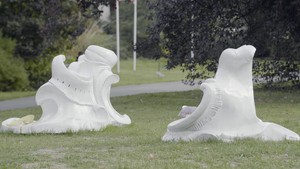
Rachel Feinstein speaks about her outdoor installation for Frieze Sculpture 2018—a set of four majolica sculptures, inspired by Franz Anton Bustelli’s Rococo commedia dell’arte figurines.
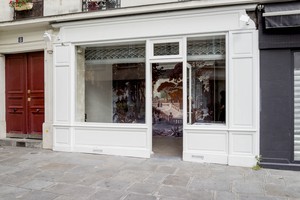
Rachel Feinstein speaks to Gagosian’s Angela Brown about “bringing Rome to Paris,” for her exhibition at Le Mur.
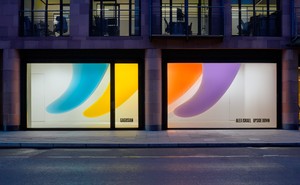
Ahead of Alex Israel’s exhibition of four new Fin sculptures at Gagosian, London, the artist spoke with Susan Casey, author of The Wave: In Pursuit of the Rogues, Freaks, and Giants of the Ocean (2010), about the ocean, surfing, and Los Angeles.

On April 16, the Institute of Contemporary Art, Boston, opened the first midcareer survey of Derrick Adams’s multidisciplinary practice. Covering over twenty years of work, the exhibition, titled View Master, brings together the artist’s painting, sculpture, collage, performance, and video, as well as a vibrant new commission created for the museum’s façade. Ahead of the opening, Adams met with Tessa Bachi Haas, cocurator of the survey, to discuss his formative experiences with television, the impact of his work in arts education on his practice, and the importance of taking a more complex, more joyful, and more expansive approach to Black American life and culture.

Jeff Koons tells Alison McDonald about his appreciation for the pioneering artist and thinker Marcel Duchamp.