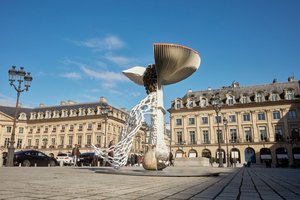
As a part of Art Basel Paris’s public programming, Gagosian is presenting a new large-scale sculpture by Carsten Höller at Place Vendôme in Paris.

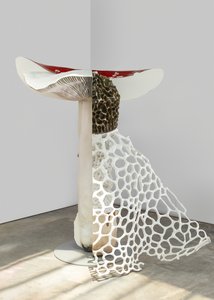
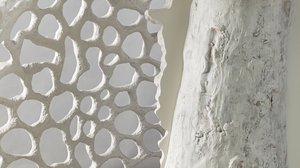
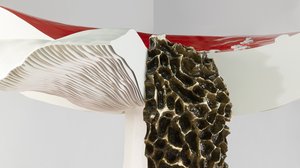
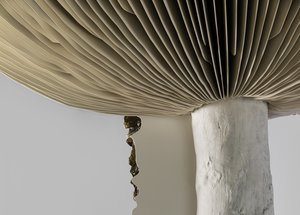
Giant Triple Mushroom (2024) combines enlarged cross-sectional segments of three different wild mushroom species into a single hybrid form. Three meters (almost ten feet) in height, the work features the bright red cap of Amanita muscaria (fly agaric), the distinctive netlike “skirt” of the Phallus indusiatus (long net stinkhorn), and the ribbed gills of Tricholoma columbetta (dove-colored tricholoma). Represented at a grand scale, the complex structures and biological functions of these mushrooms are monumentalized within the public site of Place Vendôme.

Large-scale sculpture of a mushroom installed in a plaza in Paris

Carsten Höller, Giant Triple Mushroom, 2024, installation view, Place Vendôme, Paris © Carsten Höller. Photo: Pierre Björk

<p data-block-key="lj0ni"><i>Giant Triple Mushroom</i>, 2024</p>

Carsten Höller

Giant Triple Mushroom, 2024

(Fly agaric / Long Net Stinkhorn / Dove-coloured Tricholoma)
Aluminum, stainless steel, and paint
118 ⅛ × 116 ⅛ × 94 ½ inches (300 × 295 × 240 cm)

For a long time, I’ve been curious about applying the methodology of art as one way—which I think is equal to science and other powerful explanatory concepts—for us to understand what is surrounding us and what we are.

—Carsten Höller

Carsten Höller discusses Giant Triple Mushroom (2024). Artwork © Carsten Höller. Video: Pushpin Films

Höller’s use of mushrooms as subject stems from his background as a scientist; he has a doctorate in agricultural science, having conducted research in entomology before devoting himself to producing art. Frequently incorporating or depicting animals, plants, and fungi, his sculptures and environments draw from the aesthetics and concepts of scientific inquiry while also foregrounding illogic and perplexity.

As an artist, Höller conducts radical experiments that invite exploration and conceptual play. Many of his projects, which include twisting slides and vision-flipping goggles, form part of a self-named “laboratory of doubt” that facilitates disorientating and even hallucinatory experiences. His objects and environments sometimes impose a temporary loss of control on participants, prompting them to question how they perceive and comprehend the world around them.

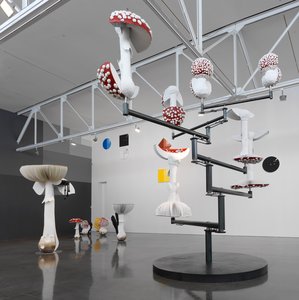
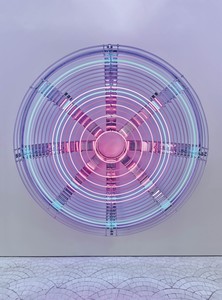
Installation view, Carsten Höller: Reason, Gagosian, 555 West 24th Street, New York, June 20–September 1, 2017. Artwork © Carsten Höller. Photo: Rob McKeever

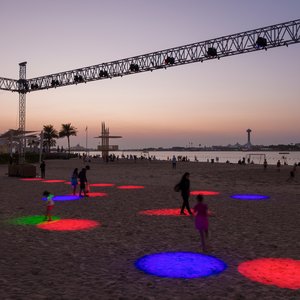
Carsten Höller, Abu Dhabi Dots, 2023 © Carsten Höller. Photo: Colin Robertson

Scaled up, Giant Triple Mushroom towers over viewers, prompting curiosity and drawing attention to a category of life that is both essential to the ecosystem and quite foreign to human experience. The sculpture resembles a scientific model or museum diorama in its anatomical accuracy, although Höller’s collage-like segmentation and conglomeration of multiple species into a single form is not found in nature.

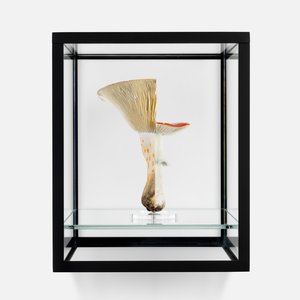
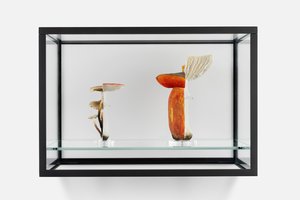
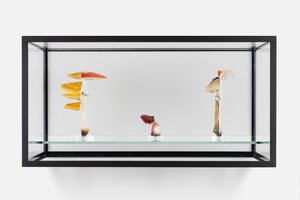
Höller has been making Giant Triple Mushroom sculptures since 2009, and each work in the series is unique, though some components remain constant. Amanita muscaria constitutes half of each sculpture, while the remaining two quarters are composed of two other mushroom species. The variety of Höller’s treatment of the subject may be seen in his related Double Mushroom vitrine works, sculptural montages that combine species of mushrooms in detailed representations realized by casting them at life-size scale. Each iteration includes a section of the fly agaric at a different growth stage—from budding to mature and worm-eaten—which determines the height of the entire sculpture.

I start with a formula to get a process going, then the formula takes over and continues into infinity on its own. It is not about creative decisions anymore; there is no choice, only reason.

—Carsten Höller

Installation view, Carsten Höller: Soma, Hamburger Bahnhof–Museum für Gegenwart, Berlin, November 5, 2010–February 6, 2011. Artwork © Carsten Höller. Photo: bpk Bildagentur/Hamburger Bahnhof–Museum für Gegenwart/David von Becker/Art Resource, New York

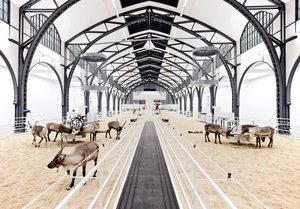
Whereas the other two species in Giant Triple Mushroom are edible, Amanita muscaria is toxic, and, at smaller doses, psychotropic. The artist’s interest in this particular mushroom lies in its cultural, historical, religious, and spiritual importance; its psychoactive hallucinogenic properties; and its alluring appearance. In 2010, Höller staged Soma at Hamburger Bahnhof, Berlin—an elaborate installation that included living reindeer, some of which were fed this type of mushroom, which historians have linked to soma, a ritual drink described in the Rig Veda, an ancient Indian religious text.

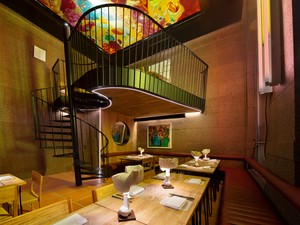
Carsten Höller’s The Double Club Los Angeles, Luna Luna, Los Angeles, March 7–10, 2024. Artwork © Carsten Höller

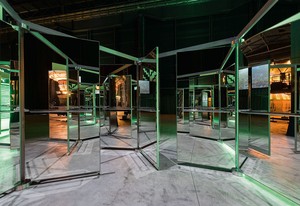
Carsten Höller, Revolving Doors, 2004/2016 © Carsten Höller. Photo: Rob McKeever

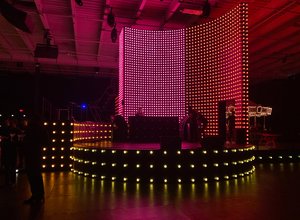
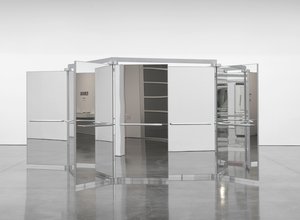
Höller’s division and reassembly of mushroom species recall strategies he has employed in other experiential projects. In different iterations of The Double Club (2008–09/2018/2024), the spaces’ interiors, music, food, and drink were all distinctly divided in various ways. The Revolving Doors (2004/2016) installation is constructed of five sets of three-winged mirrored pivoting doors that engulf the visitor in moving reflections.

Giant Triple Mushroom is in accord with Höller’s desire to explore realms that are outside the range of ordinary experience and understanding. As he explains, “My works inspired by plants and other living organisms have to do with our perception of these different forms of life. For example, mushrooms’ life is almost incomprehensible to us. Sometimes we have to surrender to doubt.”

Related Works

<p data-block-key="vco0b"><i>Double Mushroom Vitrine (Once)</i>, 2021</p>

Carsten Höller

Double Mushroom Vitrine (Once), 2021

Polyurethane, acrylic paint, glass, metal, and powder-coated metal

12 ¼ × 10 ¼ × 10 ¼ inches (31 × 26 × 26 cm)

<p data-block-key="dgo19"><i>Double Mushroom Vitrine (Twice)</i>, 2021</p>

Carsten Höller

Double Mushroom Vitrine (Twice), 2021

Polyurethane, acrylic paint, glass, metal, and powder-coated metal

12 ¼ × 18 × 10 ¼ inches (31 × 45.5 × 26 cm)

<p data-block-key="uynmn"><i>Double Mushroom Vitrine (Threefold)</i>, 2021</p>

Carsten Höller

Double Mushroom Vitrine (Threefold), 2021

Polyurethane, acrylic paint, glass, metal, and powder-coated metal

12 ¼ × 23 ⅝ × 10 ¼ inches (31 × 60 × 26 cm)

Carsten Höller: Giant Triple Mushroom

Carsten Höller: Giant Triple Mushroom

As part of Art Basel Paris’s public programming, Gagosian presented a new large-scale sculpture by Carsten Höller at Place Vendôme. In this video, the artist sits down to discuss the genesis of the work, Giant Triple Mushroom (2024).

Around and Around and Around: Federico Campagna and Carsten Höller

Around and Around and Around: Federico Campagna and Carsten Höller

Philosopher Federico Campagna and artist Carsten Höller came together, on the heels of Höller’s exhibition Clocks in Paris, to consider the measurement of time, the problem with fun, and the fine line between mysticism and nihilism.

Brutalisten: An Interview with Carsten Höller

Brutalisten: An Interview with Carsten Höller

This spring, Carsten Höller launched Brutalisten, a new restaurant concept in Stockholm and the latest embodiment of his long-term culinary and artistic project called the Brutalist Kitchen. The twenty-eight-seat restaurant features a menu overseen by chef Stefan Eriksson that adheres to three classifications: “semi-brutalist” dishes (using oil or minimal ingredients), “brutalist” dishes (using salt and water), and “orthodox-brutalist” dishes (no additional ingredients). For the Quarterly, Höller speaks with Gagosian directors Serena Cattaneo Adorno and Mark Francis about this terminology, the importance of experimentation, and the fortuitous side effects of brutalist cuisine.

Carsten Höller

Carsten Höller

Daniel Birnbaum speaks with the artist about the “unsaturated” in his work.

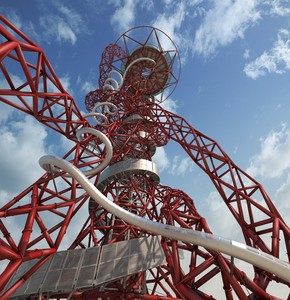
Carsten Höller’s ArcelorMittal Orbit Slide

Carsten Höller’s ArcelorMittal Orbit Slide

Carsten Höller talks with Derek Blasberg about his lifelong obsession with slides, the reactions that he intends from his creations, and the concept of fun.

Gagosian Quarterly Summer 2026

Now available
Gagosian Quarterly Summer 2026

The Summer 2026 issue of Gagosian Quarterly is now available, featuring Ellen Gallagher’s Fast-Fish and Loose-Fish (2026) on the cover.

Jenny Saville a Ca’ Pesaro

Jenny Saville a Ca’ Pesaro

In this video, Jenny Saville sits down inside her first major exhibition in Venice to discuss how the great Venetian artists of the past and the city’s heritage influence her work. The show brings together more than thirty canvases and works on paper from the 1990s to the present, tracing the development of her practice, which is deeply rooted in the history of painting.

Francis Bacon: Reinventing Realism

Francis Bacon: Reinventing Realism

Francis Bacon lived and worked in Paris for a decade starting in the mid-1970s. The city and the art he encountered there provided a profound backdrop for his austere late style, which often brings together smooth, colorful backgrounds, spare architectural signifiers, and sculptural human forms. Here, three striking paintings from that period are considered by Sebastian Smee.

James Turrell: Lifting the Veil

James Turrell: Lifting the Veil

An exhibition at Gagosian, Hong Kong, brings together three of James Turrell’s Glasswork pieces along with site plans, photographs, and models of his Skyspaces and Roden Crater. Here, Alice Godwin explores the history of the Glassworks and their relationship to the artist’s wider practice.

Divine Emanations: Nymphs, Poets, and the Painter’s Palette

Divine Emanations: Nymphs, Poets, and the Painter’s Palette

Janne Sirén considers Anselm Kiefer’s new paintings, the subject of an exhibition at Gagosian, New York, entitled Seal My Ears Shut and I Shall Hear You Still.

Derrick Adams: View Master

Derrick Adams: View Master

On April 16, the Institute of Contemporary Art, Boston, opened the first midcareer survey of Derrick Adams’s multidisciplinary practice. Covering over twenty years of work, the exhibition, titled View Master, brings together the artist’s painting, sculpture, collage, performance, and video, as well as a vibrant new commission created for the museum’s façade. Ahead of the opening, Adams met with Tessa Bachi Haas, cocurator of the survey, to discuss his formative experiences with television, the impact of his work in arts education on his practice, and the importance of taking a more complex, more joyful, and more expansive approach to Black American life and culture.
Giuseppe Penone: The Reflection of Bronze

Giuseppe Penone: The Reflection of Bronze

Adam D. Weinberg has been working with Giuseppe Penone on an exhibition of the artist’s new sculptures, The Reflection of Bronze, that opens at Gagosian, New York, on April 22. The works explore the character and possibilities of bronze. Here, Weinberg considers Penone’s enduring engagement with the alloy and addresses the conceptual underpinnings of the exhibition’s three-room structure.