Simon Hantaï’s last studio has emerged as a modern myth.
In 1982, Simon Hantaï made the decision to break with the art market and museum institutions. At the time he had begun to enjoy international recognition and was the dominant figure on the French art scene. In order to be free of all expectations and pressure, he also announced that he had stopped, or had to stop painting. From this point onward, he lived in voluntary seclusion in Paris or Meun, devoting himself exclusively to philosophical reading and “watching the grass grow.”
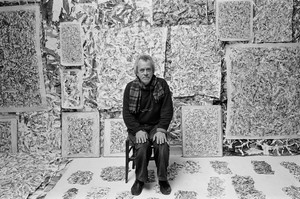
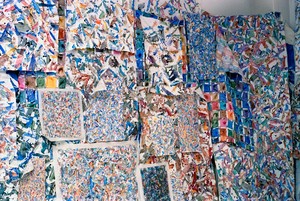
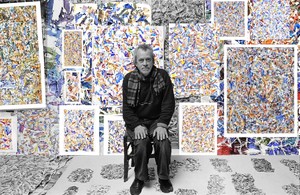
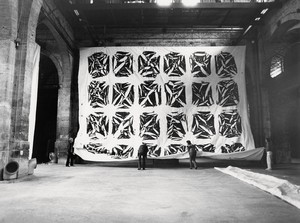
And yet, shortly after that, he would get his very occasional visitors to go up to the second floor of his house on the rue Georges Braque, where they were astonished to discover a massive accumulation of new paintings. Dozens of pliages stacked or in rows on the floor plus a good many paintings hung on the studio walls were either in progress or drying. In the powerful light streaming through the south-facing window, the kaleidoscopic polychromy of these paintings piled several layers thick filled the space with a powerful presence.
Quite apart from the significance of this pictorial project, it seems that the development of this composite installation was of particular interest to the painter. Over the following decade, this “studio in progress” was being continuously transformed by the addition of new paintings to its paintings. Whether substantial or slight, these changes bore witness to an active process that neither ebbed nor faded. The studio was alive, the painter still working. Painting was getting painted.
This body of paintings exceeds in volume the major series of pliages undertaken by Hantaï between 1960 and 1982. Indeed, the initial inventory of the last studio includes a significant number of paintings whose nature and place within his corpus have, until now, remained unclear.
In fact, the deliberate opposition maintained by the painter between his irrepressible urge to paint and the restrictive rules he imposed on himself resulted in a persistent obscuring of the work from this period, preventing any recognition from critics or museums.
The term dernier atelier (last studio) first appeared in a text about the painter published in 1992. This referred to the artistic approach Hantaï had adopted over the previous decade, and specifically since the summer of 1982, when he withdrew from public life. It should be noted that this 1992 publication benefited from the painter’s contribution and approval. He reviewed the manuscript, authorized the mention of the paradoxical existence of the last studio, and specifically suggested reproducing a photograph of the hanging taken by Édouard Boubat in 1985. 1
The only anomaly is that we can find no trace or mention of his œuvre au noir.
If Hantaï later chose to publicly acknowledge the very conceptual authorship of the works titled Sérigraphies (1981–96), Laissées (1994–95), Suaires (2000–01), H.b.l./Hebhel/Buées (2004–08), this was because they constitute a distanced commentary (in the Brechtian sense of that adjective) on the principle of “folding as method.” In these different works the painter examines the distortions of form and meaning undergone by folding during the optical or technical transfers involved in its photographic and digital reproduction. These works constitute the terms of a methodological commentary on the trace-of-the-trace-of-the-trace left by folding.
The installation of the last studio would remain in place for some twenty years, even if it was partially altered when the painter took it down and rehung it in the late 1990s. In June 2008, a few months before his death in September, he mentioned the temptation he felt at the time to destroy the entire hanging: “[...] I took several large canvases down from the wall—they’d been hanging one on top of the other for fifteen or twenty years—and tore them to pieces. Useless. But I found a 10-centimeter one for my archives. [...] I took down more paintings, ones I hadn’t seen in fifteen years. I might not keep any of them.”2
Ultimately, however, as confirmed by the identification work carried out in the course of writing this book, Hantaï seems to have kept these paintings from the last studio in his possession. This was exceptional. By this act of retention, the painter demonstrated a strong attachment to these atypical paintings, granting them a key role in understanding the structural links between the work of his earlier period (1960–82) and that of his final period (1982–2008).
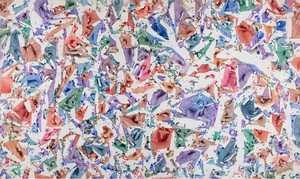
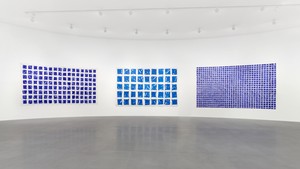
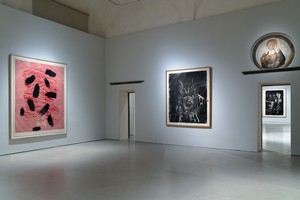
It was not until the exhibition celebrating the centenary of the painter’s birth, held in 2022, that these singular paintings were revealed to the public. This featured five monumental dripped pliages and some thirty small paintings stapled together, in the manner favored by Hantaï. In the exhibition, this visually disruptive ensemble, overwhelming in its tactile polychromy, concluded a masterful sequence of major historical series of pliages. 3
The present book, published on the occasion of an exhibition specifically dedicated to Simon Hantaï’s last studio, addresses this subject for the first time in over forty years. 4
The iconic photographs taken by Édouard Boubat in 1985 at Hantaï’s request constitute the only visual record of the artist’s last studio as it was originally conceived and convey its artistic dimension.
By using these photographs as a guide for our investigation and comparing them with the paintings from the painter’s studio, I have attempted to reconstruct the creative context of this vanished world.
The study and presentation of Boubat’s photographs, which form the guiding thread of this research, are especially important. Indeed, beyond the aesthetic evocation of the hanging, these photographs provide tangible evidence of an unreproduced pictorial cycle and make it possible both to reconstruct the display strategies favored by the painter and to identify the paintings hung in that space at that time.
Identifying the works appearing in Boubat’s photographs is all the more vital in that a significant number of these paintings are neither signed nor dated. It is therefore their clear presence in Boubat’s photographs that establishes their authenticity, their date of creation, and their place within the pictorial series to which they belong. It would seem that the painter thus entrusted these photographs with the power to objectify, bring together, catalogue, and even “sign” his works. For this to happen, there needed to be a long-established understanding governing the relationship between the painter and the photographer. The history of this relationship, and the work they did together, forms the thread of the text that follows.
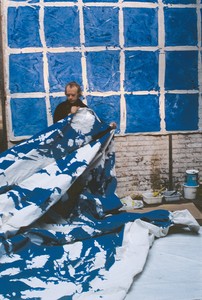
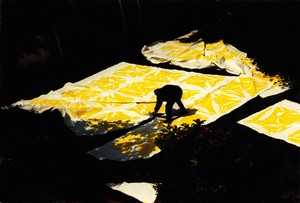
The broader question of the nature and role played by his successive studios in the painter’s work is worth dwelling on. Since Boubat was the only photographer to have taken pictures of Hantaï’s studios between 1967 and 1985, it seems essential to place the photographs of the last studio within the dynamics of their collaboration.
With the invention of the last studio, the intertwined works of Hantaï and Boubat—painting and photography side by side—resonate in unison to produce a sort of pictorial-photographic stratagem whose enigma we must now attempt to unravel. Thus, this investigation into Hantaï’s last studio—a blind spot in his painting because of its secretive nature—turns out to serve as a lever, of an eminently heuristic kind, that can reinitiate research into his life and work.
The studio is the place where Hantaï resides.
When Zsuzsa, his wife, recalls that the painter “lived within his painting,” she is not referring just to its mental, imaginary, or reflective dimension, but also to its spatial materiality. 5 This text seeks to re-establish Simon Hantaï’s studio—a studio-world, a closed space, a closed room where a scene of a singular nature is played out: the advent of painting.