
Alex Israel: Noir
Sam Wasson brings his deep knowledge of cinema, Hollywood, and film noir to Alex Israel’s new paintings of Los Angeles.
June 29, 2026
Ahead of Alex Israel’s exhibition of four new Fin sculptures at Gagosian, London, the artist spoke with Susan Casey, author of The Wave: In Pursuit of the Rogues, Freaks, and Giants of the Ocean (2010), about the ocean, surfing, and Los Angeles.
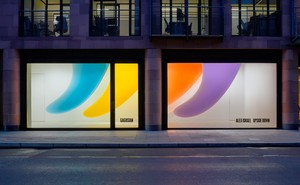
Installation view, Alex Israel: Upside Down, Gagosian, Davies Street, London, June 12–September 5, 2026. Photo: Prudence Cuming Associates Ltd
Installation view, Alex Israel: Upside Down, Gagosian, Davies Street, London, June 12–September 5, 2026. Photo: Prudence Cuming Associates Ltd
Like a wave, Los Angeles is a communicated agitation. It is energy in motion—the current of its culture passing through the medium of a city. Its flow never stops, and it’s never the same, and paradoxically it’s both an object and a field of constant, surging interactions. It’s a rush of actions, symbols, ideas, visions. Los Angeles is always inhaling and exhaling, rising and falling and rising, roiled and restored—and nobody surfs its epic wave as expertly as multidisciplinary artist Alex Israel. It’s as if the city pulses through his own bloodstream.
Israel was raised on Los Angeles’s Westside and has spent much of his adulthood in Malibu, with the beaches in his front yard, the Hollywood sign like a sentinel in his back yard, and Warner Bros. across town, where in his late twenties he would begin working with the studio’s scenic art department on fabrications, including for his Sky Backdrop and Flat paintings. His work romps widely across media—sculpture, painting, film, video, writing, AI, product design, a fragrance collaboration with Louis Vuitton—spanning the galaxies of art, fashion, cinema, television, sport, publishing, and tech. Israel’s is a dynamic, streamlined vision of LA iconography with an edgier note of nostalgia, one that evokes the past and the future simultaneously, without sentimentality. Endless summer, beach freedom, movie magic: We still yearn for these things, after all, even as we reimagine them over time.
On the eve of Israel’s Upside Down exhibition in London—a new iteration of the Fin series he debuted in Rome in 2023—it seemed like an ideal time to drop in on him for some conversation about optimism, marine influences, the aesthetics of surfing, and the Southern California dream.
Susan CaseyI grew up in steely gray Toronto, far from the LA magic that you convey so beautifully. But I relate to the dream just like everybody else, because California transcends geography.
Alex IsraelI always ask people what it was exactly that motivated them to move here, because obviously except for us natives, everyone who lives in LA moved here. People, at least of my generation, usually had some televisual or cinematic reference point or impetus. Maybe they watched Baywatch, or Beverly Hills 90210, or—I don’t know—the movie Clueless.
SCDefinitely, California has imprinted on our emotions for so many reasons over such a long period of time. Immersing myself in your work, I felt a sense of pure stoke. That’s of course a surfing term but there’s joy and curiosity in it, too.
AIYes, and I think there’s also desire in it—a desire to be a part of the history and the narrative and the myth. In my work I make it a point to celebrate some of the people who have contributed to the fabric of LA culture, who’ve inspired my work and my life. That’s my dream—to join those ranks. And I guess that’s the whole purpose of my art practice. My work comes from a position of reverence, and carries within it this desire to be a part of something bigger.
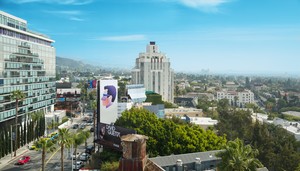
Alex Israel, Self-Portrait, 2013, Sunset Strip billboard, Los Angeles
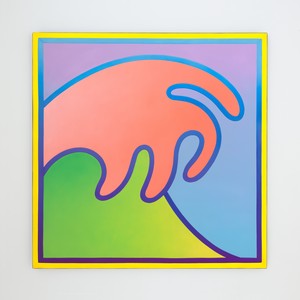
Alex Israel, Wave, 2018, acrylic on fiberglass, 96 ½ × 96 ½ inches (245.1 × 245.1 cm), Art Gallery of Western Australia, Perth
The first time I saw Los Angeles from the air, that’s what stunned me: its bigness. Its vast, sprawling size. Coming in for a night landing, there seemed to be no place where its constellation of lights stopped, and every light felt alive. The Pacific was there, but invisible. This city was a constructed creature, an ocean unto itself. In the sunlight, its character was different—exploding with tone and texture—and it did seem as though a surfboard was a better vehicle to navigate your perceptions of it all than a car, which would only pin you to the blacktop as everything streamed by in six dimensions.
Anyone who rides the energy of Los Angeles successfully carves their own line. Israel is a fan of the acclaimed writer Joan Didion—he named his online talk show As It Lays after one of her books—whose 1960s- and 1970s-era Southern California insights have become totemic. But in Didion’s view, California is precarious. It’s a land of “dusty palms” and “intention gone haywire,” and dogs that “may be coyotes.”1 She fixated on LA’s “weather of catastrophe, of apocalypse,” and the “violence and unpredictability” of the Santa Ana winds.2 This is not Alex Israel’s California. Like Didion, Israel observes precisely and creates with crystalline clarity but through his lens, rather than simmering menace and hillsides about to burst into flame, you see the kaleidoscopic allure of the place. You see its golden quality.
SCWhen I look at a lot of your work, I feel happy. This is a world I want to spend more time in. It’s got optimism, it’s got movement and color, and the color particularly, it’s got all these different dimensions. I think we could use more of that optimism in the world these days.
AII guess I’m an optimistic person. Certainly there are other ways of seeing LA and thinking about it. There’s cynicism, which runs rampant through its culture, and there are people who choose to see the darkness in it. I definitely observe and acknowledge those perspectives. They’re there; they give our city character. But I do believe that invention is the way forward. And ultimately, optimism is the gateway.
SCThat dark aspect of LA—that’s something you haven’t focused on to date, as far as I can tell.
AII’m continuing to work on a series of paintings inspired by LA noir. Of course, noir is dark in tone, but I love that it’s a pure Hollywood invention, created at Warner Bros. on the same back lot where we make my paintings. The back lot is a magical place, and my paintings lean more toward a kind of fantastical cinematic magic than, say, getting trapped in some spider woman’s web.
SCI adore your noir paintings, the ones I’ve seen. They’re like jewels. I want to use a word and I hope it doesn’t sound trite, but there’s love in there. You love your muse.
AII do. They’re rooted in love, you’re absolutely correct. There’s this question that always comes up around my work: Is it critical? Is it a critique of Hollywood? Of mainstream culture? Of the tropes of social media, et cetera, et cetera? Because a lot of people look to artists expecting a critical point of view. They want artists to take on this moralizing role, to be the purveyors of the truth that pop culture manipulates us and is constantly sucking us further into its spectacular capitalist plot. That’s how a lot of the art that I grew up looking at functions.
But at some point in the last few decades, we got to a place where there’s no curtain left to peel back. Now we all know how culture works. We know that movies manipulate our feelings, that advertisements are engineered to prey on our insecurities in order to sell us things we may not need. We know that reality TV isn’t reality. Information today travels faster than ever. Social media gives us so much backstage access. We know how things are made, and why. We can observe every celebrity’s life through their smartphone camera. Mainstream media is more transparent than ever before.
For me, as an artist, it’s not about being critical of Hollywood or of consumer culture. Rather, it’s about acknowledging, against all better judgment, that we’re still attracted to these things that we know are designed to manipulate us. We can’t help it. We love it. So rather than try to untangle or deconstruct the culture that we collectively understand and accept, I’d rather just harness its power and energy into my art. I just want to be close to the magic, to the stardust of Hollywood. I want it to be a material part of my work.
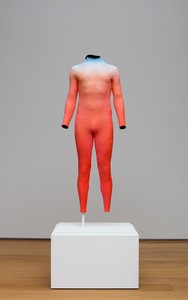
Alex Israel, Self-Portrait (Wetsuit), 2015, acrylic on aluminum, 79 ½ × 28 × 22 inches (201.9 × 71.1 × 55.9 cm), Nasher Sculpture Center, Dallas
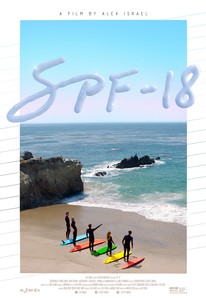
Poster for Alex Israel’s feature film SPF-18 (2017)
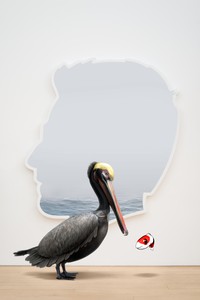
Alex Israel, Self-Portrait (Pelican with Fish), 2019, acrylic on Bondo on fiberglass with Snapchat augmented reality Lens, dimensions variable
If Hollywood is a siren in a trench coat in the Los Angeles story, the city’s beach culture is an ingenue in a bikini (or lifeguard in board shorts), forever young and fresh. Flashback to Alex Israel, six years old in 1988, at the Sand and Sea Club in Santa Monica—formerly the Marion Davies Estate—with his family, acculturating to beach life at the site where Old Hollywood’s wildest parties were thrown in the 1930s, attended by the likes of Greta Garbo, Charlie Chaplin, and Marlene Dietrich.3 Zip ahead to 2015, and here’s Israel in his signature Freeway sunglasses directing SPF-18, a film he created for a teen audience, set in oceanfront Malibu, that would find its way to Netflix two years later. On-screen: Pamela Anderson, Keanu Reeves, Molly Ringwald, many pelicans (an animal the artist identifies with), a multihued wet suit that Israel would later cast in aluminum. Also: five young actors with their surfboards laid out on the sand, deck-side down, fins pointing skyward. Cut to 2026: At an aquarium fabricator’s factory outside Rome, Israel and a team of plastics experts are putting the final touches on a nine-foot-tall surfboard fin colored Aperol-spritz orange.
SCI read that you were a boogie-boarding grommet?
AIYeah, when I was a kid I had a boogie board. My dad and my uncle were both surfers. I always wanted to be a surfer but it turns out I’m not very good at it. But I do appreciate it. I love looking at it. It’s like—I have a swimming pool in my backyard that I never swim in, but I still love looking at the blue water. It gives me a sense of well-being, just knowing that it’s there.
SCWhen I was a kid, you couldn’t drag me away if there was a swimming pool lit up at night. I was just hypnotized by that liquid glow. One of the reasons I’m drawn to your Fins series is that there’s luminosity in the material. It’s like a living color.
AIIt is like a living color when they’re shown in natural light. Their colors are constantly changing and moving with the light, the time of day. As a viewer, moving around them in space, your physical relationship to them is also always changing. There’s some variety to their surface textures and translucencies, and depending on their color and the lighting, these variables can become more or less pronounced.
The Fins work as image. You see them reproduced on a screen and you get it, it’s a giant surfboard fin. That’s an image you know, a symbol you understand, and that’s very Pop. But there’s also a sculptural experience of them, which is something you can’t fully get from an image. And that experience is very much rooted in the art history of Los Angeles, which is of course rooted in the experience of living in LA: sunsets and canyons and wide-open skies. Driving and the Pacific Ocean, the mountains and the desert, and all the Hollywood stardust.
That we’re hanging them upside down from the ceiling adds another element. To the psychology of the image, it introduces the question of upside-down-ness, and the physical experience of the sculptures becomes much more about gravity, weight, and buoyancy. Now, I’ve not yet seen them upside down, so this latter part is actually a prediction. This is a real experiment, because this week in London when we install the show it will be the first time that I’m seeing the works hung upside down. I’ll finally get to walk around them, and not just imagine—with the aid of a 3D rendering—what that experience is like.
That’s a long way of saying that yes, the work is about surfing, and all that the sport might mean to the Southern California cultural mythos, but it’s also very much about light and space, gravity and weight, land and water—and our relationship, as bodies, as perceivers, to all of these things.
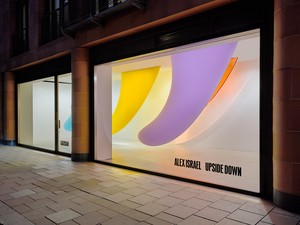
Installation view, Alex Israel: Upside Down, Gagosian, Davies Street, London, June 12–September 5, 2026. Photo: Prudence Cuming Associates Ltd
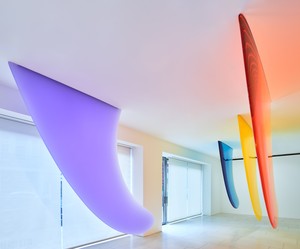
Installation view, Alex Israel: Upside Down, Gagosian, Davies Street, London, June 12–September 5, 2026. Photo: Prudence Cuming Associates Ltd
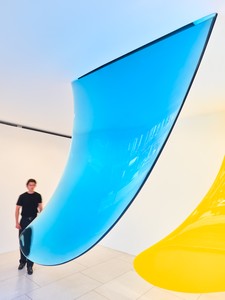
Installation view, Alex Israel: Upside Down, Gagosian, Davies Street, London, June 12–September 5, 2026. Photo: Prudence Cuming Associates Ltd
A fin might seem a simple shape but it’s the product of millions of years of physics, as test piloted by ocean creatures—and even birds. As Australian pro surfer Dave Rastovich notes, “Fins are the wings for the bodies of our surfboards.”4 Rastovich is one of the many surfers who thinks deeply about fins and their interface with waves. He refers to them as “sacred geometry.”
Legendary big-wave rider Laird Hamilton, too, has philosophical thoughts on the subject. “Surfing evolved from a board with no fins and then the fins really changed everything,” he told me. “They’re as critical as the board, and now have become even more critical.” The “now” Hamilton is referencing is hydrofoiling, the latest surfing iteration in which the rider stands on a board that soars above the water, attached to a strut and fin that slices beneath the wave’s surface: “With hydrofoils, we’re not even riding the board. We’re surfing the fin now—the foil is just a perfectly configured fin. And the fin is tiny by comparison, but it determines everything. The perfection of the shape, the outline—it’s so futuristic in a way. It’s so primitive yet so advanced. As our foils evolve they look more and more organic, like the profiles of seabirds.”5
SCHave you thought about making more fins? Because obviously there are many different fin shapes: thrusters, quads, tow fins, hydrofoils.
AIClassic fins have the most beautiful shapes. Of course they derive from marine biology—dolphins and sharks. But when isolated, engineered, and perfected, they give physical form to the idea of movement through water. I mean, if you had to make a shape that represented the movement of matter through water, it would probably look like a fin. There’s a famous sculpture by Constantin Brancusi, Bird in Space (1928), wherein he depicted not the bird itself but an abstract, aerodynamic representation of its flight. I think about that sculpture in relation to the Fins. They may relate to water in the way Brancusi’s Bird in Space relates to air.
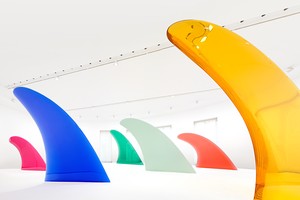
Installation view, Alex Israel: Fins, Gagosian, Rome, May 12–September 9, 2023. Photo: Matteo D’Eletto, M3 Studio
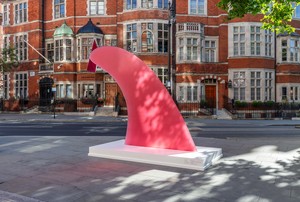
Alex Israel, Fin (Watermelon Sugar), 2023, plexiglass, 111 ⅞ × 84 ⅝ × 3 ⅝ inches (284 × 215 × 9 cm), installation view, The Connaught, London, 2024. Photo: Lucy Dawkins
Watching a video of Israel’s first Fins installation, at Gagosian in Rome, I found myself grinning in delight and yearning to experience his Fins firsthand. (In the gallery, I doubt that I could’ve resisted the urge to touch them.) They embody a mix of beauty and humor, a combination that Israel favors. Literally, the Fins are larger than life—though, alas, life is not always so elegant. Or fun. Perhaps everything is a matter of degree. A beach break where we could ride giant candy-colored surfboards with giant translucent fins is a different beast than a tsunami, though both are technically waves. These days, life can feel more like a tsunami: awesome, but also scary. I was interested to hear Israel use the word “sublime” to characterize our post-COVID era and its overwhelming energies, because there’s a deeper dimension in that. In life, in nature, and in art, nothing can be defined solely by its surface.
SCAs an author who writes about the ocean at its most extreme, I’m often writing about the force of the sublime. I like a little terror mixed in with my beauty. But then, I’m not as much of an optimist as you are.
AIThat’s fair, it’s dark times. But in spite of all the horror in the world, it’s important to remember that it’s still the best time in the history of the world to be a human being on planet Earth.
SCThat’s true.
AII mean, it could be so much worse, right?
SCKnock on wood. Do you have any mantras? Something you always fall back on telling yourself?
AIHmmm. How about: The future arrives in waves. We have to be ready to surf it.
FIN.
1 Joan Didion, “Some Dreamers of the Golden Dream,” in Slouching Towards Bethlehem (New York: Farrar, Straus and Giroux, 2008), pp. 21, 5, 6.
2 Joan Didion, “Los Angeles Notebook,” in Slouching Towards Bethlehem, p. 221.
3 See for instance Laura M. Holson, “A Dip into Hollywood, August 28, 2009, https://www.nytimes.com/2009/08/30/fashion/30pool.html.
4 https://www.surfline.com/surf-news/visual-history-surfboard-fins/25660.
5 In 2013 Hamilton was a guest, albeit a fairly laconic one, on Israel’s talk show, As It Lays:
Alex: Can you carry a tune?
Laird: If it’s heavy.
Alex: Do people ever really change?
Laird: Yes.
Alex: Do you sleep on your back, your side, or your stomach?
Laird: Uh-huh.
Alex Israel: Upside Down, Gagosian, Davies Street, London, June 12–September 5, 2026
Artwork © Alex Israel
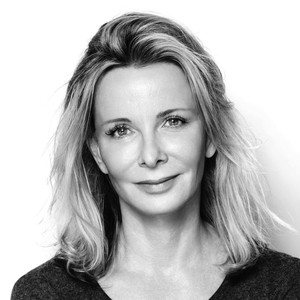
Susan Casey is the author of four New York Times’ bestselling nonfiction books: The Devil’s Teeth: A Tale of Obsession and Survival Among America’s Great White Sharks; The Wave: In Pursuit of the Rogues, Freaks, and Giants of the Ocean; Voices in the Ocean: A Journey Into the Wild and Haunting World of Dolphins; and The Underworld: Journeys to the Depths of the Ocean. Casey is the former editor-in-chief of O, The Oprah Magazine and Sports Illustrated Women, development editor and editor-at-large for Time Inc., and creative director of Outside magazine. She is a National Magazine Award–winning journalist whose work has appeared in Vanity Fair, Esquire, Sports Illustrated, Fortune, Time, Outside, National Geographic, as well as the Best American Science and Nature Writing, Best American Sportswriting, and Best American Magazine Writing anthologies.
Sam Wasson brings his deep knowledge of cinema, Hollywood, and film noir to Alex Israel’s new paintings of Los Angeles.
The exhibition Alex Israel: Freeway, presented at Fosun Foundation, Shanghai, is an in-depth survey of the artist’s practice. Curated by Jeffrey Deitch, the exhibition is accompanied by a catalogue featuring a conversation between Israel and Jenny Wang Jinyuan, as well as essays by the artist, Deitch, and cultural critic Sean Monahan. To celebrate the occasion, we are sharing Monahan’s essay, “Teenage Obsolescence.”
An animated, short video by Alex Israel takes viewers on a visual journey through the ideas and imagery behind his latest exhibition in Hong Kong.
Alex Israel speaks with curator and writer Venus Lau about New Waves, his latest exhibition in Hong Kong. Israel reveals his spirit animal, discusses his love of Duchamp, and tells Lau about the process behind his newest works.
Alex Israel discusses his feature-length film with Derek Blasberg.
Hans Ulrich Obrist interviews the artist and writer about their recent collaboration.
Diana Widmaier Picasso, curator of the exhibition Desire, reflects on the history of eroticism in art.
On July 9, Simon Hantaï: the last studio opens at Gagosian, Gstaad. Curated by Anne Baldassari, the show comprises sixteen of the artist’s dernier atelier (last studio) paintings of 1982–85. The exhibition is accompanied by an illustrated catalogue, copublished by Gagosian and Skira, which features an essay by Baldassari and an extensive portfolio of previously unpublished photographs by Édouard Boubat. Here, we share the introductory chapter from the publication.

On April 16, the Institute of Contemporary Art, Boston, opened the first midcareer survey of Derrick Adams’s multidisciplinary practice. Covering over twenty years of work, the exhibition, titled View Master, brings together the artist’s painting, sculpture, collage, performance, and video, as well as a vibrant new commission created for the museum’s façade. Ahead of the opening, Adams met with Tessa Bachi Haas, cocurator of the survey, to discuss his formative experiences with television, the impact of his work in arts education on his practice, and the importance of taking a more complex, more joyful, and more expansive approach to Black American life and culture.

Adam D. Weinberg has been working with Giuseppe Penone on an exhibition of the artist’s new sculptures, The Reflection of Bronze, that opens at Gagosian, New York, on April 22. The works explore the character and possibilities of bronze. Here, Weinberg considers Penone’s enduring engagement with the alloy and addresses the conceptual underpinnings of the exhibition’s three-room structure.

Jeff Koons tells Alison McDonald about his appreciation for the pioneering artist and thinker Marcel Duchamp.
The Singular Experience at Gagosian’s Le Bourget gallery is the largest exhibition of Walter De Maria’s work in France in several decades. Organized by Donna De Salvo, senior adjunct curator at Dia Art Foundation, the exhibition marks the first time De Maria’s final sculpture, Truck Trilogy (2011–17), is being shown outside of the United States. Here, De Salvo speaks with artist Lucy Raven about her evolving kinship with De Maria and more.