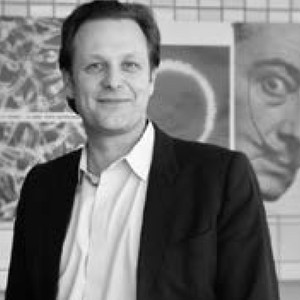
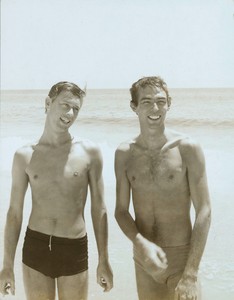
Daniel Birnbaum has been the director of Moderna Museet, Stockholm, since 2010. He was previously the director of the Städelschule Fine Arts Academy, Frankfurt, as well of its Kunsthalle Portikus. He was Artistic Director of the 53rd Venice Biennale in 2009. Photo: Moderna Museet/Åsa Lundén
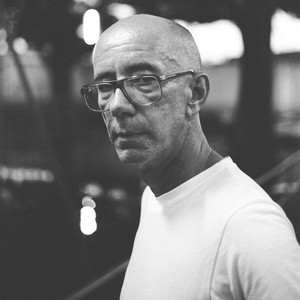
Born in Brussels in 1961 to German parents, Carsten Höller lives and works in Stockholm, Sweden, and Biriwa, Ghana. Using his training as a scientist in his work as an artist, Höller concentrates particularly on the nature of human self-exploration. He has undertaken many projects that invite viewer participation and interaction while questioning human behavior, perception, and logic. Photo: Jamie-James Medina
Daniel BirnbaumYou have a PhD in agricultural science. Might one think of your work as a bridge between science and art?
Carsten HöllerNo, certainly not. I haven’t introduced scientific experiment into the art context, only the experimental form. Scientific experiment aims at reaching a finding through the testing of a hypothesis. In art the experiment is more of an experiment with oneself, without tangible results—there’s no objective observer collecting data and drawing conclusions. There’s only the artwork and its viewers, who are subjected to a situation and called on to examine themselves. That’s a major difference.
DBEven if you’re not creating a bridge between art and science, I at least have the feeling that certain themes migrate from one to the other.
CHThat’s true, but the result is critical of science. Natural science is finished and its importance is completely overrated. Its great discoveries are in the past. Even so, certain realms continue to be the exclusive property of science. That exclusivity bothers me—I’d like the opposite of rationality to take up just as much space as scientific logic.
DBIn early works you intoxicated yourself with the psychoactive mushroom fly agaric, and mushrooms turn up again and again in your work. Is it the shifting of perception through chemical reactions that interests you?
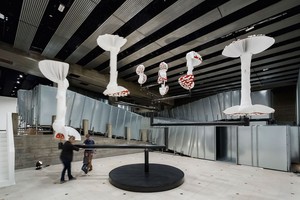
CHI find mushrooms incredible. But for truffles and a few others, they grow out of the ground as they ripen—in fact their sole function is to lift their spores out of the ground to be carried away by the wind. So why do they have this immense variety of shapes, colors, and constituents, some of them psychoactive? As far as we know, they don’t communicate with other mushrooms above the ground, and they don’t use these toxins to protect themselves. There’s something else going on that we don’t understand.
The fly agaric is a remarkable mushroom. It’s important in shamanism, though under Christianity that’s been suppressed. It may still be used in some tribal cultures in northeast Siberia to put shamans into trance states. There’s archaeological evidence to suggest that fly agaric was the basis of the soma described in the Vedas, a juice derived from vegetables or mushrooms that was a pathway to the divine. It’s perfectly legitimate to assume that the importance of fly agaric as a symbol has not entirely disappeared.
DBThe mushroom’s toxicity isn’t altogether irrelevant: your work doesn’t glorify drugs but does show an interest in shifts in perception. Those kinds of shifts can also be triggered by optical instruments.
CHMany methods and routes are useful for breaking out of the logic in which we find ourselves, and that we have created, with great effort, to tame the world. Science and technology are major components of that logic. If psychoactive mushrooms or other substances can give us a way of thinking and being outside it, not only in art or in dreams, then they’re alright with me.
DBWhat is this logic? Is it what we think of as normality?
CHIt’s a logic that has imposed itself on everything and instantly absorbs everything different. In fact difference is a kind of culture for breeding it, making it all the more logical. It has a kind of hegemony, it has spread across the world like a pandemic. It creeps into the most remote regions and suppresses everything else like a parasitic organism. It’s so all-encompassing that we can no longer see, in certain circumstances, the possibility of something else.
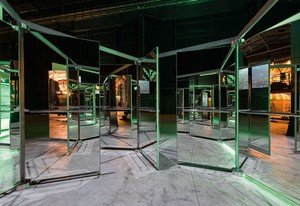
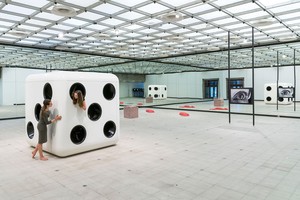
Installation view, Carsten Höller: Decision, Hayward Gallery, London, June 10–September 6, 2015. Photo by Ela Bialkkowska
In art the experiment is more of an experiment with oneself, without tangible results.
Carsten Höller
DBAre your works attempts to escape this logic?
CHAt the least they’re suggestions, though I’m fully aware of the paradox that to reject the logic is only to confirm it. I try to imagine how an expedition would have to be equipped in order to get outside it. Perhaps there aren’t any extralogical realms. Perhaps we’re just like sailors convinced that beyond the horizon is the end of the world, which we’re afraid to find, but in any case as we move toward the horizon it keeps moving away from us. Still, it’s worth trying to get to the horizon, since there seems to be as much ignorance about the extralogical as there once was about the shape of the earth.
DBA quality of many of your works is the fact that they’re not only objects, they’re usable. They’re tools.
CHYou had suggested calling them “unsaturated” works. That’s a good term.
DBThe logician Gottlob Frege talked about “unsaturated functions.” For the idea “being human,” for example, he said that “X is a human” is true, is a sentence, but “being a human” is a function, and as such is unsaturated because it lacks an object, lacks an X. In this sense your artworks are functions—in your flying machine, say, something has to be filled in for X. The work is an unfinished object, since it only functions when someone flies in it. One can say that every artwork requires an observer to be complete. But with you it happens especially often that the unsaturated quality goes beyond the mere presence of the viewer.
CHI find the idea problematic that artists create things they consider “finished,” and that once this object or performance or film is finished it goes on public display. To escape that logic, it seems sensible to me to make works that are unsaturated and have the overall nature of tools.
DBLeo Castelli once said that no artwork is finished in the studio, it first has to have a public. It probably has to be sold before it’s finished. In the work of Marcel Duchamp, who was less interested in the art market than in the idea of the artwork, you find the notion that the viewer is just as important as the artist.
CHYet Duchamp produced almost only finished works of art.
DBAnd the readymades? How saturated would you say a readymade is, 50 percent? 100 percent?
CHAt least 200 percent, since it’s doubly saturated. The readymades are something different. The manufacturer of the bottle-drying rack thought the object was finished and released it for sale. Then Duchamp took it and introduced nonsaturation into it, since he denied the exclusivity of its original function—drying bottles—without giving it a new function in Frege’s sense. The bottle rack was a sentence that Duchamp turned into a function. But then he displayed it as a finished art object. Having lost the saturated exclusivity of its original use, it now worked as a sculptural form, but could still be used, potentially, as a bottle rack. So saturation had become layered, and is therefore 200 percent.
DBI feel that the more saturated a work is, the more effective it is in the art market.
CHYes, unfortunately.
DBA perfect object, say a Brancusi—
CH—which is saturated, highly saturated.
DBDuchamp’s ideas are no longer new—it has become almost normal for art to take the viewer into account.
CHYes. One could also say of my work Test Site (2006–07) that it was a sculpture in a space that is in itself saturated. It wasn’t absolutely necessary for a person to climb into the work and slide down; the libidinously spiraling tracks were justified in their relation to the rectilinear industrial architecture of Tate Modern’s Turbine Hall. But now somebody comes along and climbs in. At that moment a situation appears to which the artist no longer has access, namely the existential and individual experience of the person sliding. Roger Caillois described the experience of vertigo as “a kind of voluptuous panic in an otherwise lucid mind.” So the work could be used in different ways. To that extent it was both saturated and unsaturated, and as such perhaps more unsaturated: the saturated aspect became a pawn of the nonsaturation.
DBThat’s a whole new theory of art! Let’s talk about the idea that the viewer of an artwork, or perhaps the reader of a book, brings a great deal to it and actively participates in it. A book is nothing until someone reads it, but the person in a slide has no freedom: the adventure, the experience, may belong to her or him alone, but there is only one way of sliding down.
CHThe action is predetermined: you end up where you think you will in the manner you had expected. You slide down a preset course, and yes, in doing so you briefly lose part of your usual condition. You are no longer the person you usually are. But that’s a kind of liberation. There’s no longer any room for decision-making, you’re freed from yourself. If the artist can manage to offer a specific form of interference that is possible in this form and in this form only, to my mind that’s worth the effort.
My question is, how can one make things that release a person from the certainty of logic? How can one produce a situation that elicits doubt without illustrating that doubt and thereby neutralizing it? My first attempt was Laboratory of Doubt in Antwerp (1999). I bought a car and pasted stickers all over it that read “Laboratory of Doubt” in Belgium’s three languages, Flemish, French, and German. Loudspeakers attached to a microphone and amplifiers were mounted on the roof. I wanted to drive around in the car and sow doubt, wanted to make doubt proliferate. But I didn’t manage it, because I couldn’t think what to say to sow doubt. There was a degree of nonsaturation here that I found appealing. There was only potential.
DBIn what works by other artists do you see nonsaturation?
CHMaybe the Passstücke [Adaptives] that Franz West began in the early 1970s. Those are beautiful unsaturated works. To some extent they function like my slides, or better, for on the one hand there’s an object in plaster and steel that is weirdly appealing, and on the other there’s a functionality that goes undefined. Here it was truly a matter of producing a unique experience with simple means.
Installation view, Carsten Höller: Decision, Hayward Gallery, London, June 10–September 6, 2015. Photo by Ela Bialkkowska
Even if you’re not creating a bridge between art and science, I have the feeling certain themes migrate from one to the other.
Daniel Birnbaum
DBMany of Bruce Nauman’s works are unsaturated in that they require an observer who becomes part of the work. Unlike the slides, though, those are unpleasant, almost claustrophobic situations. Umberto Eco, in his book The Open Work (1962), writes that a work of art is never truly finished but rather is always being read in a new way. New generations arise and time goes by. And Duchamp not only talks about the observer’s involvement in the artwork but also points to posterity, to the fact that it will only be clear in fifty years whether or not a work was important. Duchamp also says that the cards are reshuffled: for a long time no one is interested in El Greco, then El Greco resurfaces. Is that also part of the public’s collaboration?
CHDuchamp also said that posterity makes mistakes. How a work of art is viewed later, after the artist’s death, depends on more than the work of art itself; there are errors that creep in and can become altogether major, then perhaps disappear again. That too is a form of nonsaturation, since that’s how art lives on. I don’t think we can make an absolute distinction between the saturated and the unsaturated artwork, though we can make a relative one. The unsaturated work doesn’t present a form of truth, doesn’t pretend to make it possible to get to the truth. But that refusal can’t continue into eternity, into posterity’s posterity—something static adheres in the process, since the artwork is a mausoleum of its own meaning. The issue lies in producing something that goes beyond that, in the sense that it works as a tool that helps us climb inside ourselves. It’s that tool-like quality that makes it possible to climb out of the finished state again.
Carsten Höller, Divisions (Roach and Surface), 2016, acrylic glass, paint, stainless steel, screws, and roach (taxidermy), 17 ¾ × 29 ½ × 7 ½ inches (45 × 75 × 19 cm) Photo by Thomas Bruns
DBI’m wondering what the consequences of that are. I’m afraid that the more saturated a work is, the more it’s seen as a masterwork. That seems to be the exact opposite of what you’re after—you look for maximum unsaturation.
CHBoth . . . and. An unsaturated work of art has to have both qualities at once, otherwise it is not unsaturated. The unsaturated aspect may be temporary but the saturated aspect is not. I’m not saying this is the philosopher’s stone, but in this age of the great ordering system of logic what I propose is this doubling, this replication, and the uncertainty it brings. As I said, I want to try to escape that logic, to achieve a kind of extralogical uncertainty. The unsaturated aspect will not replace the saturated one; it’s a part of it, at the same time that it’s an extralogical continuation of it. “Unsaturation” is such an appropriate concept of yours, because it suggests chemical reactions, such as those with fatty acids.
DBI was waiting for you to mention unsaturated fatty acid.
CHAnd the reactions taking place are beyond anyone’s control—at least that would be the idea.
Daniel Birnbaum has been the director of Moderna Museet, Stockholm, since 2010. He was previously the director of the Städelschule Fine Arts Academy, Frankfurt, as well of its Kunsthalle Portikus. He was Artistic Director of the 53rd Venice Biennale in 2009. Photo: Moderna Museet/Åsa Lundén
Born in Brussels in 1961 to German parents, Carsten Höller lives and works in Stockholm, Sweden, and Biriwa, Ghana. Using his training as a scientist in his work as an artist, Höller concentrates particularly on the nature of human self-exploration. He has undertaken many projects that invite viewer participation and interaction while questioning human behavior, perception, and logic. Photo: Jamie-James Medina