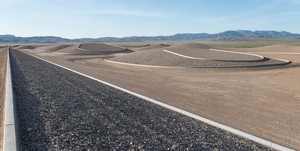
To mark the occasion of Michael Heizer’s eightieth birthday on November 4, 2024, and the designation of that day in his honor in the state of Nevada—the site of his monumental City (1970–2022), among other works—we revisit seventeen of his sculptures.
Double Negative is a defining work of Heizer’s career. Located in the Moapa Valley on Mormon Mesa near Overton, Nevada, the work consists of two massive straight trenches measuring thirty feet wide and fifty feet deep, formed through the displacement of 240,000 tons of desert sandstone. The two indentations imply a continuous linear volume—a negative sculpture slicing through and extending across the Mesa’s scalloped edge. The sixty-acre site for Double Negative was originally purchased by art collector and gallerist Virginia Dwan (1931–2022), who owned the sculpture until 1984 when she donated it to the Museum of Contemporary Art, Los Angeles, to coincide with the exhibition Michael Heizer: 45m, 90m, 180m/Geometric Extraction.
One of the first major artworks commissioned by the Seattle Office of Arts & Culture, Adjacent, Against, Upon consists of three large granite rocks placed in distinct positions relative to their respective cement plinths. For Heizer, the creative act of recontextualizing the natural objects by placing them on or around manmade bases articulates the organic rocks and transforms them into a sculpture. The granite for Adjacent, Against, Upon was quarried in the Cascade Range mountains, which extend from British Columbia through Washington and into Oregon and Northern California. Installed in the urban environment of Myrtle Edwards Park in Seattle, the three megaliths establish visible and tangible ties with local geography and terrain.
Building upon his replacement of negative space in the earth with massive rocks, an endeavor begun with Displaced Replaced Mass (1969, no longer extant) in Silver Springs, Nevada, this sculpture was executed in 1977 and installed outside a private home in Marina del Rey, California. The work consists of four subterranean depressions, each scaled to fit its respective rock so that the face sits at ground level. The heft of the rocks juxtaposed with their deft placement establishes tension between object and site, and states of passivity and activity.
Owned by the Metropolitan Museum of Art, New York, but currently on loan and installed at the Massachusetts Institute of Technology (MIT), Guenette is a sculpture consisting of eleven distinct slabs of pink granite that was mined in the eponymous town in northeastern Quebec. Much like Heizer’s earlier, smaller scale circle sculptures, here one disklike form establishes the geometric proportions of the other related segments positioned around it. The sculpture was previously installed at Seagram Plaza in New York City (as pictured), before it was moved and reconfigured for MIT, where it is fittingly located near the Physics and Mathematics departments.
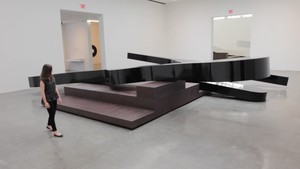
Heizer’s Rift, Dissipate, and Isolated Mass/Circumflex (#2) are three negative sculptures made of weathering steel. Each was originally conceived of in 1968 as part of the artist’s Nine Nevada Depressions—a group of nine excavations dug into the earth of a dry lake bed in Nevada that have all since eroded away. Taking various forms—zigzags, loops, broken lines, and intersections—each was an exploration of the possibility of line through a sculptural form defined by absence.
Isolated Mass/Circumflex (#2) was installed in the Menil Collection’s front lawn in advance of its opening in 1987. It is positioned to bisect the central walkway to reinforce that it is a physical object rather than purely a continuous line.
Given to the museum in 1994 by Virginia Dwan, the form of Dissipate is based on a chance composition that Heizer made by dropping matches. It is installed with Rift, a dynamic, jagged line in a gravel courtyard adjacent to the Menil Drawing Institute.
Commissioned by International Business Machines Corporation (IBM) for its historic location in Midtown Manhattan, Heizer’s Levitated Mass comprises a horizontal slab of Vermont granite that appears to hover over water that is continuously flowing (only in the warm months) within a tightly framed, five-sided steel tank. The face of the central rock is etched with a barcode representing the work’s physical address developed by the artist, which echoes the sharp geometric lines and rigid angularity of the surrounding city’s architecture and grid-planned streets.
The first major commission of public art for Rice University’s campus, Heizer’s 45°, 90°, 180° comprises three granite monoliths deftly placed at the angles noted in the work’s title. The triptych is a concise summation of the sculptural possibilities of objects—that they can be leaned against, stood up, or laid down—and pays tribute to the triumphs of ancient engineering in art through its material, scale, and form. Initiated by notable patron of the arts Alice Pratt Brown (1902–1984), it was later dedicated to her husband, philanthropist George R. Brown (1898–1983), after his death.
Installed at the entrance to the Menil Collection in 1991, Charmstone is one in a group of propeller-shaped sculptures of the same name. The son of an archeologist and raised within the discipline, Heizer recognizes modern forms, such as aerodynamic wings, as adaptations of early functional tools and ceremonial objects from prehistoric times.
The work’s title and stretched form reference talismans called charmstones thought to possess religious or mystical powers among numerous indigenous cultures from Heizer’s native California and other regions throughout the Southwestern United States.
Prismatic Flake Geometric, installed at the University of Nebraska, Lincoln, in 1991, consists of concrete, steel, and granite molded into a rudimentary, elongated form. One of Heizer’s numerous works made in the late ’80s and early ’90s modeled on ancient utilitarian objects, it takes the distinct shape of an obsidian glass blade often used for cutting and shaving. Much like his massively scaled interventions into the landscape and his works incorporating megalithic rocks, his monumental object sculptures represent human industry and the point at which raw materials take on new meaning.
Completed in 1994, Black Diorite Negative Wall Sculpture consists of a megalith suspended within a steel-lined box set within the wall of the Hyatt Regency in Seattle. The work is a formal extension of the visual and conceptual premises of Displaced/Replaced Mass (1969), one of Heizer’s earliest excavations in the desert that features three depressions, lined with concrete and holding granite boulders. Presented vertically—a more complex and audacious installation than his traditional interventions into the ground—Black Diorite Negative Wall Sculpture deepens the artist’s exploration of the volume, density, and nature of materials through their removal, replacement, and juxtaposition with negative space.
Heizer’s first negative sculpture, North, East, South, West (1967/2002) was conceived of in 1967 as a series of four large-scale geometric pits. Partially executed that year as North and South and then dismantled, it was not until 2002 that Dia:Beacon commissioned the artist to permanently install the four mammoth chambers as originally drawn by his engineers. The title—referencing the four cardinal directions—reflects the artist’s interest in the discrepancies between mapped and physical space.
Heizer’s Negative Megalith #5 (1998), a behemoth stone entombed in a wall cutout, is on long-term loan from the Menil Collection, Houston, and is installed in a neighboring gallery at Dia:Beacon.
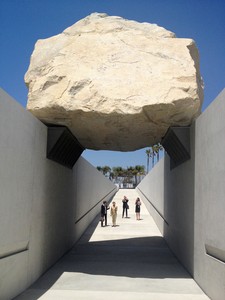
Comprising a 340-ton granite megalith suspended over a 456-foot-long concrete slot, Heizer’s Levitated Mass is one of his most ambitious sculptures. Conceived of in 1969, Heizer first attempted Levitated Mass that year in a dry lake bed in northern Nevada. Though he successfully excavated the slot depression, the 120-ton rock identified for the work broke one of the two cranes being used for the project, thus ending the installation prematurely. A feat of engineering that recalls a dolmen—a megalithic tomb structure—composed of massive rocks, Levitated Mass invites visitors to walk beneath the hovering megalith, reinforcing the experiential quality that underpins the artist’s monumental sculptures from Double Negative (1969) to City (1970–2022).
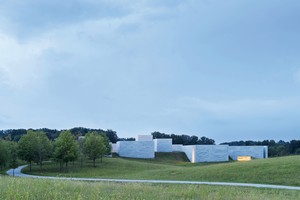
Commissioned for Glenstone, but originally built when the artist was working in California’s Mojave Desert in 1968, Heizer’s Compression Line (1968/2016) is a concave steel negative sculpture. Constructed by Heizer on-site, the work’s bowed shape is the result of the surrounding 2,200 cubic yards of soil exerting immense pressure on the rectangular steel structure, forcing the metal walls to curve inward and meet at the midpoint. Compression Line encapsulates Heizer’s enduring interest in the reconceptualization of absence and physical phenomena as sculpture.
Commissioned for Glenstone, Heizer’s Collapse (1967/2016) is a large-scale weathering steel sculpture comprising fifteen beams placed in a cavernous rectangular pit within the earth. The sculpture is based on a wooden model made in 1967 and references the artist’s study of chaos structure through the intricate, but seemingly haphazard arrangement of the massive beams. Itis installed in an exposed outdoor structure that was designed in collaboration with the artist.