Across his nearly six-decade career, Michael Heizer has continued to probe the possibilities of sculptural form defined by its absence. His exhibition Negative Sculpture features Convoluted Line A and Convoluted Line B, among the artist’s most complex negative sculptures. Here, we consider a selection of works that have preceded the new sculptures.
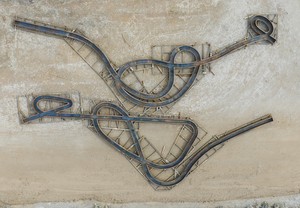
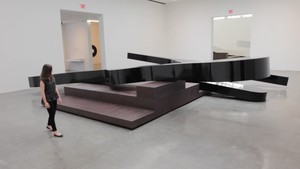
Michael Heizer, Convoluted Line A and Convoluted Line B, 2024 (both), steel, 87 feet 6 inches × 30 feet (26.7 × 9.1 m); 87 feet 7 inches × 35 feet 5 inches (26.7 × 10.8 m). Photo: Clint Jenkins
Michael Heizer, Convoluted Line A and Convoluted Line B, 2024 (both), steel, 87 feet 6 inches × 30 feet (26.7 × 9.1 m); 87 feet 7 inches × 35 feet 5 inches (26.7 × 10.8 m). Photo: Clint Jenkins
Negative
Since the mid-1960s, Michael Heizer’s work has sought to challenge long-held artistic traditions and the established art gallery system. This began in earnest in 1966 with shaped, three-dimensional canvases with cut-out voids and then shaped canvases composed of lighter and darker geometric passages to suggest the absence and presence of form. These works questioned the boundaries between painting and sculpture. In winter of the following year, Heizer visited the Sierra Nevada mountains, where he dug two large pits in the woods. Lining one, North, with plywood and the other, South, with sheet metal, he inaugurated his career-long pursuit of sculptural form described through negative space.
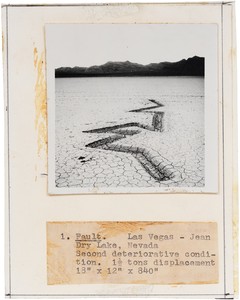
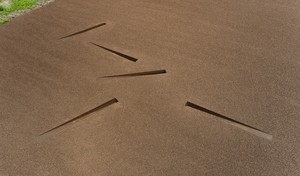
With the financial backing of New York taxi tycoon and art collector Robert Scull, the following year Heizer embarked on his most ambitious body of work then to date: the Nine Nevada Depressions (1968)—nine excavations into the earth in the form of loops, intersections, zigzags, and broken lines placed across 520 miles of dry lake beds in Nevada. Rift (1968, deteriorated), the first of these, is a 1.5-ton displacement of earth in the form of a dynamic, jagged line. These interventions have all deteriorated or been dismantled, but their forms and the questions their physical reality provoked remain central to Heizer’s work even today.
Michael Heizer, Untitled (Nine Nevada Depressions, Rift [Fault]), 1968, silver gelatin print mounted on paper, 6 × 5 inches (15.2 × 12.7 cm). Photo: Rob McKeever
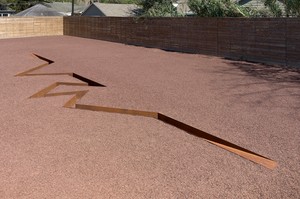
Michael Heizer, Rift, 1968/1982, steel, 10 feet × 51 feet 9 inches × 6 inches (3 × 15.8 × .2 m), Menil Collection, Houston. Photo: Adam Neese
Heizer ultimately turned to more resilient media to ensure the longevity of the sculptures, making later versions of some early works—Dissipate #2, Isolated Mass/Circumflex, and Rift, for example—in weathering steel. These were acquired by the Menil Collection, Houston, in 1994, 1997, and 1999, respectively. Convoluted Line A and Convoluted Line B do not take the form of any one of the original depressions; instead, they elaborate on this tradition and reflect the refinement of the artist’s aesthetic sensibility over time.
Curvilinear
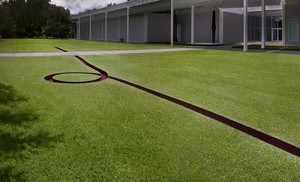
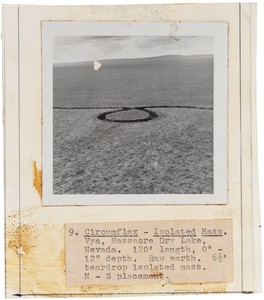
For Heizer, defying the inherent limitations of media is part and parcel of making sculpture. Isolated Mass/Circumflex (1968, deteriorated) of the Nine Nevada Depressions takes the form of one long, softly curved horizontal line punctuated by a single loop just off center. Formed by digging into the ground and removing several tons of raw earth, it exemplifies the finesse with which Heizer rendered lyrical form using simple construction tools early in his career.
Isolated Mass/Circumflex (#2), the later weathering steel version, was installed in the Menil Collection’s front lawn bisecting the central walkway in advance of its opening in 1987.
Michael Heizer, Untitled (Nine Nevada Depressions, Isolated Mass/Circumflex), 1968, silver gelatin print mounted on paper, 6 × 5 inches (15.2 × 12.7 cm). Photo: Rob McKeever
Convoluted Line A and Convoluted Line B are the most intricate of Heizer’s curvilinear negative line sculptures. Meandering with the delicacy of a hand-drawn line, their elegant twists belie the rigidity of steel. Indeed, it is the deft handling of heavy machinery that underpins the precise articulation of Heizer’s most sophisticated sculptural concepts.
Chance
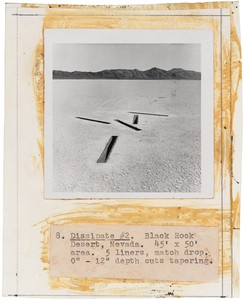
Chance was an integral part of Heizer’s process of sculpting and painting while working in the California and Nevada deserts throughout the late 1960s. Remade in weathering steel in 1970, Dissipate #2 (1968, deteriorated), of the Nine Nevada Depressions, consists of five wooden earthliners whose haphazard arrangement references a composition entitled Matchdrop (1968)—five matchsticks that were dropped from two feet in the air and then taped onto a sheet of paper where they landed. This mode of generating composition through chance continued with other work, including Adze Dispersal (1968–71). Installed for the first time in California’s Mojave Desert in 1968, it consists of 524 stainless-steel elements of varying sizes tossed and sunken into the earth. Later dismantled, the work was exhibited in the Whitney Museum of American Art’s exhibition Two Hundred Years of American Sculpture (1976) and later acquired and shown by the Museum Ludwig, Cologne, each time with the components arranged in a different formation.
Michael Heizer, Dissipate, 1968/70, steel, in 5 parts, each: 12 ¼ × 144 ⅝ × 12 ¾ inches (31.1 × 367.3 × 32.4 cm), Menil Collection, Houston; gift of Virginia A. Dwan. Photo: Adam Neese
Michael Heizer, Untitled (Nine Nevada Depressions, Dissipate #2), 1968, silver gelatin print mounted on paper, 6 × 5 inches (15.2 × 12.7 cm). Photo: Rob McKeever
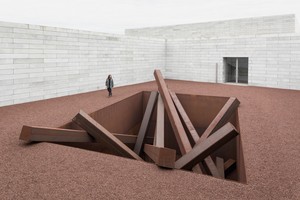
Michael Heizer, Collapse, 1967/2016, steel, 36 × 24 × 16 feet (11 × 7.3 × 4.9 m), Glenstone. Photo: Eric Piasecki
First designed as a small-scale wooden model in 1967, and later commissioned at monumental scale for Glenstone, Maryland, Collapse (1967/2016) also finds its sublime power in the tension between random disorder, and balance and control. Composed of massive steel beams deftly leaned upon one another in an enormous open box, it represents the artist’s interest in chaos theory—the study of the organizational patterns that underlie the apparent unpredictability of chaotic systems.
Convoluted Line A and Convoluted Line B continue these lines of investigation.
City
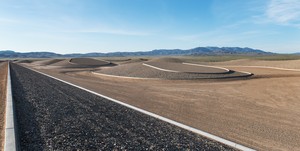
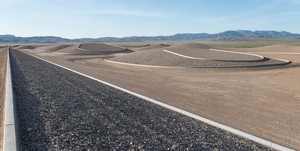
From 1970 until 2022, Heizer built the City. Located in remote central eastern Nevada, the work consists of mounds and depressions made of compacted raw earth and delineated by snaking concrete curbs. The City serves as a central point of reference for the entirety of Heizer’s artistic output, even for those works preceding it, including the Nine Nevada Depressions. It is where the artist’s career-long interest in the articulation of negative space, the limits of orientation, and the potential of scale, heft, and perspective coalesce.
To traverse the City’s expansive footprint, one must navigate its difficult terrain, and surrender to its sublime vastness, scale, and wild solitude.
Michael Heizer, City, 1970–2022. Courtesy Triple Aught Foundation. Photo: Ben Blackwell
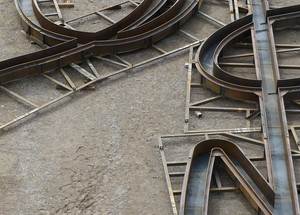
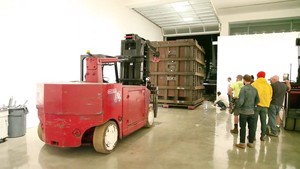
Detail of Convoluted Line A and Convoluted Line B prior to installation, with structural support system, in production yard, 2024. Photo: Clint Jenkins, courtesy the artist
The sensorial impact of Convoluted Line A and Convoluted Line B, each of which is a sprawling 87 ½ feet long, is also rooted in their scale. Like the sweeping stretches of the City’s terrain, their form cannot be perceived from one viewpoint but must be traced on foot. Their curvilinear shape also evolves out of the City’s formal vocabulary—from its undulating paths to its hooked mounds and vertiginous hairpin turns.