
Now available
Gagosian Quarterly Spring 2026
The Spring 2026 issue of Gagosian Quarterly is now available, featuring Marcel Duchamp’s L.H.O.O.Q. (1964) on the cover.
Spring 2026 Issue
Jeff Koons tells Alison McDonald about his appreciation for the pioneering artist and thinker Marcel Duchamp.
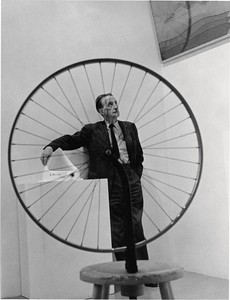
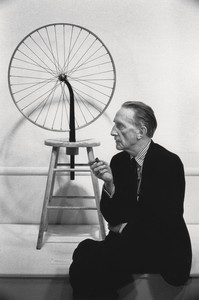
Marcel Duchamp at the exhibition The Art of Assemblage, Museum of Modern Art, New York, 1961. Photo: Marvin Lazarus
Marcel Duchamp at the exhibition The Art of Assemblage, Museum of Modern Art, New York, 1961. Photo: Marvin Lazarus
Alison McDonaldThank you so much for taking the time to talk to me about Marcel Duchamp, an artist whose influence I see in a lot of your work. I wanted to start by asking if you have a favorite work by Duchamp?
Jeff KoonsWhenever someone mentions Duchamp’s name, the work that immediately comes to mind is Fountain [1917]. I enjoy that work for its form, its materialism. And as you know, I’ve worked in porcelain, and the urinal is part of the reason I chose to work in that material.
AMDesire is such an important part of your work—I was curious how you think Duchamp reflects on desire?
JKI think desire is strong in Duchamp’s work. I love the prints, which tend to have a sexualized desire there. But even more than that, in an absolutely abstract way, the readymades bring about a desire for transcendence. They present something so much bigger, a dislocation, very ethereal possibilities—the idea that something can be manifested opened such a vast new area for exploration in art. And I think that’s a desire—a desire to be able to find that opening, to reveal that possibility. So I think desire in Duchamp’s work is both sensual, a desire of becoming, and at the same time it’s spiritual, allowing us to open any type of understanding about the space that we can create for ourselves, both physically and intellectually.
AMIt’s so interesting you used the word “spiritual” because I think for Duchamp all good art holds within it something akin to a religious sensibility, or the potential for a moment of profound revelation. That can come from a canvas that’s been labored over by the artist’s hand, from something that’s been crystallized as a conceptual idea, or from an object that’s been appropriated and brought into a different context.
One question I have for you, because this permeates your work as well, is related to Duchamp’s elevation of the viewer as essential to completing the work of art.
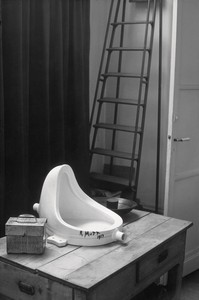
Fountain (1964, after 1917 lost original) in Duchamp’s studio, Neuilly-sur-Seine, France, 1968 © Fondation Henri Cartier-Bresson, Magnum Photos
JKI’ve always enjoyed Duchamp’s generosity—his opening us to the environment and everything that’s within our world, our life experience, that can be looked at as art, or as a material that can be incorporated into art. Everything is in play. That’s a tremendous generosity—anything can be looked at without judgment. I see it as the removal of judgment and the acceptance of everything. Eric Kandel, a Nobel Prize–winning neuroscientist at Columbia who has always been supportive of my work, once told me that he loved my work’s reflectivity, the fact that it brought in the viewer. He made me aware of Alois Riegl, a nineteenth-century Viennese art historian who was the first to speak about the idea of the beholder’s share in art. I would assume these ideas eventually made their way to Duchamp, who was very, very curious about everything. Of course, in Vienna at the time you had Sigmund Freud, and you had all this development related to the mind and sociology, and these types of ideas. But Riegl was the first to discuss the idea that the work of art is finished in the mind of the viewer, and that’s where the real experience lies.
AMThat’s fascinating. I’ve never heard about that before.
JKIt’s interesting speaking about Duchamp because he’s so critical within my work. I started working with the readymade back in the ’70s. For me, it was a way of dealing with objects and with images and of removing judgment, having everything be a source and a possibility. There’s a certain point when Duchamp’s work became a critical foundation for my work, and of course it’s the basis of Pop art and Andy Warhol’s work, and you know the homage Jasper Johns and Robert Rauschenberg would give. His work is a cornerstone for so much that follows. He offers a new way of thinking, this presence, this opportunity, a way of opening oneself to the world and a sense that art can be anything.
AMThose traces of Duchamp in the work you made at the very beginning of your career continue in the works you’re making today, but perhaps in different ways. Do you feel that your thinking about Duchamp has evolved over time? Has your sense of his influence shifted over the years? Have you gotten to know him better?
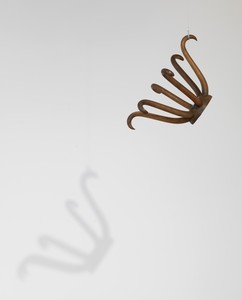
Marcel Duchamp, Porte-chapeau (Hat Rack), 1964 (after 1917 lost original), wood hat rack, 9 ½ × 18 × 18 inches (24 × 45.7 × 45.7 cm), private collection. Photo: Rob McKeever
JKWell, one of the things I enjoy most about the idea of the readymade is that everything’s already there. As I was saying before, he certainly laid a foundation for generations of artists to follow, and while that’s radical, he’s also connected to art history. I was once in Greece with an archeologist and historian, Dr. Harry [Ilias Theocharis] Tzalas, who was acting as a tour guide on some of the islands, taking us around to show us sites. And he said to me, Jeff, I know you love the idea of the readymade, but the readymade is an ancient idea: If you lived in ancient Greece you would have walked by a temple and if it was falling apart, you’d realize, oh, you could put that above the doorway of your house, and you would have just taken some of those stones home. Everything was a readymade. Everything was there to absorb, to use, and to adapt in any manner. And I thought that was really beautiful and that it was a tie that Duchamp was connecting us to, this adaptability. And you know, maybe in society—the way we developed through the nineteenth century, the Industrial Revolution, all of these objects that carry an essence of ownership—this idea of adaptability and that everything was there to serve and be used, he reopened all that.
AMDuchamp once said that “you can cut off the artist’s hands and still end up with something that is a product of the artist’s choice,” that art can be a product of that choice. Of course this idea relates clearly to Warhol, but as we have already discussed, he was influenced by Duchamp. I wonder whether that way of thinking ever offered you freedom in your practice.
JKAbsolutely. After my first year of art school I was at home for a summer working in a machine shop that built big wrenches, it was a way to make some money, and I was using one of these machines to lift the cranes and my hands slipped. I ended up getting a cut on my left hand and I had to get stitches. And I remember going to the doctor, I was worried whether this was going to be okay, and he said yes. But it made me think about my approach and I started to lean into this Duchampian manner. I was also thinking of Henri Matisse, lying in bed making those big cutout pieces, those big designs. It was about this sense of freedom that yes, art is an intellectual, philosophical pursuit, not just a physical pursuit.
AMWe’ve spoken about Duchamp’s influence, but I think it’s remarkable that even the few artists we’ve mentioned—Warhol, Johns, Rauschenberg—make work that looks absolutely nothing alike. It fascinates me to see how the work of one artist can shape the way future generations think, and the art that they make, in ways that are totally unpredictable. Also, looking at Duchamp’s contemporaries, there was such a wide swath of artmaking happening across those groups at that time. What has surprised you about Duchamp, and the way his work connects to other artists?
JKI’ve always loved the idea of the avant-garde, and with Duchamp and his friends around him, Francis Picabia, Salvador Dalí, you have all these people establishing a way of life, to have as vast a life as possible, to have as great an experience as possible, and to enjoy the pleasures of art as much as possible, while at the same time trying to offer the rest of the world the opportunity to transcend too. But most of all what I really love about Duchamp is that kind of aha moment. I mean, just think about the bigness of the idea. It was a game changer. They talk about being outside the box, but it’s really about opening oneself up, embracing all the freedom, all the possibilities, everything. There’s nothing restraining us in any manner other than ourselves. Culture, the external world, really doesn’t make judgment; it’s inanimate. Judgment comes from within us. And if we can just remove that, we can, I believe, really be engaged.
AMIf you met Duchamp at a dinner party, what would you talk about? What questions would you have for him?
JKWell, I’d probably start by asking about his interests. We know that he was extremely cerebral but also that he loved physical, sensual experience, so I guess I would want to speak about the connection there. And I might want to see if he had any awareness of Riegl or if it was just something in the air that he happened to pick up on. And I would ask about his generosity, whether that was something he consciously sought. I know as an artist when I was younger, I would always just enjoy that sensual experience of developing personal iconography and learning that I could control feelings and sensations. And the readymades do have those, even though they’re removed. But you look at a shovel, you feel that piece. You feel these readymade objects. They’re still very sensual.
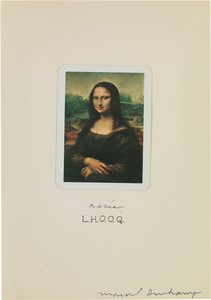
Marcel Duchamp, L.H.O.O.Q. rasée (L.H.O.O.Q. Shaved), 1965, playing card with ink mounted on printed invitation, 8 ¼ × 5 ⅜ inches (21 × 13.7 cm), private collection. Photo: Rob McKeever
AMLately I’ve been reading interviews with him and one talk stood out, a panel discussion with Rauschenberg and several art historians at the Museum of Modern Art in New York on the occasion of the Art of Assemblage exhibition in 1961. It was a very animated talk, and Rauschenberg was quite provocative in challenging the art historians, who were sharing these quite heady ideas that may have been a bit hard to follow. The historians seemed to enjoy the banter quite a bit and it certainly kept the talk interesting, but Duchamp was very quiet the whole time. He seemed so reserved, but when he spoke, it packed such a punch. You can tell that everyone in the room was hanging on his every word. During a different panel conversation at MoMA, this one in 1964, there’s one moment that I loved where Alfred H. Barr Jr. challenged Duchamp on his idea that art is not about beauty by saying, Well, then why are your objects so beautiful? And Duchamp apparently smiled and said, Well, nobody’s perfect.
JK[Laughs] I’ve always felt that there tends to be a lot of critical dialogue around Duchamp’s work that creates a hierarchy, and sometimes it feels like this hierarchy was created as a way to keep Duchamp for themselves. For Duchamp it’s about an intellectual equality, made not just by the hand but by the mind. There’s no desire for this hierarchy. And what I’ve tried to do with my work is emphasize the removal of hierarchy—these ideas are for everyone, and are to be celebrated by this act of the removal of judgment, this act of acceptance, of opening everything up to be used, adapted. Everything is empowerment at that point. But as soon as you bring in hierarchy, it’s disempowering, it’s segregating. And I’ve always looked at his work as the opposite.
Duchamp is such a cornerstone in so many ways. And this part about removing the body and bringing about intellectual discourse opens us up to the beauty of, okay, all the human disciplines can be engaged. I would even say that maybe the idea of the dilettante—to be a dilettante is always looked at as negative but I think of it as positive, because it reflects being open to everything and being involved in all the human disciplines. And I think Duchamp represents that freedom.
Artwork © Succession Marcel Duchamp/ADAGP, Paris/Artists Rights Society (ARS), New York
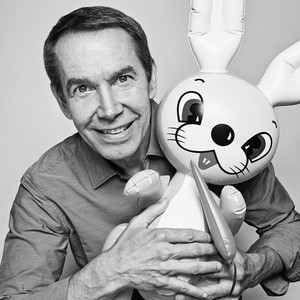
Since his emergence in the 1980s, Jeff Koons has blended the concerns and methods of Pop art, Conceptual art, and the readymade with popular culture to create his own unique iconography, often controversial and always engaging. He works with everyday objects to address themes of self-acceptance and transcendence. Photo: Sabastian Kim/August Image, LLC
Alison McDonald is the chief creative officer at Gagosian and has overseen marketing and publications at the gallery since 2002. During her tenure she has worked closely with Larry Gagosian to shape every aspect of the gallery’s extensive publishing program.
The Spring 2026 issue of Gagosian Quarterly is now available, featuring Marcel Duchamp’s L.H.O.O.Q. (1964) on the cover.
Don Quaintance’s new book Duchamp in California: Walter Hopps Curates a Retrospective (Menil Collection/König, 2025) details the rich history of the Pasadena Art Museum and the consequential Marcel Duchamp retrospective that Walter Hopps curated there in 1963. Here Quaintance gives the backstory to the monograph and shares an excerpt from the book’s fourth chapter.
Harry Thorne reflects on Brian O’Doherty’s recording of Marcel Duchamp’s heart.
The Summer 2023 issue of Gagosian Quarterly is now available, featuring Richard Avedon’s Marilyn Monroe, actor, New York, May 6, 1957 on its cover.
The Fall 2022 issue of Gagosian Quarterly is now available, featuring Jordan Wolfson’s House with Face (2017) on its cover.
Jacquelynn Baas profiles Isabelle Waldberg, writing on the sculptor’s many friendships and the influence of her singular creations.
The Spring 2020 issue of Gagosian Quarterly is now available, featuring Cindy Sherman’s Untitled #412 (2003) on its cover.
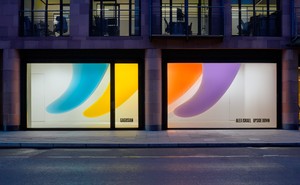
Ahead of Alex Israel’s exhibition of four new Fin sculptures at Gagosian, London, the artist spoke with Susan Casey, author of The Wave: In Pursuit of the Rogues, Freaks, and Giants of the Ocean (2010), about the ocean, surfing, and Los Angeles.

On April 16, the Institute of Contemporary Art, Boston, opened the first midcareer survey of Derrick Adams’s multidisciplinary practice. Covering over twenty years of work, the exhibition, titled View Master, brings together the artist’s painting, sculpture, collage, performance, and video, as well as a vibrant new commission created for the museum’s façade. Ahead of the opening, Adams met with Tessa Bachi Haas, cocurator of the survey, to discuss his formative experiences with television, the impact of his work in arts education on his practice, and the importance of taking a more complex, more joyful, and more expansive approach to Black American life and culture.

The Singular Experience at Gagosian’s Le Bourget gallery is the largest exhibition of Walter De Maria’s work in France in several decades. Organized by Donna De Salvo, senior adjunct curator at Dia Art Foundation, the exhibition marks the first time De Maria’s final sculpture, Truck Trilogy (2011–17), is being shown outside of the United States. Here, De Salvo speaks with artist Lucy Raven about her evolving kinship with De Maria and more.
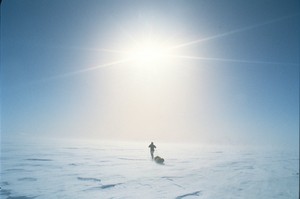
Ed Ruscha sits down with the author and explorer Erling Kagge to discuss existence.
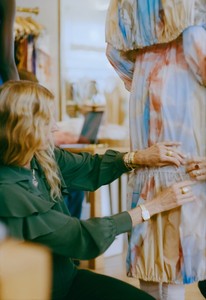
Following the debut of her Fall/Winter 2026 collection at Dia Chelsea, New York, Ulla Johnson met with Sarah Godfrey to discuss her recent collaborations with the Helen Frankenthaler and Lee Krasner foundations, her upbringing in and dedication to New York City, and her nonhierarchical approach to collecting.