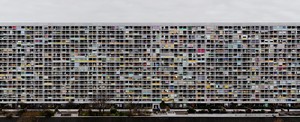
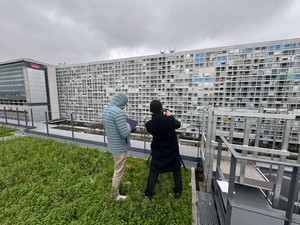
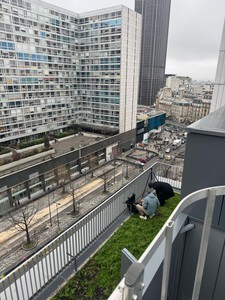
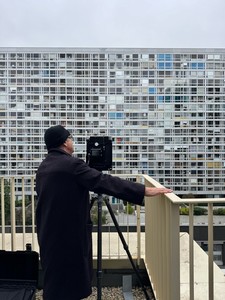
Wyatt AllgeierIt has been thirty-two years since Paris, Montparnasse (1993) was created. Could you take us back to that original work? What prompted you to photograph this building—L’immeuble d’habitation Maine-Montparnasse II, a quarter-mile-long modernist housing block designed by Dubuisson in 1959 and completed in 1964—in particular?
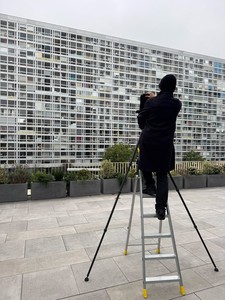
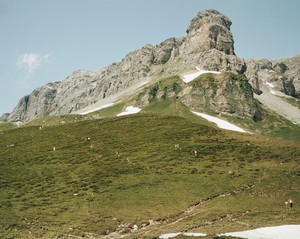
Andreas GurskyI would have to provide some context to explain how this new version of Paris, Montparnasse came about. Last year, I began revisiting a select number of locations I had originally photographed in the 1980s and 1990s. Against this backdrop, Aletschgletscher II (Aletsch Glacier II) emerged in 2024, followed by Elektroherd (Electric Cooker) and Paris, Montparnasse II earlier this year.
What fascinated me from the outset about Montparnasse was that the building functions as a vast panopticon, revealing a wide array of personal tastes at a single glance. Through its 1122 large windows, one has a clear view into the individual interiors. Since the rooms are relatively small, the lifestyles of their occupants are compressed into view. Over the past thirty-two years, the social cross-section appears to have remained largely unchanged. For instance, easels are still visible through the windows, indicating ongoing artistic pursuits. A friend who previously engaged with the original image—producing a remarkable box set with texts and image details—may revisit his sociological study of the building this year.
WAFor this reengagement here in 2025, how have your interests and objectives evolved? In the same vein as your images of the Rhine taken in 1999 and 2018, or of an alpine glacier in Switzerland photographed in 1993 and 2024, there is a consideration of time’s passing and the material change that takes place in a location. Are you able to speak to the specifics of those changes to this building and its inhabitants, and of the changes you may have experienced as the artist encountering them?
AGIt all began with a renewed engagement with the Rhine motif, which culminated in the work Rhein III (Rhine III) (2018). By coincidence, I had observed that the meadows at the very site where I had captured Rhein II (Rhine II) in 1999 had transformed almost into their opposite. What had happened? In 2018, Germany experienced an extraordinarily dry summer—one of the driest in a century—which left the previously lush green meadows scorched, turning them a dull shade. This shift in reality effectively created the new motif, and I sought to document this transformation photographically.
WATechnology has advanced considerably since 1993, as well. With Paris, Montparnasse II, what new freedoms and parameters arose due to the new technology? Without giving too much away, are there novel alterations that intrigued you while working on this new photograph?
AGOf course, image capture and digital processing techniques have advanced significantly over the past thirty-two years. Both works span about four meters [thirteen feet] in width. Compared to Paris, Montparnasse II, the initial image now appears almost picturesque—a result of its graininess and soft focus. Today’s photographic techniques allow for an analytical, even forensic rendering. Like an X-ray, they transform figurative elements into structural patterns.