With an exhibition of all-new work at Gagosian, New York, in November, Jeff Koons met with Alison McDonald at his New York studio to discuss the processes, inspirations, and metaphysical underpinnings of his latest sculptures and paintings.
Jeff Koons in his studio, New York, 2025. Photo: courtesy Jeff Koons
Jeff Koons in his studio, New York, 2025. Photo: courtesy Jeff Koons
Alison McDonald is the chief creative officer at Gagosian and has overseen marketing and publications at the gallery since 2002. During her tenure she has worked closely with Larry Gagosian to shape every aspect of the gallery’s extensive publishing program.
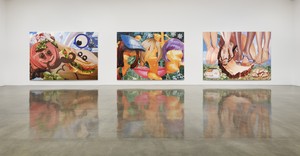
Alison McDonaldLet’s talk about your upcoming exhibition, where you’ll be presenting never-before-seen paintings and sculptures from the Porcelain series. In these new paintings you’re layering together various art-historical images, painted with your traditional studio-based approach but adding gestures from your own hand and working with elaborate aluminum line drawings on the surface.
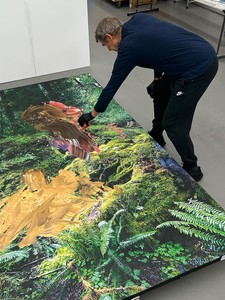
Jeff KoonsAs you know, my works draw on the past, from human history up until this moment. The backgrounds, such as a forest, are photorealistic depictions, there’s painting after that using stenciling techniques, and hand painting is applied on top for the gestural strokes.
AMThose gestures are rich, thick, and brushy, which makes them feel fresh and remarkably different for you: Earlier gestural strokes in your work tend to be flat, and are applied meticulously using a blend of colors. Is this the first time you’ve applied your own gestural handwork over other layers of precise painting?
JKAll the gestures are painted by me, no one else touched any of these gestures. I was always a painter; I painted up until my paintings got too big to be on the wall anymore, I think that was 1976? Then I took them off the wall and started making sculpture more, and at that point I embarked on machine-made paintings—I made the Nike posters as part of the Equilibrium [1985–93] series, which were prints shown as visual 2D works. That led to the Luxury and Degradation works [1986] and the Made in Heaven [1989–91] paintings, which were machine made. Later I returned to the handmade with the Celebration series [1994–2019] and the Popeye series [2002–13]. They’re all handmade paintings.
AMBut they’re not thick and gestural like this.
JKNo, that’s new, but even in the past I was consistently creating systems where I could be responsible for each and every mark. We worked intensively with the staff for many years, developing the process and making it better and better and better.
AMOn the top surface of your new paintings there’s aluminum outlining lines from an enlarged etching, almost like a reflective silver drawing.
JKYes, the aluminum is applied through a sizing technique, similar to how you’d work with gold leaf. This is the first time we’ve used aluminum. We have used silver paints in the past, but this is very very different. We really did a deep dive into the best way to be able to do this, and we believe that 200 years from now it will look exactly the same as it does today.
AMOh, that’s interesting. And where is the aluminum-lined image sourced from?
JKWell, that one over there comes from an [Annibale] Carracci. All the prints are basically from the Counter-Reformation. The range is from [Bartholomeus] Spranger, Carracci, [Marcantonio] Raimondi after Raphael, The Judgment of Paris [1513–15]. So after the aluminum is applied on top of my first layer of gestures, we come back and I make other gestures on top.
AMHow much will the presence of the aluminum change on the surface when the lighting is different?
JKOh, it will change with the lighting. This one, you see how bright this is? But when we put on just one row of lights, it changes the reflection completely.
AMAh, look at that—the aluminum can dance across the surface or can recede quietly to allow room for the colors, depending on how the light hits. And then, when you see the new gestures, they’re bold and colorful and thick with paint. And, at the moment, they’re still wet . . .
JKYes, they’re drying but everything’s going great. I did the first gestures, then the aluminum, then came back and did these final gestures. But I think the color is beautiful.
AMIn the backgrounds there are art-historical inspirations, similar to those that appear in your Gazing Ball series [2013–].
JKOn this one the background is originally by Raphael, but Raimondi created a print based on the Raphael work and that’s what we used for the aluminum lines on top. So this painting speaks to the story of Raphael and of Raimondi as well. This is The Judgment of Paris. This is Paris here, where this small fleshy gesture appears on top.
AMIt would be great to talk about the new sculptures. It sounds like you just came back from a trip where you saw some of those works being finished.
JKI just went and was viewing Diana. It’s a very large piece and we just finished it. I gave my final approval.
AMMost of the Porcelain series sculptures in the show have never been shown before?
JKYes, a few have been shown but many never have. What’s really exciting is that this is the first time we’re showing works from the series together in a dedicated exhibition, and we get to bring the sculptures together with the paintings.
AMThe scale for these sculptures is quite large—some of them tower over the viewer, giving them a “wow” factor—but the original sources are far more modest in scale, affordable, and able to be held in the hand.
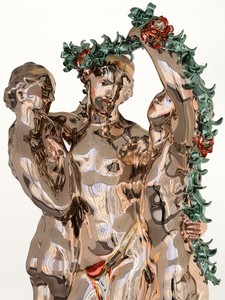
JKThe originals are porcelain objects that range from the eighteenth century up to the early twentieth. There are mythical gods and lovers kissing and embracing. The only one in the lovers’ series that isn’t two people is Eros, because Eros is a representation of love. Then I’ve included animals that kind of exchange roles with humans: In certain situations in the Porcelain series the animals are like the lovers and the lovers can be like the animals. Not all of those works will be shown in the exhibition, but there is that type of role play in the series as a whole.
AMThe figures often have clothing that feels specific to earlier historical moments.
JKIf I made a sculpture of a contemporary embracing couple, it might be somewhat corny because they’d be in contemporary clothes. It’s almost like that should be on top of a wedding cake. But as soon as you bring in time, the work becomes metaphysical, because now these are eternal lovers. That happens through Platonism, where even though this is an eighteenth-century shoe, a shoe is a shoe, and even though these are eighteenth-century pants, pants are pants, and lovers are lovers. So that’s where I want to be able to depict the aspect of a continuum: This is a dialogue about the history of humanity, our wants, our desires, our excitements, our needs.
AMIt’s also universally accessible to a wide audience. Everyone can relate to it and take something from it.
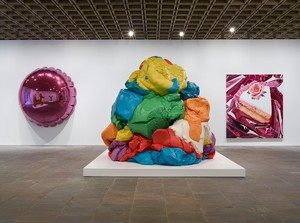
JKYes, that’s true. And these pieces are reflective. They’re stainless steel. I’ve always liked stainless steel because of its sense of permanence. It’s something lasting, a durable material, and the polish of it—
AMThe mirror—
JKYes, it’s dependent on light. You take a polished stainless steel piece, and I’m going to say polychromed here, but if you turn out the lights, it’s just black. Turn on the lights and it reflects its environment. It loves light, just like all life loves light. So the energy, the response, the excitement that we can feel within our own bodies, comes from light and the reflective aspect of it.
AMWell, I think that’s part of the illusion that makes this dense sculptural material feel weightless, right? It’s such a heavy object, but it doesn’t feel heavy because of the light.
JKYes, and it makes the image somewhat intoxicating: It excites our senses, makes us feel lighter. It makes our own being feel somewhat out of body, as if we were on the surface, or in between.
AMYou’re continually pushing the limits of the fabrication process to achieve the effects you desire, and working in stainless steel is no different. Even the colors and the gradations are seductive.
JKThank you. One of the greatest compliments, Alison, that was ever given to me in relation to my work came from Vinzenz Brinkmann, who’s the director of the Liebieghaus in Frankfurt. He’s a great archaeologist and he really understands that the ancient world was polychrome. Historians knew that; archaeologists knew that, but it was always kept hidden. And even archaeologists wouldn’t bring it to the forefront for different reasons throughout history. But Vinzenz said, If the ancients—and when he’s talking about the ancients he’s talking about Praxiteles, Lysippos, and Phidias—had the technology that I have today, they’d be doing exactly what I’m doing.
AMOh wow. That’s a lovely compliment.
JKSo in a way, this work is very much in dialogue with the ancient artists. But it’s really a dialogue for me about art and about humanity and our belief systems and our need for belief systems; and at the same time, our freedom and our awareness that we’re in nature and that we don’t have control.
AMYou mean we don’t have control over nature, or the course of time, or the future?
JKIn fact, I think this work is very much about enlightenment. There’s a certain awareness and transcendence. But at the same time, we can never completely understand nature. And really, if anybody looks at the work and has any sense of wonderment, in the end it really is all in the wonderment of nature itself. Just cells interacting.
AMYou just came back from giving your final approval on a sculpture that you’ve been working on for close to ten years. What’s it like to see a piece finished after so long?
JKWell, the Diana sculpture is one that’s important to me. Diana is a porcelain originally, from the late nineteenth century. I come from readymades; I worked with readymades because, for me, the readymade speaks to the importance of being open to everything in the world. We just have to open ourselves up to experience, and that happens through acceptance, through removing fear and anxiety. If we can’t make judgments, then we can accept things. Everything is there to serve us, and it does serve us. We start to recognize it when that type of connectivity happens, the serendipitous type of information. The connectivity of everything becomes very abundant to us.
AMThese works are part of the Porcelain series but the sculptures are made of stainless steel. How do you retain the sensation of porcelain in such a different medium?
JKThe original models are porcelain; these are stainless steel, but they have the same aspect of tension of surface. There’s a type of softness in the porcelains that I’ve worked with that runs very, very parallel to the stainless steel. So it has both at the same time, this sense of being a regal, elevated material and a common, democratized material.
AMThis isn’t the first time you’ve brought porcelain into your works.
JKI played in a similar way, somewhat, in my Banality series [1988] and in working with porcelain as the material of sculptures such as Michael Jackson with Bubbles [1988] and Woman in Tub [1988]. But I was working with the actual material, and playing with the aspect that it came from the emperor’s kitchen. That’s where the porcelain factory was located, and an everyday person wouldn’t have been able to access porcelain. Now today, we can all have it.
AMAnd how do you handle the colors and their gradients in stainless steel?
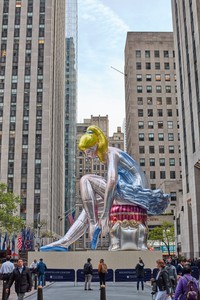
JKThe Ballerinas and the Seated Ballerina, which are both part of the Antiquity series [2008–], have these gradations, but the Seated Ballerina more than the others. If you look at the cheeks and knees, you’re going to have gradation, and there’s more color, more warmth, at the feet. And these different areas on the piece, this is all painted. It’s incredible. In a piece like this, we’re going to have thousands of 3D slides applied by machine, so that we can always have the flower in the same location and get the correct gradation to go from a density of color to a lighter shade. And the lines must always be in the correct place, the correct edge. We’re very careful about the gradation because it helps us attain that metaphysical quality. When you see this gradation, you’re not consciously thinking about only this spot on this sculpture, but you’re in a profound part of your mind. It’s time, it’s a sunrise, it’s a sunset. Just think about when you look at a sky: It’s a big gradation. The sun came up over here, you can see the way the light is affected. So in a way, gradations depict time. It’s another element in dialogue with presence and connectivity.
AMDid you always feel this drive toward being open to experience and the importance of connectivity?
JKWhat I loved about the art world when I was younger, and the way I fell into art, was I wanted to be part of a group. I always made art; I’d take art lessons, I’d be in an art class. But there was a desire to participate in the avant-garde and to be part of a group of people trying to do something. There was a sense of connecting with a community with similar interests, and a desire to be in dialogue with a wider view, a humanity.
AMDo those shelves hold original porcelain sources?
JKYes, we collect original porcelains throughout the process of preparing the work. Let’s say I have an interest in making a sculpture of a stag and dog: I’ll try to get as many models that I can of it, so I can study the possibilities, pick up on different coloring information, that sort of thing. But of course I’m free to manipulate these. When I say manipulate, there are certain things that I don’t change, or I want just like that. There are other things where I need to be free. I don’t want to be locked in, I’m a creative person, and if I believe that I can communicate something, I’m only using that image, that object, as a tool. So if I want to manipulate things, if I want to change the color, I do that.
AMThese porcelain originals are all hand painted and feel unique, in that the same sculptural form can have a variety of different types of painting applied. For instance, patterns on the clothing can change from piece to piece. Were they made in different moments by different artisans?
JKDifferent companies, different artisans. This couple happens to be by a very famous model-maker from Munich. For me, this one is special because there’s a bird in a cage, a symbol that she’s pregnant. This work is of a music lesson.
AMThere are relatable stories within every scene.
JKLet’s look at the lovers in comparison with the stags. See how the stag is kissing? The head of the doe is licking him. You look at it, it’s very much about power, it’s sexual, but in a way I think it’s somewhat about being fearful of sex. And when you work with images of gods, the storytelling that comes along with those figures is almost like a pendant that you can bring into the finished sculpture.
AMWell, that’s one of the most powerful aspects of your work, that it’s relatable to everyone, regardless of their age or background. I could bring my children or my parents in and they would each take something away from the experience without feeling like it wasn’t for them.
Alison McDonald is the chief creative officer at Gagosian and has overseen marketing and publications at the gallery since 2002. During her tenure she has worked closely with Larry Gagosian to shape every aspect of the gallery’s extensive publishing program.