
Now available
Gagosian Quarterly Winter 2025
The Winter 2025 issue of Gagosian Quarterly is now available, featuring Jeff Koons’s Kissing Lovers (2016–25) on the cover.
February 11, 2026
Stella McCartney’s new limited-edition capsule collection made in collaboration with Jeff Koons launched in January 2026. Blending the two creators’ singular visions, the collection, which was first seen in McCartney’s Winter 2025 runway show, features a wide array of garments and accessories printed with artworks by Koons and slogans by McCartney. The collaboration continues the pair’s long-standing creative partnership, which has previously included jewelry, prints, and charitable initiatives. At the unveiling in New York, Koons met with Derek C. Blasberg to reflect on the collaboration, the importance of caring and community, and meeting Salvador Dalí when he was nineteen years old.

Doggy Style T-shirt from the Stella McCartney × Jeff Koons capsule collection
Doggy Style T-shirt from the Stella McCartney × Jeff Koons capsule collection
Derek C. BlasbergLet’s start with this Stella McCartney collaboration, and let’s start at the beginning. How did you two first meet?
Jeff KoonsWe first met in the Hamptons at a party at Larry Gagosian’s house. Stella came in, and I immediately felt like I had always known her. She’s so disarming. It felt like we’d known each other in high school and had stayed friends all the years since.
DCBI remember when she opened a store in New York’s Meatpacking District in the early 2000s, and she used a print that the two of you collaborated on in the dressing rooms. Was that the first time you worked on something together?
JKStella also used some of my Celebration designs for dresses, I think in 2004. I can’t recall which came first, but all of that was around the same time. It’s been nice to come back together, work with the newer imagery, and see where else we can take things.
DCBHow do you two collaborate?
JKStella usually comes to my studio when she visits New York. She likes seeing the colors—little swatches that are used for paintings. Sometimes she takes them back to her studio to see if she can incorporate them into something she’s working on. What I’ve always loved about her brand is that you can see the essence of her personality in her designs. You look, and you can feel Stella. There’s a confidence and a warmth. Humanity, playfulness, a sensual quality—all the attributes of her personality that have enabled her to survive in this world. I’m always a little awestruck.

Derek C. Blasberg and Jeff Koons at the Stella McCartney store, New York, 2026. Photo: Matteo Prandoni
DCBYou revisited one of your most famous works, Rabbit of 1986, with Stella. Talk to me about that.
JKAfter 1986, the only other time I made my rabbit in a physical form was with Stella, and we did it as a necklace. She designed the necklace part, and my studio made the rabbit. All the details of the original were complex, so that project was time consuming.
DCBLet’s talk more broadly about the convergence of fashion and art, a favorite topic of mine. Salvador Dalí and Elsa Schiaparelli collaborated, Pablo Picasso and Coco Chanel collaborated—what is your opinion on the convergence of these worlds?
JKArt is something that lets you become. It’s a vehicle. There are many vehicles that, if you focus on your interests, can lead you to a kind of universal vocabulary where experiencing things that are special, like great fashion design, can be transcendent. It’s surprising. It’s new. It gives you a sense of possibilities. The feelings and the sensations of being able to experience certain textures, certain colors—these are the things that enable us to change.
DCBAt a dinner party years ago, you told me that your first art teacher taught you that one can overcome almost anything through art. Do you remember that story?
JKThat was my first-grade art teacher, Mrs. Miller, who was missing one hand. At the end of her right arm, there was a wrist and five tiny nubs. She was fantastic. What I picked up from her was that through art, you can overcome any limitation, any type of handicap. Think of artists like Titian, who was going blind when he created his late work, yet I think it is his best. Look at Picasso—well, Picasso had a tremendous amount of energy, so his handicap was in a sense the assumption that he couldn’t continue to transcend higher and higher, and yet he did.
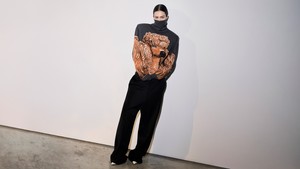
Poodle Jumper from the Stella McCartney × Jeff Koons capsule collection
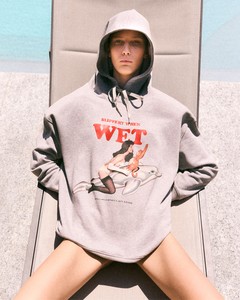
Slippery When Wet Hoodie from the Stella McCartney × Jeff Koons capsule collection
DCBHas the style world influenced or impacted what you do in your art practice? Apart from being incredibly stylish yourself, obviously!
JKI wish that I could be more stylish! In all the arts, across all realms of communication and creation, fashion is essential. It’s powerful. It’s so important in life to accept oneself, and fashion is a powerful vehicle for feeling confident. As soon as you accept yourself, you open yourself up to the world, to experience, and to the ability to transcend.
DCBPerhaps the biggest difference between the fashion and the art worlds is the timeline. Stella has a new show every six months, whereas you can spend years, even decades, on a single work.
JKI’m always amazed at how the fashion world deals with that type of creative pressure—the expectation is that you reinvent yourself season upon season upon season. Anyone involved in the arts knows that initial ideas are usually pretty strong and powerful, so I have to assume that designers think about things they want to commit to and then just have to lock in, so to speak. Whereas, to give a little comparison, the Gagosian exhibition I have up right now, Porcelain Series, has been a work in progress for a decade. I’ve had other projects happening during that time, too, of course, but it’s been a decade.
DCBSomeone wanted me to ask if you had any advice for young fashion designers.
JKEnjoy being a part of a larger community of designers, because you’re performing as a generation; it’s just not your own singular voice. For me as well, it’s always been about participating. I want to be a part of a community. It’s exciting to engage with people and have a dialogue. People talk about success, whether it’s the success of a designer or an artist or whatever the profession—but success doesn’t matter if you’re not engaged with others. To have extended friendships where you find meaning in common ideas—that’s the reward, that’s success. That’s what makes Stella so special. She communicates through so many different communities, and is able to share, to experience kindness and empathy for others. For me, the highest attribute that a person can have is caring. I know from working on different collaborations with Stella and other people involved in fashion that there can exist a high level of care—care for other people, for yourself, for the past, for the future, for the environment. It’s the same for an artist. I tell my children that if they learn anything from my wife and me, I hope it’s the importance of caring.
Stella McCartney and Jeff Koons’s Rabbit (2005) collaboration
DCBI’d love to hear you retell—and I know our readers would too—the story about how you met Salvador Dalí.
JKI’ve always loved this story. When I was a nineteen-year-old college student, my mom said to me, “Jeff, I just saw in a magazine that Salvador Dalí lives half the year at the St. Regis Hotel in New York.” Aha, that’s interesting. So I called up the St. Regis and asked if I could please be put through to Salvador Dalí’s room. They said, “Just one moment.” They put me through! Salvador Dalí answered the phone, and I said, “Hello.” He started speaking in different languages—he would speak a little bit in Spanish and different languages, and I only spoke English. But I was able to communicate to him that I was a fan, a college student, and that I would like to visit him. He told me that if I came that Saturday, he would meet me in the lobby at noon. I said I’d be there. He said, “Great.” We hung up, I got on a bus from Baltimore to New York, and I went to the St. Regis Hotel. At exactly noon on Saturday, the doors of the elevator opened, and Dalí walked out, wearing this big buffalo fur coat and carrying an elaborate cane with a silver handle, and his mustache turned up.
DCBWere you in awe?
JKI think it was the photographer Philippe Halsman’s daughter who once said, “When you meet Dalí, he makes you feel as though he’s gone out of his way and has done all this for you.” That’s exactly how you feel! When I met him, he said, “I have an exhibition up at the Knoedler gallery. If you would like to see it, I’m going there right now to meet a French journalist. You’re welcome to come along.” I got in a taxi, went up to Knoedler, and when I arrived, Dalí was walking around with this very tall woman. He was really excited. His own work was on view, and also a group exhibition of Surrealists that he had curated. I didn’t realize it at the time, but years later, I put together that the tall French journalist was Amanda Lear. She was his muse and inspiration throughout the 1970s and ’80s. Dalí came over to me and asked, “Would you like to take a photograph?” (I had with me a big Pentax camera.) I said, “Yes, yes, I’d love to.” He stood in front of a painting of a tiger where if you stood back, it morphed into three heads of Lenin. I’m getting ready, and he’s arranging his mustache and saying, “Come on, kid. I can’t hold this pose all day.”
DCBDid you get the shot?
JKI got it! I’m so happy to have this photograph. And I’m grateful that I subsequently had the opportunity to acquire one of the studies for that painting.
DCBNow that’s a sense of community.
JKThe tremendous generosity! You sometimes hear negative stories about Dalí, but I find that unfair because he was an extremely generous person, somebody who was happy to meet a nineteen-year-old kid. Think of our lives today, think of your life without seeing Dalí on The Dick Cavett Show, walking in with an anteater and putting it on a woman’s lap. I mean, it’s insanity.
DCBMaybe I can draw a link between Dalí’s desire to collaborate with other creatives and yours, many years later?
JKWorking with Stella has been a great collaboration. But I also want to say that in dealing with art and fashion and all these objects, at the end of the day, everything that we’re looking for is within ourselves. External things can excite and stimulate us, but only so that we can find meaning and purpose within ourselves. To be here today, to be rallied around aesthetics, that we find meaning in life through aesthetics—for me, there’s nothing more beautiful than that.
Stella McCartney × Jeff Koons capsule collection
Photos: courtesy Stella McCartney

Derek C. Blasberg is a writer, fashion editor, and New York Times best-selling author. He has been with Gagosian since 2014, and is currently the executive editor of Gagosian Quarterly.
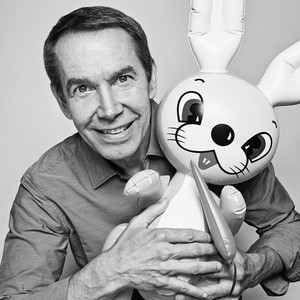
Since his emergence in the 1980s, Jeff Koons has blended the concerns and methods of Pop art, Conceptual art, and the readymade with popular culture to create his own unique iconography, often controversial and always engaging. He works with everyday objects to address themes of self-acceptance and transcendence. Photo: Sabastian Kim/August Image, LLC
The Winter 2025 issue of Gagosian Quarterly is now available, featuring Jeff Koons’s Kissing Lovers (2016–25) on the cover.

With an exhibition of all-new work at Gagosian, New York, in November, Jeff Koons met with Alison McDonald at his New York studio to discuss the processes, inspirations, and metaphysical underpinnings of his latest sculptures and paintings.

Catalyzed by Laws of Motion—a group exhibition pairing artworks from the 1980s on by Jeff Koons, Cady Noland, Rosemarie Trockel, and Jeff Wall with contemporary sculptures by Josh Kline and Anicka Yi—Wyatt Allgeier discusses the convergences and divergences in these artists’ practices with an eye to the economic worlds from which they spring.
The Fall 2019 issue of Gagosian Quarterly is now available, featuring a detail from Sinking (2019) by Nathaniel Mary Quinn on its cover.

Paul Goldberger tracks the evolution of Mitchell and Emily Rales’s Glenstone Museum in Potomac, Maryland. Set amid 230 acres of pristine landscape and housing a world-class collection of modern and contemporary art, this graceful complex of pavilions, designed by architects Thomas Phifer and Partners, opened to the public in the fall of 2018.
Jenny Saville reveals the process behind her new self-portrait, painted in response to Rembrandt’s masterpiece Self-Portrait with Two Circles.
Learn more about Jeff Koons’s Easyfun-Ethereal series in this video featuring Rebecca Sternthal, one of the organizers behind the most recent exhibition of these works in New York.
Derek Blasberg speaks with Diane Brown, president and founder of RxART, and with contributing artists Dan Colen, Urs Fischer, and Jeff Koons about the transformative power of visual art.
Jeff Koons speaks with Alison McDonald and Maura Harty about his longstanding commitment to protecting the rights of children.

The FLAG Art Foundation hosted a conversation between Jeff Koons and FLAG founder Glenn Fuhrman, in which the two discuss the dichotomy between sexuality and childhood innocence in Koons’s oeuvre, remaking Made in Heaven with Lady Gaga, what drives Koons to make more work, and several works including Cat on a Clothesline (1994–2001) and Winter Bears (1988).
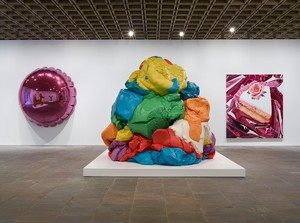
Derek Blasberg speaks with Scott Rothkopf, a curator at the Whitney Museum of American Art, about the last thirty-six hours of the Jeff Koons retrospective, which also marked the end of the museum’s tenure in uptown Manhattan.

Jeff Koons’s flowering sculpture Split-Rocker, at once imposing and adorable, has cast a spell on New York City’s Rockefeller Center. Derek Blasberg interviews Matt Donham, Koons’s landscape designer on the project, to find out more.