
Tradition and Innovation: The 2026 Loewe Foundation Craft Prize
The Loewe Foundation Craft Prize celebrates its ninth edition with an exhibition at the National Gallery Singapore.
June 25, 2026
The exhibition Pomellato, Le Joaillier Révolutionnaire opened at Palais de Tokyo, Paris, on June 24. The Italian jewelry house’s trailblazing advertising campaigns—created by some of the most consequential names in photography—act as the narrative arc of the exhibition, curated by Alba Cappellieri. Here, Sarah Godfrey tracks Pomellato’s history, speaks with Cappellieri about what drew her to this project, and examines some of the key photographs from the show.
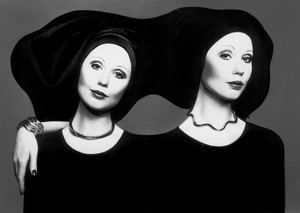
Le Gemelle (The Twins), Pomellato Advertising, Milan, 1971. Photo: Gian Paolo Barbieri
Le Gemelle (The Twins), Pomellato Advertising, Milan, 1971. Photo: Gian Paolo Barbieri
Shot by fashion photographer Gian Paolo Barbieri in 1971, Pomellato’s first campaign was more than an advertisement. It was a manifesto—a promise to challenge convention, to embrace difference and individuality, and to celebrate women. It featured the now-iconic Le Gemelle (The Twins), a photograph as uncanny as it is alluring. It shows two identical women—both the actress Lilly Bistrattin—seemingly conjoined by a fitted top with two rounded neck holes and a voluminous hat. The illusion of their connectedness is disrupted, however, by a mysterious hand bedecked in undulating bangles limply draped over the left twin’s right shoulder. The pair’s black clothing set against the solid gray backdrop creates silhouettes that echo the curves of the structured chokers that slither around their respective necks.
Much like Diane Arbus’s earlier Identical Twins, Roselle, N.J., 1966 (1966), Barbieri’s photograph embraces eccentricity and, through styling and pose, subverts the notion that even two identical women are truly the same. For the first time in the world of jewelry, necklaces and bracelets were being presented not just as a vaunted objects, but as assertions of individuality, extensions of inner beauty. The campaign was, in a word, a revolution, and for Pomellato, it was just the beginning.
It is no wonder, then, that professor Alba Cappellieri, curator and head of jewelry design at Politecnico di Milano, chose revolution as the unifying theme for the exhibition Pomellato, Le Joaillier Révolutionnaire, on view at Palais de Tokyo, Paris, June 24 through July 20, 2026. The expansive presentation includes historic jewelry and fine-art photographs, charting the evolution of the house’s visual language through its many collaborations with titans of the photographic medium. As Cappellieri explains, the show is an opportunity to become immersed in the revolutions in creativity, craft, image, style, meaning, and femininity that characterize the house. It is not simply a chronological history; it is the story of “how photography redefined what jewelry could mean” and “how jewelry can be a lens through which to read broader cultural and social transformations.”
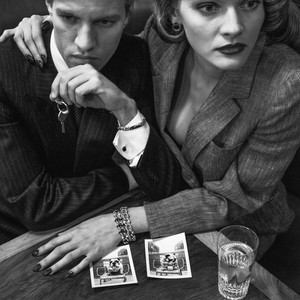
Photo: Helmut Newton, Pomellato, Paris, 1982 © Helmut Newton Foundation/Trunk Archive
Founded in Milan in 1967 by Pino Rabolini, the son of an Italian goldsmith, Pomellato takes its name from the speckle-coated horse, a symbol of rarity, but also the unbridled freedom of the late 1960s. Indeed, Rabolini’s initial idea for the brand was sparked by the vitality of women creatives—actresses, ceramicists, singers—that he encountered at the Jamaica Bar, a local haunt for intellectuals, artists, and performers that still exists today. He started Pomellato to pay homage to these women and the liberal spirit of the age through his family’s craft.
Establishing such a brand in the mid-twentieth century presented the major challenge of rewriting jewelry’s cultural codes. “Rabolini understood very clearly that jewelry could no longer be regarded only as an object of status or investment,” Cappellieri told me. “It had to become part of a lifestyle, a gesture, a personality.” It needed to be infused with the same sense of joy, freedom, and individuality that defined Italian prêt-à-porter. Jewelry, then its own independent category, had to become a part of the larger world of fashion, as it is today. “So, despite his limited financial resources, Rabolini made the visionary decision to entrust Pomellato’s image to Gian Paolo Barbieri.” The result, Le Gemelle, laid the foundation for Pomellato’s distinct, but ever-evolving, visual identity and established a new conversation between jewelry and photography, and jewelry and fashion.
Over the ensuing decades, Pomellato has maintained a public image in step with the shifting lives of women through collaborations with legendary fashion photographers. This began in the 1980s with Helmut Newton, whose campaigns surged with sensuality and cinematic glamour. Newton’s women are made up in smoky eyes and dark lips, or wear sunglasses inside. They dine alone, confidently, with their dopey bulldog in tow, or pull a man in by the chin for a kiss. They exude a boldness that borders on audacity, just as their jewelry serves as a glistening declaration of agency, independence, and strength.
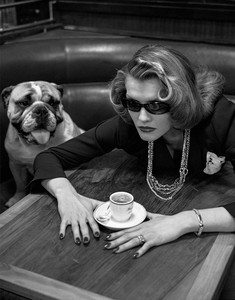
Photo: Helmut Newton, Pomellato, Paris, 1982 © Helmut Newton Foundation/Trunk Archive
Later in the decade, Pomellato would turn to Horst P. Horst, a master of “classic” fashion photography known for his sculptural images and nuanced use of chiaroscuro. His 1987 campaign featured a model reclined in a C-curve showcasing her delicate musculature and a group of cascading gold chains—a house signature—draped down her back. The image oozes elegance and stylish sophistication. It also exhibits a different sort of feminine strength than Newton’s—subtler in its assertion, but just as resolved.
Notable campaigns from the 1990s expressed a pronounced sense of intimacy. Herb Ritts’s portraits of nude, clay-covered bodies holding Pomellato chains are marked by their simplicity and frankness. Even more poignant is a photograph from Snowdon’s campaign of 1992. The magnetic picture captures a woman with her hair swept over the right side of her face, exposing her left eye and ear hung with a rounded cabochon. This is not an encounter or a declaration, but an invitation to observe a woman arrested in a moment of introspection. Her visage, both revealed and concealed, alludes to the complexities of identity, just as the cabochon—a unique stone—acts as a metaphor for the beauty of individuality.

Photo: Herb Ritts, 1990/Trunk Archive
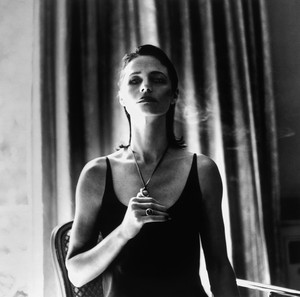
Photo: Michel Comte, 1994/Action Press
History is made when someone summons the courage to break with convention. The exceptional quality and historic importance of the photographs included in Pomellato, Le Joaillier Révolutionnaire are testaments to the maison’s pioneering vision and spirit. Through its many revolutions, the house has left an indelible mark on the history of photography and on the lives of women by transforming the ways jewelry communicates meaning. Even today, Pomellato continues to break down barriers with projects such as Pomellato for Women, an initiative launched in 2017 to promote gender equality in myriad contexts.
In preparation for the Paris exhibition, Cappellieri asked her mother, a jewelry enthusiast, to share how Pomellato’s advertisements affected her in her youth. “Oh,” her mother said, “it was really a new way of looking at jewelry.” The subtext: It was really a new way of looking at the world.
Pomellato, Le Joaillier Révolutionnaire, Palais de Tokyo, Paris, June 24–July 20, 2026
Photos: courtesy Pomellato

Sarah Godfrey joined Gagosian in 2024. As an artist liaison, she supports exhibitions and special projects for Michael Heizer, Anselm Kiefer, and the Willem de Kooning Foundation. Previously she was assistant curator of works on paper at the Fine Arts Museums of San Francisco and worked in the luxury sector at Christie’s, New York.
The Loewe Foundation Craft Prize celebrates its ninth edition with an exhibition at the National Gallery Singapore.

Stella McCartney’s new limited-edition capsule collection made in collaboration with Jeff Koons launched in January 2026. Blending the two creators’ singular visions, the collection, which was first seen in McCartney’s Winter 2025 runway show, features a wide array of garments and accessories printed with artworks by Koons and slogans by McCartney. The collaboration continues the pair’s long-standing creative partnership, which has previously included jewelry, prints, and charitable initiatives. At the unveiling in New York, Koons met with Derek C. Blasberg to reflect on the collaboration, the importance of caring and community, and meeting Salvador Dalí when he was nineteen years old.

Since 1982, François Laffanour has been operating the Paris-based Galerie Downtown, a Left Bank outpost specializing in modern furniture and design. The gallery has played a key role in the exhibition and promotion of work by such midcentury greats as Charlotte Perriand, Jean Prouvé, Jean Royère, and Ettore Sottsass. Ahead of this year’s TEFAF New York, Laffanour met with Gagosian archivist Timothée Viale in Paris to speak about the fair, the gallery’s evolution, and the importance of embracing the future.
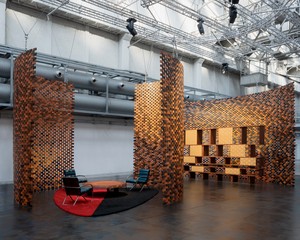
This year’s Salone del Mobile Milano brought together a range of installations, debuts, and collaborations from across the worlds of design, fashion, and architecture. We present a selection of these projects.

David Cronenberg’s film The Shrouds made its debut at the 77th edition of the Cannes Film Festival in France. Film writer Miriam Bale reports on the motifs and questions that make up this latest addition to the auteur’s singular body of work.
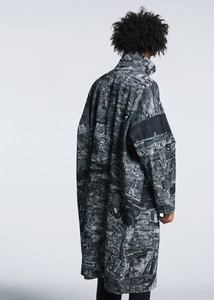
Founded in 1998 by Issey Miyake, A-POC (“A Piece of Cloth”) set out to bring the development and production of fabric and garments into the future. Over the subsequent decades, A-POC has worked at the forefront of technology to realize its goals, and under the leadership of Yoshiyuki Miyamae—who has been with Miyake Design Studio since 2001—A-POC ABLE has engaged in a dynamic series of collaborations with artists, architects, craftspeople, and new technologies to rethink how clothing is designed and made. On the occasion of the line being made available in the United States for the first time, the Quarterly’s Wyatt Allgeier visited the brand’s flagship in New York to speak with Yoshiyuki about the A-POC process, as well as the latest collaboration with the artist Sohei Nishino.

This year’s Salone del Mobile Milano brought together a range of installations, debuts, and collaborations from across the worlds of design, fashion, and architecture. We present a selection of these projects.

Chris Eitel, Vladimir Kagan’s protégé and the current director of design and production at Vladimir Kagan Design Group, invited the Quarterly’s Wyatt Allgeier to the brand’s studio in New Jersey, where the two discussed the forthcoming release of the First Collection. The series, now available through holly hunt, reintroduces the first chair and table that Kagan ever designed—part of Eitel’s efforts to honor the furniture avant-gardist’s legacy while carrying the company into the future.
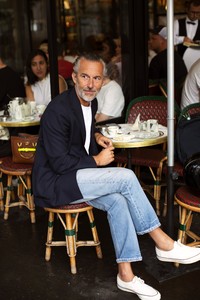
In October 2023, Officine Générale, the Paris-based brand of elegantly crafted, understated menswear and womenswear, opened its newest store on Madison Avenue in New York. Pierre Mahéo, the brand’s founder and creative director, met with the Quarterly’s Wyatt Allgeier at this location to discuss the evolution and consistency of his process, the influence of modernists like Charlotte Perriand, and what’s next for the brand.

Wife-and-husband team Heidi and Christian Batteau launched their bespoke wallcovering company, Assemblage, in 2013. Building on their educations in fine art and working alongside a studio of exceptional artisans, the couple has steadily grown their award-winning, museum-collected creations from their repurposed seed mill in Arkansas. Here, they speak with the Quarterly’s Wyatt Allgeier about their inspirations, their techniques, and their partnership with Holly Hunt throughout the United States and Europe.

Launched during NYC×DESIGN week in New York earlier this year, a new mural by celebrated artists FAUST and Vexta was painted on the wall of Ligne Roset’s New York flagship store on Park Avenue South. Utilizing each of their distinctive styles, the two painters collaborated to celebrate the message of nonconformism as part of the fiftieth anniversary of the Togo, Ligne Roset’s iconic furniture design. Here, the artists talk to the Quarterly’s Wyatt Allgeier about their aesthetics, scale, and the development of the project.
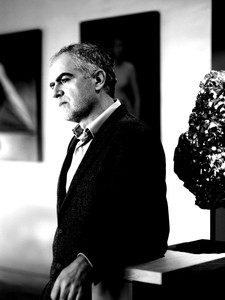
Swiss jeweler Christophe Graber reflects on his influences, the importance of place, and the development of his practice.