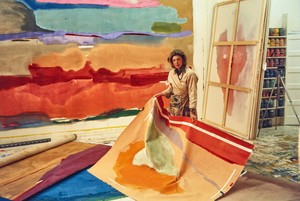
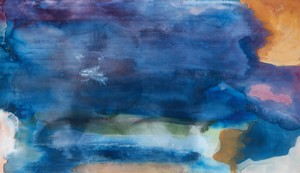
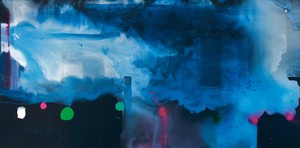
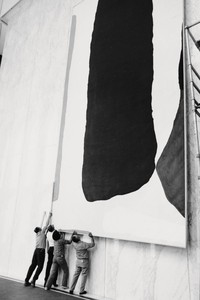
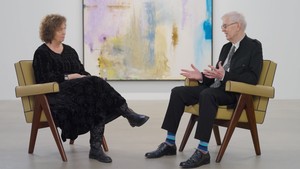
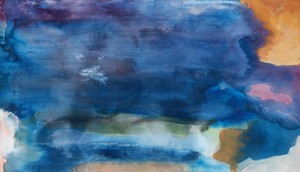
Helen Frankenthaler—the largest exhibition of the artist’s paintings to originate in Europe and her first institutional solo show at Kunstmuseum Basel in Switzerland—is now on view through August 23, 2026. Curated by Anita Haldemann, this monumental exhibition, spanning fifty paintings, offers a unique opportunity to examine Helen Frankenthaler’s immersive and atmospheric approach to color and abstraction. The presentation proposes a dialogue between Frankenthaler’s “paraphrases” of old master paintings and the original works on which her paintings are based. Here, Haldemann speaks with Filip Jakab about Frankenthaler’s transhistorical engagement, formal innovation, and enduring influence.
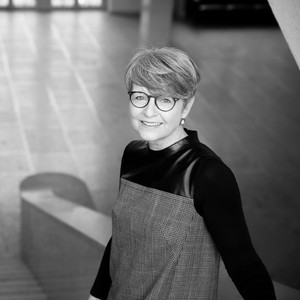
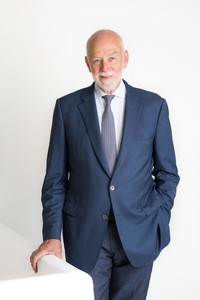
Anita Haldemann is a Swiss art historian who received her MA from Johns Hopkins University in 1995 on a Fulbright Scholarship and her PhD from the University of Bern in 2001. After working as a curator, she became head of the Kupferstichkabinett (Department of Prints and Drawings) at the Kunstmuseum Basel in 2015, curating acclaimed exhibitions on drawing and prints. From 2019 to 2026 she also served on the Kunstmuseum’s executive board as head of art and research and deputy director. She has held teaching positions at the Universities of Bern and Basel. Photo: Sara Rüedi
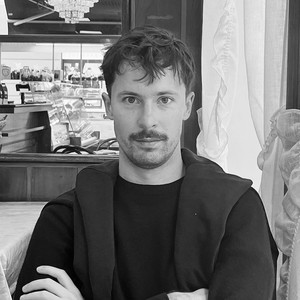
Filip Jakab is a writer and editor based between Brussels and Zürich. His short fiction has appeared in XRAY Literary Magazine, ExPat Press, and David Horvitz’s Garden. Filip contributes reviews, profiles, and conversation pieces to Vogue CS, the Whitney Review of New Writing, Public Parking, Our Culture Mag, and Flaunt. In December 2024, he completed a creative writing program at Stanford University. He writes the Substack life eats life. Photo: Mileva Testas
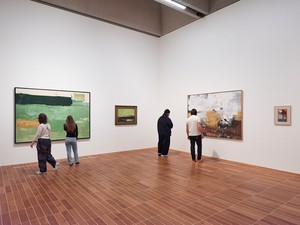
FILIP JAKABHelen Frankenthaler unfolds across nine galleries on the second floor of the Kunstmuseum Basel. Could you speak about the genesis of this exhibition and the curatorial framework that shaped its development?
ANITA HALDEMANNWe received the wonderful painting Riverhead [1963] as a gift from the Helen Frankenthaler Foundation two years ago. And immediately we thought it offered the perfect chance to do a show on one of the important women artists who worked in the 1950s, because women artists from that period are not present in our collection at all. And it’s part of our mission to make women’s careers or women artists more visible. We decided on a chronological survey because the general audience here in Switzerland doesn’t know Frankenthaler’s work very well. And compared to other artists, her work develops in such an interesting way that we really wanted to show it didn’t just stop in the ’50s. She went way beyond and worked for several decades. She was always innovative, experimental, and courageous to try new things.
But then we had another idea because, reading John Elderfield’s updated monograph [Gagosian, 2024] and working in a museum with such a long history and a focus on Renaissance art, we thought it would be really interesting to pick up the idea of her paraphrases or homages to paintings of earlier decades. And this is what we did. In the third gallery, we start to present these with direct comparisons to the original works. This is the framework of the show.
FJI’ve been ruminating about the Riverhead since I saw it in the Kunstmuseum. Can you tell me about the context of this work in the exhibition?
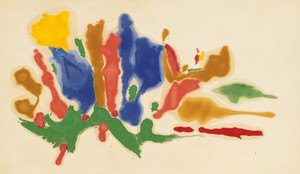
AHDuring 1963, when Riverhead was created, Frankenthaler went deep into using acrylic paint rather than oil paint. This opened up new possibilities for her. The colors stay brighter even though they’re diluted, and they dry much faster. Riverhead marks the peak of what she could do with her soak-stain technique and layering of colors. What’s interesting is that so many of her paintings have titles that refer to water or liquids or flowing like Flood [1967] from the Whitney Museum of American Art, in addition to Riverhead’s notion of the river’s current. You see how the color moves on the canvas. There are beautiful references between her painting style and the kind of title she chooses. And even though the paintings are not figurative or do not represent anything specific, like a landscape, they’re abstractions of a climate, for instance, or a mood that she conveys through color and the liquid quality of the paint.
FJWhen I saw Frankenthaler’s paintings for the first time in person during Sea Change: A Decade of Paintings, 1974–1983 at Gagosian in Rome in 2019, I was bedazzled by the emotional resonance of the paintings. I thought of her abstractions as kind of “environments”—rich in movement and hues, panoramic, expanding.
AHYes, they’re amazing also because of their size. It’s interesting when you see visitors, they first always step back because they want to have the overview of these huge paintings. But then as you approach, you see so much more, and you can almost dive into the colors or the environment, as you say.
FJYou mentioned the exhibition’s main subject is Frankenthaler’s paraphrase paintings. By translating some of the old masters, it’s as though she atomizes their subject matter into psychological color compositions of her own interpretation. What does it mean that Frankenthaler interprets them abstractly, and at a much larger scale? Is it essential for the appreciation of her paintings to know their source?
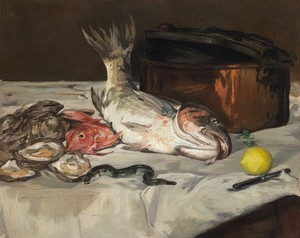
AHFor most of her paintings, one wouldn’t guess the source. She often veiled or hid what the reference was by just using titles like Hommage à H.M. [1971], not revealing the names, really. Yet it was important for her to make that reference and make it possible to guess what she referred to. Sometimes she said that she was interested mostly in using a reference painting as a starting point when it puzzled her, or when it was just interesting or challenging. She said something like, Matisse is almost too perfect. What she sought was someone like Manet, Monet, or Degas, whose paintings and approach were more puzzling to her. She was asking herself what a certain painter did and why it works. She takes that aspect, sometimes it’s a color combination or movement in a painting, but she always makes it her own. She never really copies—maybe reinterpretation is not a bad word to use.
Edouard Manet, Fish (Still Life), 1864, oil on canvas, 29 × 36 ⅜ inches (73.5 × 92.4 cm), Art Institute of Chicago, Mr. and Mrs. Lewis Larned Coburn Memorial Collection. Photo: Art Institute of Chicago
FJIt’s as though Frankenthaler decoded the pictorial subject matter and broke it down to its essence. Then she interpreted that essence into her own abstract image.
AHIt’s often just a detail or some aspect of the painting that fascinated her. It was never everything like the composition and the color and the brushstroke. Sometimes she did the opposite. For example, when she refers to the print by Hiroshige, which is all about these flat, unified areas of color, she instead creates a lively painting with thick color relief on top of the canvas. So sometimes it’s like twisting it into the contrary, almost.
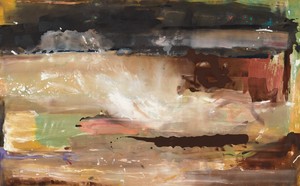
FJWhen I visited the exhibition this May, one of the paintings that struck me most profoundly was April Mood [1974]. Could you speak about this luminous and panoramic work, and its place within Frankenthaler’s practice?
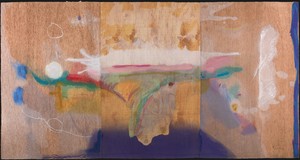
AHApril Mood was initially much larger. She cut the painted canvas horizontally in half and April Mood is the upper part. The lower part is called Under April Mood [laughs]. She really had a good sense of humor. She sold it into two pieces because it would’ve been way too huge.
In the exhibition we compare such an extreme horizontal format, which she so often did very early on, even with these panoramic formats, to [André] Derain, which is a suggestion John Elderfield made in a lecture he gave at the New York Studio School [in 2024]. Because so many of the colors that neighbor each other don’t really match, or we don’t perceive them as classically “beautiful.” There’s tension in the color, even though the painting is so bright, lively, and positive. But when you look at the details, there’s brown next to pink, for instance. And that’s when you look at the Derain. It’s a much smaller scale, but that’s what he does. He makes these dissonant color harmonies that are more interesting than just beautiful.
FJOften situated between Abstract Expressionism and Color Field painting, Frankenthaler’s work consistently resists neat categorization. Who were Frankenthaler’s artistic influences and how does the exhibition complicate established narratives surrounding her place within postwar American art?
AHIt was important for us at the Kunstmuseum to have that first gallery, where we show that Frankenthaler was very much inspired by Arshile Gorky, Willem de Kooning, mostly, but also Wassily Kandinsky and Paul Klee around ’49 to ’51. She had such a way of absorbing different influences or inspirations—often it’s several painters that she digests into one work. She doesn’t just have the Kandinsky phase and then the de Kooning phase. When she experiments with the soak-stain painting, she departs from Jackson Pollock, of course, being the role model of working on the floor and the all-over structure, but she does it so differently that it’s difficult to categorize her. What I mean is that her work has the Color Field approach, but has different gestures in it. Then she loses these gestures and changes again. It’s really hard to put her in a specific basket, but that probably was also a challenge for her reception at the time; she didn’t fit anywhere.
FJFrankenthaler’s development of the soak-stain technique fundamentally altered the possibilities of painting. Beyond its technical innovation, what does this breakthrough reveal about her broader artistic ambitions?
AHWhat’s truly captivating is how she allowed herself to lose control to some degree, but then always reacted to what happened when she did. And that’s why it inspired so many artists afterward, from Lynda Benglis to Sam Gilliam. The technical and intuitive idea of the color and the way it moves when it’s poured. With the soak-stain technique, by the late ’60s, she was so much in control of allowing coincidences or chance to happen, and at the right moment, would provoke something truly fascinating.
FJThroughout her career, Frankenthaler continually redefined her relationship to color, line, scale, and material. How does the exhibition trace this spirit of experimentation across different periods of her practice?
AHIt was challenging to make a selection, because there are so many of her spellbinding paintings where she tries out so many things. Within the Kunstmuseum format, every gallery brings an important aspect into the survey of her whole work. For instance, after she creates panoramic paintings in the ’60s, we move on to what are called the “floorboard paintings,” where she turns over the canvas after the color saturates one side. She allows the imprint of the wooden floor to appear in her painting. The next gallery shows her darker palette, which many people don’t acknowledge as much.
As you say, line always plays a role. Sometimes it’s less prominent, like at the beginning with the soak-stain period, it’s more the edges of the color areas or puddles. For example, in Moveable Blue, she added at the end this single line in the middle, probably with a brush, in the area of the canvas where the colors start to flow way more. It’s fascinating how she adapts this relationship of line and color throughout her career. One of her last paintings, Cloud Burst [2002], is again a great example of the liquid soak-stain technique. And yet, in the top left corner, there are a few lines again on the surface. It’s just mesmerizing.
FJFrankenthaler traveled extensively throughout Europe. She had two exhibitions in Zürich at the André Emmerich Gallery in 1974 and 1980. And in 1974 she visited Basel and the Kunstmuseum. To what extent did these encounters shape her artistic sensibility and understanding of pictorial space?
AHIt’s very unusual that a painter of her generation would spend so much time abroad, especially in Europe. I mean, of course, in New York, everyone went to the Metropolitan Museum of Art to see their collection [of old master paintings]. But the time Frankenthaler spent in Europe, and her practice of going through collections carefully, taking notes on many individual paintings, is astounding. She said she learned to understand or evaluate contemporary art by studying old masters. This is the most visible in the paraphrases, where she really takes as a point of departure the paintings of Manet, Monet, and even Cezanne. Although she didn’t paraphrase him directly, he is visible in a lot of her paintings as well. She was deeply interested in the painters of the late nineteenth century who still painted figuratively, but the viewer can observe their brushstrokes; it’s the color and the touch that become more important. It’s this ambivalence between seeing a landscape and painted dots or brushstrokes. And I think that was essential for her at that moment.
FJThe later works in the exhibition possess a stellar sense of freedom, chromatic intensity, and spatial complexity. Which paintings or works on paper do you consider particularly representative of the final decades of Frankenthaler’s career, and why? You already spoke about Cloud Burst.
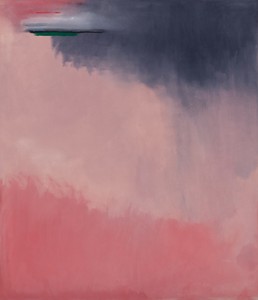
AHStar Gazing [1989] is one of Frankenthaler’s paintings that fascinates me because, on the one hand, it has this flat black area on the bottom that’s really just a surface area. And then it includes several dots or marks as well. Above all—the entire mood of this painting dissolves into a kind of cloud burst, as well as a sky with clouds and mist. To perceive this contrast between flat painting and a color event on a canvas that opens up a space is alluring.
FJWhat became apparent about Frankenthaler’s practice during the preparation of this exhibition that surprised you, either as a curator or as a scholar?
AHI didn’t know her later work very well. I mean, she’s famous for the ’50s and ’60s. So when I discovered the later decades, and we decided to include these paintings, I only had reproductions at the beginning. When I saw these later works in person, I was just so amazed because, especially with Star Gazing, seeing this huge painting in a small book reproduction, it never comes across the way the original does. I was really impressed by the way later works evolve. One painting we haven’t mentioned is Maelstrom [1992], for instance, where there’s gel in the color, and the relief is really thick with an increased amount of white color. It’s as though Frankenthaler uses a tool to grate through the color. In some instances, her work is dark, then brighter. Her courage to be continuously open to so many possibilities rather than to simply return to her origins is undoubtedly an impressive and surprising moment. I’m glad we included that period in the exhibition.
FJFrankenthaler’s influence on subsequent generations of painters is often acknowledged. How would you assess her legacy? In what ways does her work continue to resonate with contemporary artists today?
AHSome painters today seemingly don’t even know that they’re in some ways returning to Frankenthaler’s approach, because it’s being mediated through other artists. I think of Vivian Suter, for example. I believe that the inspiration to be free and be open with what a painter does with a canvas persists today: You hang it up, you put it on the floor. Such shifting and experimenting are still crucial. In Basel, it’s Renée Levi, who is also in our collection—we have a wonderful wall piece of hers. Also, sticking to painting is about dedication. Throughout all the decades when Frankenthaler kept painting, there was Minimal art, there was Conceptual art, there was so much going on. And yet, she dedicated her practice mostly to painting. Perhaps that should give younger artists today the courage to stick to what they love.
Anita Haldemann is a Swiss art historian who received her MA from Johns Hopkins University in 1995 on a Fulbright Scholarship and her PhD from the University of Bern in 2001. After working as a curator, she became head of the Kupferstichkabinett (Department of Prints and Drawings) at the Kunstmuseum Basel in 2015, curating acclaimed exhibitions on drawing and prints. From 2019 to 2026 she also served on the Kunstmuseum’s executive board as head of art and research and deputy director. She has held teaching positions at the Universities of Bern and Basel. Photo: Sara Rüedi
Filip Jakab is a writer and editor based between Brussels and Zürich. His short fiction has appeared in XRAY Literary Magazine, ExPat Press, and David Horvitz’s Garden. Filip contributes reviews, profiles, and conversation pieces to Vogue CS, the Whitney Review of New Writing, Public Parking, Our Culture Mag, and Flaunt. In December 2024, he completed a creative writing program at Stanford University. He writes the Substack life eats life. Photo: Mileva Testas