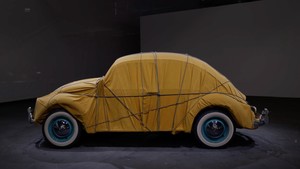
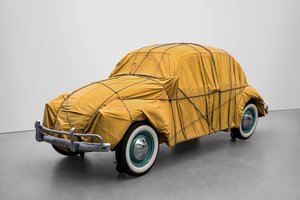
Christo’s Wrapped 1961 Volkswagen Beetle Saloon (1963–2014) features in the 2024 edition of Art Basel Unlimited, an exhibition platform dedicated to monumental and trailblazing projects.

Given his status as perhaps the artist most affiliated with these two descriptors in the history of postwar art, Christo’s ambitious proposals to wrap, drape, or stack at an architectural scale around the world wholly align with the platform’s aim to show artworks that are not only large but that transcend the typical boundaries of art making. Wrapped 1961 Volkswagen Beetle Saloon offers a rare opportunity to see up close—and permanently—one of Christo’s large-scale, three-dimensional wrapping projects, a work that is situated between his smaller wrapped objects from the beginning of his mature career and his massive projects that temporarily wrapped buildings and bridges.

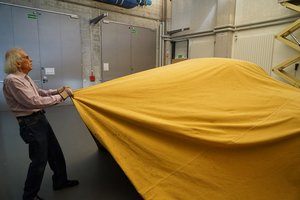
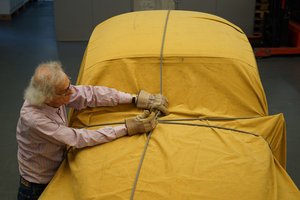
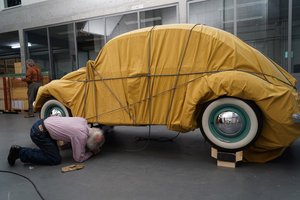
1961 Volkswagen Beetle Saloon wrapped in mustard yellow tarpaulin and rope

Christo

Wrapped 1961 Volkswagen Beetle Saloon, 1963–2014

1961 Volkswagen Beetle Saloon, tarpaulin with grommets, and ropes
59 1⁄8 × 160 × 60 ⅝ inches (150 × 406.4 × 154 cm)

The act of wrapping objects for Christo was about revealing through concealing. That was always the mantra.

Vladimir Yavachev
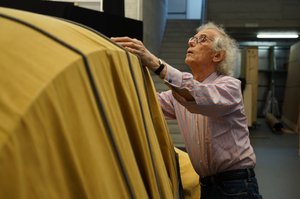
Christo wrapping a 1961 Volkswagen Beetle Saloon in mustard yellow tarpaulin and rope

Christo working on Wrapped 1961 Volkswagen Beetle Saloon (1963–2014), Basel, 2014. Artwork © Christo and Jeanne-Claude Foundation. Photos: Wolgang Volz

Christo’s Wrapped 1961 Volkswagen Beetle Saloon (1963–2014) installed at Art Basel Unlimited 2024. Artwork © Christo and Jeanne-Claude Foundation. Video: Pushpin Films

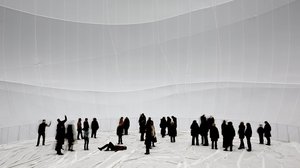
By 2014, Christo could be counted among the world’s most recognized artists. Monumental projects that he and his collaborator and wife, Jeanne-Claude, had carried out across the globe since the early 1960s had garnered the pair much recognition and, as time went on, acclaim. In 2013, Christo realized Big Air Package (2010–13) at the Gasometer Oberhausen in Germany. Then billed as the largest indoor sculpture to ever be created, this work was a 90-meter-high, 50-meter-wide package of air that allowed visitors to enter its 177,000 cubic meter volume—certainly an unforgettable experience for those lucky enough to experience it firsthand.

90-meter-high, 50-meter-wide package of air that allowed visitors to enter its 177,000 cubic meter volume

Christo and Jeanne-Claude, Big Air Package, Gasometer Oberhausen, Germany, 2010–13, Oberhausen, Germany, 2013 © Christo and Jeanne-Claude Foundation. Photo: Wolgang Volz

Sadly, Jeanne-Claude passed away in 2009, and so memories of these astonishing successes must have been bittersweet for Christo. It seems the artist found himself intent on reliving some of his early memories of working with Jeanne-Claude. Rather than focusing on one of their internationally renowned projects, Christo found himself lingering on the temporary object Wrapped Car (Volkswagen) (1963).

Archival footage of Christo working on Wrapped Car (Volkswagen) (1963) in the courtyard of his temporary studio, Düsseldorf, Germany, February 1963. Artwork © Christo and Jeanne-Claude Foundation. Video: Charles Wilp © BPK, Berlin, Dist. GrandPalaisRmn/image BPK

The wrapped car in question was a 1961 Beetle that was lent to the artists by Claus Harden, a young art director that Christo and Jeanne-Claude met through Charles Wilp, who had filmed and photographed Christo wrapping women for Christo’s solo exhibition at Galerie Schmela in Düsseldorf, Germany, in February 1963. Christo had been planning this work for two years with a Beetle specifically in mind. Not only did the artist appreciate that vehicle’s distinctive shape, but he also admired the countercultural notions associated with the “Love Bug.” As a Soviet refugee, he particularly clung to the counterculture’s emphasis on freedom of expression. Likewise, as the home of the storied Kunstakademie and the heart of the German avant-garde, Düsseldorf was an ideal location in which to realize the work. The discovery of Harden, an owner of a Beetle willing to turn his car over to Christo to be covered in fabric, was a fortunate turn of events.

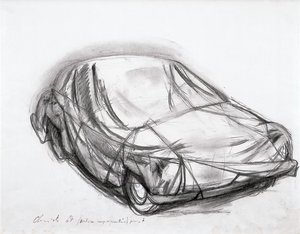
Charcoal drawing of a car wrapping in fabric

Christo, (Voiture empaquetée) Projet, 1964, charcoal on paper, 14 ⅛ × 17 ⅛ inches (36 × 43.5 cm) © Christo and Jeanne-Claude Foundation

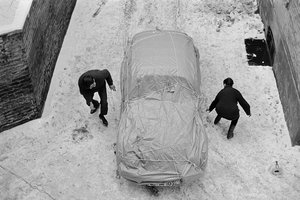
Though Harden was willing to loan his car for the project, he did so on one condition: that the artist return his vehicle to him after the exhibition’s conclusion in the same—unwrapped—condition in which it was given. This was the first car that Harden (who was then twenty-five years old) had bought on his own—and his generosity only stretched so far. Years later, he would bemoan this decision as perhaps the most regrettable of his life. Knowing that their time with the Beetle was limited, Christo and Jeanne-Claude promptly got to work wrapping the sage-color Bug in tarpaulin and rope. It was likely driven by Harden (since Christo never learned to drive himself) to the courtyard of German artist Günter Uecker’s studio, which the artist-couple had commandeered as their own temporary workspace, where they swathed all but the car’s tires in fabric.

Christo and Jeanne-Claude wrapping a 1961 Volkswagen Beetle Saloon in mustard yellow tarpaulin and rope

Christo and Jeanne-Claude with Wrapped Car (Volkswagen) (1963) in the courtyard of Christo’s temporary studio, Düsseldorf, Germany, February 1963. Artwork © Christo and Jeanne-Claude Foundation. Photo: © bpk Bildagentur/Charles Wilp/Art Resource, New York

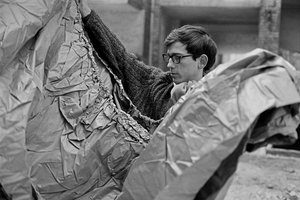
Christo wrapping a 1961 Volkswagen Beetle Saloon in mustard yellow tarpaulin and rope

Christo working on Wrapped Car (Volkswagen) (1963) in the courtyard of his temporary studio, Düsseldorf, Germany, February 1963. Artwork © Christo and Jeanne-Claude Foundation. Photo: © bpk Bildagentur/Charles Wilp/Art Resource, New York

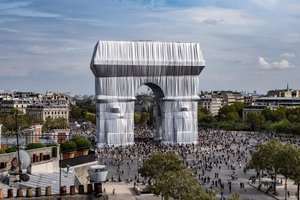
Wrapping was Christo’s signature technique; it was an integral aspect of the artist’s revolutionary practice throughout his seventy-year career. From his first wrapped paint cans to the posthumously realized L'Arc de Triomphe, Wrapped, Paris (1961–2021), Christo covered objects to intensify their mystique, as well as to invoke new ways to understand an object’s three-dimensionality and form. Indeed, for over seventy years, Christo embraced the act of “revelation through concealment,” as critic David Bourdon asserted in his 1970 biography on the artist. And though Christo had moved from wrapping single objects to entire buildings, in 2014 the artist decided to revisit Wrapped Car (Volkswagen) from fifty years ago, when he was in the first years of his career and Jeanne-Claude was still by his side.

Arc de Triomphe wrappeded in fabric

Christo and Jeanne-Claude, L’Arc de Triomphe, Wrapped, Paris, 1961–2021, Paris, 2021 © Christo and Jeanne-Claude Foundation. Photo: Wolgang Volz

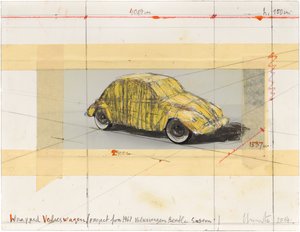
Related Drawings

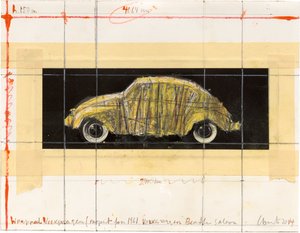
Collaged drawing of 1961 Volkswagen Beetle Saloon wrapped in fabric

Christo

Wrapped Volkswagen (Project for 1961 Volkswagen Beetle Saloon), 2014

Graphite, wax crayon, enamel paint, photograph by André Grossmann, and masking tape on paper
8 ½ × 11 inches (21.6 × 27.9 cm)

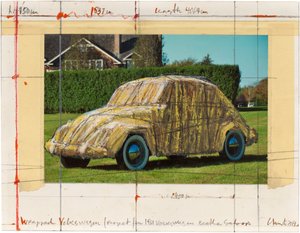
Collaged drawing of 1961 Volkswagen Beetle Saloon wrapped in fabric

Christo

Wrapped Volkswagen (Project for 1961 Volkswagen Beetle Saloon), 2014

Graphite, wax crayon, enamel paint, photograph by Wolfgang Volz, and masking tape on paper
8 ½ × 11 inches (21.6 × 27.9 cm)

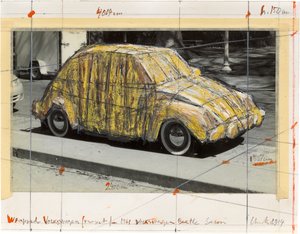
Collaged drawing of 1961 Volkswagen Beetle Saloon wrapped in fabric

Christo

Wrapped Volkswagen (Project for 1961 Volkswagen Beetle Saloon), 2014

Graphite, wax crayon, enamel paint, photograph by André Grossmann, and masking tape on paper
8 ½ × 11 inches (21.6 × 27.9 cm)

Collaged drawing of 1961 Volkswagen Beetle Saloon wrapped in fabric

Christo

Wrapped Volkswagen (Project for 1961 Volkswagen Beetle Saloon), 2014

Graphite, wax crayon, enamel paint, photograph by André Grossmann, and masking tape on paper
8 ½ × 11 inches (21.6 × 27.9 cm)

Christo: Wrapped 1961 Volkswagen Beetle Saloon (1963–2014)

Christo: Wrapped 1961 Volkswagen Beetle Saloon (1963–2014)

Join Vladimir Yavachev, director of operations for the Christo and Jeanne-Claude Foundation, as he discusses the genesis of the artist’s work Wrapped 1961 Volkswagen Beetle Saloon (1963–2014), which Gagosian presented at Art Basel Unlimited 2024.

Christo: Early Works

Christo: Early Works

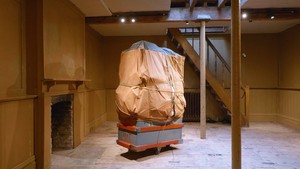
Christo: Early Works, curated by Elena Geuna, is the inaugural exhibition in the Gagosian Open series of off-site projects. In this video, Geuna explores the connection between Christo’s sculptural works and their setting in the historic Georgian house at 4 Princelet Street, London.

The Iron Curtain: Christo & Jeanne-Claude

The Iron Curtain: Christo & Jeanne-Claude

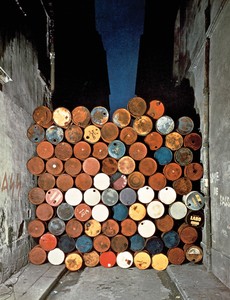
To mark the sixtieth anniversary of Christo and Jeanne-Claude’s seminal installation The Iron Curtain, author William Middleton addresses the radicality of this work and its enduring relevance to the artists’ subsequent projects.

Gagosian Quarterly Summer 2026

Now available
Gagosian Quarterly Summer 2026

The Summer 2026 issue of Gagosian Quarterly is now available, featuring Ellen Gallagher’s Fast-Fish and Loose-Fish (2026) on the cover.

Jenny Saville a Ca’ Pesaro

Jenny Saville a Ca’ Pesaro

In this video, Jenny Saville sits down inside her first major exhibition in Venice to discuss how the great Venetian artists of the past and the city’s heritage influence her work. The show brings together more than thirty canvases and works on paper from the 1990s to the present, tracing the development of her practice, which is deeply rooted in the history of painting.

Francis Bacon: Reinventing Realism

Francis Bacon: Reinventing Realism

Francis Bacon lived and worked in Paris for a decade starting in the mid-1970s. The city and the art he encountered there provided a profound backdrop for his austere late style, which often brings together smooth, colorful backgrounds, spare architectural signifiers, and sculptural human forms. Here, three striking paintings from that period are considered by Sebastian Smee.

James Turrell: Lifting the Veil

James Turrell: Lifting the Veil

An exhibition at Gagosian, Hong Kong, brings together three of James Turrell’s Glasswork pieces along with site plans, photographs, and models of his Skyspaces and Roden Crater. Here, Alice Godwin explores the history of the Glassworks and their relationship to the artist’s wider practice.

Divine Emanations: Nymphs, Poets, and the Painter’s Palette

Divine Emanations: Nymphs, Poets, and the Painter’s Palette

Janne Sirén considers Anselm Kiefer’s new paintings, the subject of an exhibition at Gagosian, New York, entitled Seal My Ears Shut and I Shall Hear You Still.

Derrick Adams: View Master

Derrick Adams: View Master

On April 16, the Institute of Contemporary Art, Boston, opened the first midcareer survey of Derrick Adams’s multidisciplinary practice. Covering over twenty years of work, the exhibition, titled View Master, brings together the artist’s painting, sculpture, collage, performance, and video, as well as a vibrant new commission created for the museum’s façade. Ahead of the opening, Adams met with Tessa Bachi Haas, cocurator of the survey, to discuss his formative experiences with television, the impact of his work in arts education on his practice, and the importance of taking a more complex, more joyful, and more expansive approach to Black American life and culture.
Giuseppe Penone: The Reflection of Bronze

Giuseppe Penone: The Reflection of Bronze

Adam D. Weinberg has been working with Giuseppe Penone on an exhibition of the artist’s new sculptures, The Reflection of Bronze, that opens at Gagosian, New York, on April 22. The works explore the character and possibilities of bronze. Here, Weinberg considers Penone’s enduring engagement with the alloy and addresses the conceptual underpinnings of the exhibition’s three-room structure.

Engaging with the Past: An Interview with Jenny Saville

Engaging with the Past: An Interview with Jenny Saville

On March 28, a major exhibition of Jenny Saville’s work opened at Ca’ Pesaro–Galleria Internazionale d’Arte Moderna in Venice, bringing together nearly thirty paintings from the 1990s to the present. The exhibition is curated by Elisabetta Barisoni, head of the museums division at Venice’s Ca’ Pesaro, Museo Fortuny, and head of MUVE in Mestre. Saville’s monumental canvases are set in dialogue with the great Venetian artists of the past, creating a unique encounter between contemporary painting and the city’s artistic heritage. Here, the artist speaks with Stefania Ventra, professor with Ca’ Foscari University of Venice, about her early trips to Venice, the radicality of Titian’s painting, and depicting emotional truth.

A Tremendous Generosity: Jeff Koons on Marcel Duchamp

A Tremendous Generosity: Jeff Koons on Marcel Duchamp

Jeff Koons tells Alison McDonald about his appreciation for the pioneering artist and thinker Marcel Duchamp.