Gagosian is pleased to announce its participation in TEFAF New York 2026 with a presentation of new sculptures by Kathleen Ryan. The works are the latest additions to Ryan’s Bad Fruit series (2018–), in which chunks of decomposing fruit are enlarged and embellished with swathes of gems and semiprecious stones, their rinds ripped from salvaged vehicles and granted new life.

The sculptures presented at TEFAF exemplify the dedicated process through which Ryan creates her Bad Fruit, one that harks back to the American craft tradition of pushpin-beaded fruit. Having allowed items of fresh produce to rot, the New York–based artist begins a slow process of emulation, rearticulating patches of mold in thousands of pearls, opals, and crystals, each fixed in place with a single steel pin. As is evidenced by Bad Cherries (Princess) and Bad Lime (Treasure) (both 2026), the result is an entrancing richness of color, texture, and surface tension that beautifies, in a way that is both humorous and poignant, the inevitable process of decay.

Through this act of immortalization—of freezing time in semiprecious stone—Ryan raises in a uniquely lighthearted manner the far weightier subject of life and death, thereby nodding to the art historical tradition of the vanitas. But so too does the putrefaction of the Bad Fruit speak to the throwaway culture that is prevalent under consumer capitalism. This is emphasized by Ryan’s tendency to repurpose old car parts as the rinds of her fruits, fusing the organic with such icons of automotive design as the Volkswagen Beetle (Bad Melon [Fantasy], 2026) and the Airstream trailer Bad Melon (Little Chunk & Little Baby Chunk) (2020–24). The exposed segment walls of Bad Orange (Amulet) (2026) resemble the riblike tubing of a V8 engine.

While Ryan’s incorporation of such fragments speaks to the seductions, false promises, and failings of consumerism, at the heart of her Bad Fruit is a deep affection for materials and an interest in regeneration—creative, cultural, and societal. The saclike forms of Bad Grapes (Siphon) (2026) are dehydrated to such an extent that they are becoming raisins. Picked, placed, and coated in burgundy gems that resemble grapes of a younger vintage, the work embodies the cycle of life, death, and potential rebirth that spins throughout Ryan’s practice more broadly. As with the process of bletting, in which certain fruits are allowed to overripen to the point of rotting in order to increase their sugar levels, the work isolates and celebrates the beauty, sweetness, and potential that can be found within decay. Deterioration not as an end but an evolution. Bad Fruit as an exquisite thing.

Download the full press release (PDF)
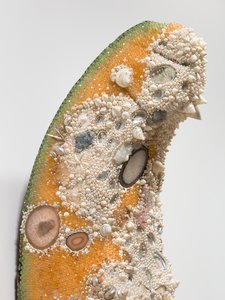
Detail of a sculpture that resembles a melon encrusted with glass and acrylic beads to delineate “fresh” parts and semiprecious stone beads for “rotten” areas

Kathleen Ryan, Bad Melon (Fantasy), 2026 (detail) © Kathleen Ryan. Photo: Lance Brewer

Gagosian’s booth at TEFAF 2026, featuring sculpture by Kathleen Ryan. Artwork © Kathleen Ryan. Video: Lance Brewer

#TEFAFNewYork
Kathleen Ryan: Time, Crafted

Kathleen Ryan: Time, Crafted

On the occasion of two exhibitions—one at Gagosian, London, and the other at Kistefos in Jevnaker, Norway—the Quarterly shares an essay included in the forthcoming book Kathleen Ryan: 2014–24. Here, Harry Thorne writes on Kathleen Ryan’s artistic process, methods of assemblage, and how her studio resembles an excavation site.

Kathleen Ryan: Sculpting Time

Kathleen Ryan: Sculpting Time

Art historian, curator, and writer Daria de Beauvais tracks Kathleen Ryan’s sustained and evolving engagement with the temporal, the memento mori, Americana, and ecology. The artist was the subject of a recent survey at the Hamburger Kunsthalle (May 17–August 11, 2024) that saw thirty of her sculptures from the past ten years brought together.

Gagosian Quarterly Summer 2026

Now available
Gagosian Quarterly Summer 2026

The Summer 2026 issue of Gagosian Quarterly is now available, featuring Ellen Gallagher’s Fast-Fish and Loose-Fish (2026) on the cover.

Jenny Saville a Ca’ Pesaro

Jenny Saville a Ca’ Pesaro

In this video, Jenny Saville sits down inside her first major exhibition in Venice to discuss how the great Venetian artists of the past and the city’s heritage influence her work. The show brings together more than thirty canvases and works on paper from the 1990s to the present, tracing the development of her practice, which is deeply rooted in the history of painting.

Francis Bacon: Reinventing Realism

Francis Bacon: Reinventing Realism

Francis Bacon lived and worked in Paris for a decade starting in the mid-1970s. The city and the art he encountered there provided a profound backdrop for his austere late style, which often brings together smooth, colorful backgrounds, spare architectural signifiers, and sculptural human forms. Here, three striking paintings from that period are considered by Sebastian Smee.

James Turrell: Lifting the Veil

James Turrell: Lifting the Veil

An exhibition at Gagosian, Hong Kong, brings together three of James Turrell’s Glasswork pieces along with site plans, photographs, and models of his Skyspaces and Roden Crater. Here, Alice Godwin explores the history of the Glassworks and their relationship to the artist’s wider practice.

Divine Emanations: Nymphs, Poets, and the Painter’s Palette

Divine Emanations: Nymphs, Poets, and the Painter’s Palette

Janne Sirén considers Anselm Kiefer’s new paintings, the subject of an exhibition at Gagosian, New York, entitled Seal My Ears Shut and I Shall Hear You Still.

Derrick Adams: View Master

Derrick Adams: View Master

On April 16, the Institute of Contemporary Art, Boston, opened the first midcareer survey of Derrick Adams’s multidisciplinary practice. Covering over twenty years of work, the exhibition, titled View Master, brings together the artist’s painting, sculpture, collage, performance, and video, as well as a vibrant new commission created for the museum’s façade. Ahead of the opening, Adams met with Tessa Bachi Haas, cocurator of the survey, to discuss his formative experiences with television, the impact of his work in arts education on his practice, and the importance of taking a more complex, more joyful, and more expansive approach to Black American life and culture.

Giuseppe Penone: The Reflection of Bronze

Giuseppe Penone: The Reflection of Bronze

Adam D. Weinberg has been working with Giuseppe Penone on an exhibition of the artist’s new sculptures, The Reflection of Bronze, that opens at Gagosian, New York, on April 22. The works explore the character and possibilities of bronze. Here, Weinberg considers Penone’s enduring engagement with the alloy and addresses the conceptual underpinnings of the exhibition’s three-room structure.

Engaging with the Past: An Interview with Jenny Saville

Engaging with the Past: An Interview with Jenny Saville

On March 28, a major exhibition of Jenny Saville’s work opened at Ca’ Pesaro–Galleria Internazionale d’Arte Moderna in Venice, bringing together nearly thirty paintings from the 1990s to the present. The exhibition is curated by Elisabetta Barisoni, head of the museums division at Venice’s Ca’ Pesaro, Museo Fortuny, and head of MUVE in Mestre. Saville’s monumental canvases are set in dialogue with the great Venetian artists of the past, creating a unique encounter between contemporary painting and the city’s artistic heritage. Here, the artist speaks with Stefania Ventra, professor with Ca’ Foscari University of Venice, about her early trips to Venice, the radicality of Titian’s painting, and depicting emotional truth.

A Tremendous Generosity: Jeff Koons on Marcel Duchamp

A Tremendous Generosity: Jeff Koons on Marcel Duchamp

Jeff Koons tells Alison McDonald about his appreciation for the pioneering artist and thinker Marcel Duchamp.

Donald Judd: Patiently Constructed

Donald Judd: Patiently Constructed

From their respective fields, three international cultural figures—artist and designer Ronan Bouroullec, fashion visionary Michèle Lamy, and chef and restaurateur Enrique Olvera—reflect on Donald Judd’s work in furniture, the subject of recent exhibitions in South Korea and Japan.