Spotlight
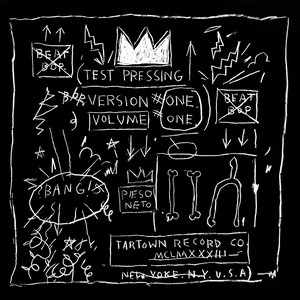
Jean-Michel in Black and White
Fred Hoffman looks back on the creation of Jean-Michel Basquiat’s Tuxedo (1983), examining the work’s significance in relation to identity and the hip-hop culture of the 1980s.
April 12, 2022
Larry Gagosian reflects on Peter Paul Rubens’s The Massacre of the Innocents (c. 1610).
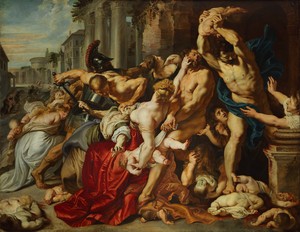
Peter Paul Rubens, The Massacre of the Innocents, c. 1610, oil on panel, 55 ⅞ × 72 inches (142 × 183 cm), The Thomson Collection at the Art Gallery of Ontario, Toronto, 2014
Peter Paul Rubens, The Massacre of the Innocents, c. 1610, oil on panel, 55 ⅞ × 72 inches (142 × 183 cm), The Thomson Collection at the Art Gallery of Ontario, Toronto, 2014
Fred Hoffman looks back on the creation of Jean-Michel Basquiat’s Tuxedo (1983), examining the work’s significance in relation to identity and the hip-hop culture of the 1980s.
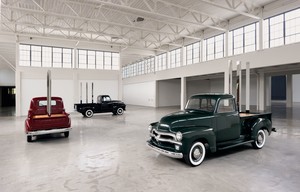
Lars Nittve investigates Truck Trilogy, Walter De Maria’s last work, conceived in 2011 and premiered at Dia:Beacon in 2017.
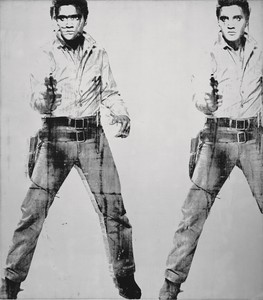
Text by Derek Blasberg.
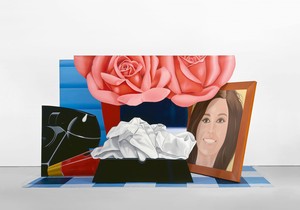
The story behind Tom Wesselmann’s Still Life #59 (1972). Text by Lauren Mahony.
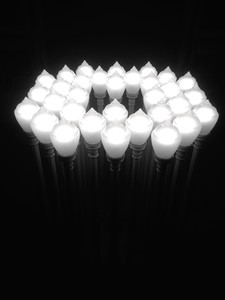
The story behind Chris Burden’s Buddha’s Fingers (2014–15) and its connection to all of his streetlamp installations. Text by Sydney Stutterheim.
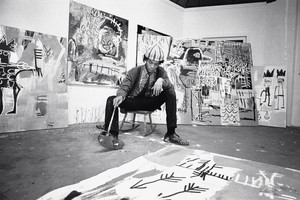
Jean-Michel Basquiat’s Untitled (L.A. Painting) (1982) was a game changer. Text by Derek Blasberg.
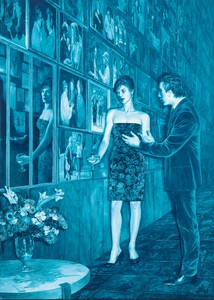
Alexander Wolf guides us through a multilayered new painting by the celebrated artist.
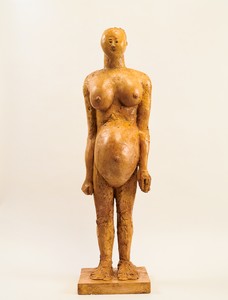
The story behind the sculpture that Diana Widmaier Picasso highlighted in Picasso’s Picassos: A Selection from the Collection of Maya Ruiz-Picasso.
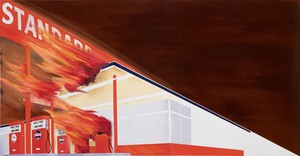
Ed Ruscha’s Burning Gas Station (1965–66) was a game changer. Text by Larry Gagosian.
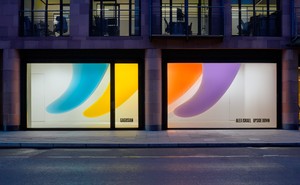
Ahead of Alex Israel’s exhibition of four new Fin sculptures at Gagosian, London, the artist spoke with Susan Casey, author of The Wave: In Pursuit of the Rogues, Freaks, and Giants of the Ocean (2010), about the ocean, surfing, and Los Angeles.
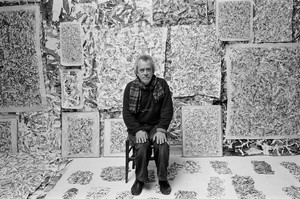
On July 9, Simon Hantaï: the last studio opens at Gagosian, Gstaad. Curated by Anne Baldassari, the show comprises sixteen of the artist’s dernier atelier (last studio) paintings of 1982–85. The exhibition is accompanied by an illustrated catalogue, copublished by Gagosian and Skira, which features an essay by Baldassari and an extensive portfolio of previously unpublished photographs by Édouard Boubat. Here, we share the introductory chapter from the publication.

Adam D. Weinberg has been working with Giuseppe Penone on an exhibition of the artist’s new sculptures, The Reflection of Bronze, that opens at Gagosian, New York, on April 22. The works explore the character and possibilities of bronze. Here, Weinberg considers Penone’s enduring engagement with the alloy and addresses the conceptual underpinnings of the exhibition’s three-room structure.