Winter 2024 Issue

Jeff Wall:
Before the Image

Jeff Wall explains the stories and literary allusions behind two of his photographs that will appear in an exhibition at Gagosian, New York, in November.

Jeff Wall's artwork "Informant: An occurrence not described in chapter 6, part 3 of Últimas tardes con Teresa by Juan Marsé" (2023) is a photograph of a person standing in the center of the frame holding a telephone to their ear

Jeff Wall, Informant: An occurrence not described in chapter 6, part 3 of Últimas tardes con Teresa by Juan Marsé, 2023, inkjet print, 53 ⅝ × 55 ½ inches (136 × 141 cm), edition of 3 + 1 AP

Jeff Wall, Informant: An occurrence not described in chapter 6, part 3 of Últimas tardes con Teresa by Juan Marsé, 2023, inkjet print, 53 ⅝ × 55 ½ inches (136 × 141 cm), edition of 3 + 1 AP

Informant (2023)

Juan Marsé’s novel Últimas tardes con Teresa (Last afternoons with Teresa), published in 1966, is the story of an affair between Manolo, a young man from one of Barcelona’s post–World War II migrant neighborhoods, and Teresa, a girl from a wealthy family. The book creates a panoramic critical vision of the rapidly changing social order of the 1950s. The ambitious and attractive antihero, poorly educated and without prospects, is pursuing illegal means of livelihood—stealing motorbikes—in the rough conditions of the El Camel neighborhood, still emerging from the hillsides above the city. This involves him in business with an older man, uncle to a fifteen-year-old girl who otherwise has no family. She is Hortensia, and has been infatuated with Manolo for some years. She, like her rival Teresa, is blonde. Hortensia has found work in a local pharmacy, one of the newly established businesses in an area with rudimentary services and few paved streets. Priding herself on her properly legal occupation, in contrast to the kinds of things she sees around her, she insists on wearing her white lab coat everywhere and has become well-known locally. The author devotes few passages to Hortensia, but her relationship with Manolo and her intense frustration and jealousy pulse throughout the long narrative.

Things come to a climax near the end of the novel. One night, provoked once too often by Manolo’s flirtatious yet dismissive treatment, Hortensia witnesses him stealing another motorbike in order to visit Teresa in her parents’ distant villa, and, seemingly on impulse, decides to inform the police. The pharmacy has a private telephone, in an era when access to the device was very restricted; this gives Hortensia a unique opportunity to inform anonymously. Marsé never describes or comments on her feelings, thoughts, or actions in enabling the authorities to arrest and convict Manolo and bring the novel to its conclusion.

The photograph was taken in Barcelona in 2023. The smaller image inserted into the larger one reveals that she is on the telephone to the police.

Gagosian quarterly weekend reads

Get the best of the Quarterly in your inbox twice a month.

By subscribing you agree to our Privacy Policy.

Jeff Wall, Portrait in Noto, 2007, inkjet print, 78 ¾ × 96 inches (200 × 244 cm), edition of 3 + 1 AP

Portrait in Noto (2007)

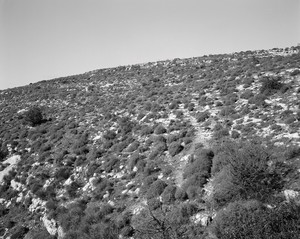
I traveled in Sicily in the autumn of 2007 with the intention of photographing a rocky hillside. There’s something timeless about them, captured in this passage from Giuseppe Tomasi di Lampedusa’s novel il Gattopardo (The Leopard, 1958) describing a hunt by the protagonist and his companion:

Jeff Wall, Hillside, Sicily, November 2007, 2007, gelatin silver print, 97 × 120 ¼ inches (246.3 × 305.3 cm)

The term “countryside” implies soil transformed by labour; but the scrub clinging to the slopes was still in the very same state of scented tangle in which it had been found by Phoenicians, Dorians, and Ionians when they disembarked in Sicily, that America of antiquity. Don Fabrizio and Tumeo climbed up and down, slipped and were scratched by thorns, just as any Archidamus or Philostratus must have been tired and scratched twenty-five centuries before. . . . When the hunters reached the top of the hill, there among the tamarisks and scattered cork trees appeared the real Sicily again, the one compared to which baroque towns and orange groves are mere trifles.

A few days after completing the photograph Hillside, Sicily, we entered the baroque town of Noto, intending a brief visit before continuing my search for another possible hillside image. (I soon found one on the outskirts of Ragusa.) At a café, we noticed a middle-aged woman accompanied by a young man who might have been her son. She was behaving unusually and he was attempting to manage and possibly protect her. My wife, Jeannette, felt an intense sympathy for the woman and the boy and suggested we try to photograph them. But we hesitated and they disappeared. We left Noto after admiring its remarkable architecture and headed west into the hills, but we continued to think about those two and decided to go back to Noto to see if we could find them, thinking that they were likely known in the neighborhood. Our guide was confident he could locate them, and did so within a few hours. She came to our meeting place, without the young man, who was in fact her son, but with an adult man who negotiated with us. I photographed her in about fifteen minutes. I explicitly do not do portraits, but made an exception in this one circumstance.

Jeff Wall, Gagosian, 541 West 24th Street, New York, November 8, 2024–January 25, 2025

Artwork © Jeff Wall

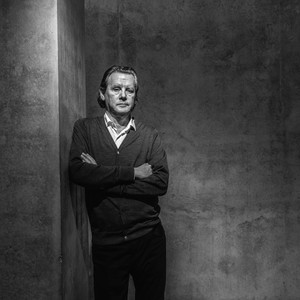
Black-and-white portrait of Jeff Wall

Jeff Wall was born in 1946 in Vancouver, Canada, where he continues to live and work. He has exhibited widely, including solo exhibitions at Tate Modern, London (2005), the Museum of Modern Art, New York/Art Institute of Chicago/San Francisco Museum of Modern Art (2007), the Stedelijk Museum Amsterdam/Kunsthaus Bregenz (2014), and the Kunsthalle Mannheim, Germany (2018). Photo: Miro Kuzmanovic

See all Articles

Jeff Wall: In the Domain of Likeness

Jeff Wall: In the Domain of Likeness

The Fondation Beyeler, Riehen/Basel, has staged a comprehensive Jeff Wall exhibition including more than fifty works spanning five decades. Here, Barry Schwabsky reflects on the enduring power of and mystery in Wall’s photography.

Jeff Wall: An Exhibition Tour

Jeff Wall: An Exhibition Tour

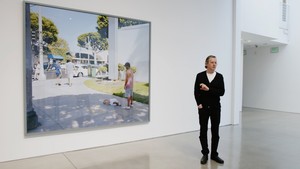
Join Jeff Wall as he leads a tour through his latest exhibition in Beverly Hills. The artist speaks about the genesis and creation of each photograph, addressing the aesthetic decisions involved.

Jeff Wall and Gary Dufour

In Conversation
Jeff Wall and Gary Dufour

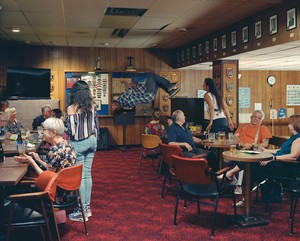
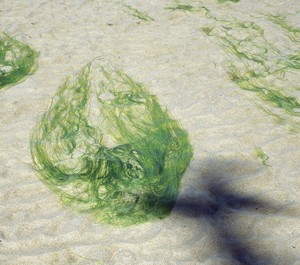
Jeff Wall speaks to Gary Dufour about his new photographs, made on the beachfront of English Bay in Vancouver, Canada, that record the endlessly varied and shifting patterns created in seaweed by the ebb and flow of the tide.

Death Valley ’89: Jeff Wall vs. Photography

Death Valley ’89: Jeff Wall vs. Photography

Daniel Spaulding considers formal and technical developments in the photographer’s work against the background of global shifts of power and politics, specifically the fall of the Berlin Wall in 1989.

Laws of Motion

Laws of Motion

Catalyzed by Laws of Motion—a group exhibition pairing artworks from the 1980s on by Jeff Koons, Cady Noland, Rosemarie Trockel, and Jeff Wall with contemporary sculptures by Josh Kline and Anicka Yi—Wyatt Allgeier discusses the convergences and divergences in these artists’ practices with an eye to the economic worlds from which they spring.

Jeff Wall: The Space of Photography

Jeff Wall: The Space of Photography

Jeff Wall leads a tour through his most recent exhibition in New York.

Gagosian Quarterly Summer 2019

Now available
Gagosian Quarterly Summer 2019

The Summer 2019 issue of Gagosian Quarterly is now available, featuring a detail from Afrylic by Ellen Gallagher on its cover.

Jeff Wall: The World as It Appears

Jeff Wall: The World as It Appears

The artist speaks with David Rimanelli about his newest works, the physicality of photography, and the persistence of certain motifs throughout his career.

Unreal Americans

Unreal Americans

Benjamin Nugent reflects on questions of verisimilitude and American life in the group exhibition I Don’t Like Fiction, I Like History at Gagosian, Beverly Hills.

Andreas Gursky and Jeff Wall

In Conversation
Andreas Gursky and Jeff Wall

On the occasion of a major survey of Andreas Gursky’s work at the Hayward Gallery in London, Gursky and Jeff Wall discuss the state of photography and the evolution of the medium.

Francis Bacon: Reinventing Realism

Francis Bacon: Reinventing Realism

Francis Bacon lived and worked in Paris for a decade starting in the mid-1970s. The city and the art he encountered there provided a profound backdrop for his austere late style, which often brings together smooth, colorful backgrounds, spare architectural signifiers, and sculptural human forms. Here, three striking paintings from that period are considered by Sebastian Smee.

Divine Emanations: Nymphs, Poets, and the Painter’s Palette

Divine Emanations: Nymphs, Poets, and the Painter’s Palette

Janne Sirén considers Anselm Kiefer’s new paintings, the subject of an exhibition at Gagosian, New York, entitled Seal My Ears Shut and I Shall Hear You Still.