Lee MergnerHow was Basquiat introduced to jazz? Was it from his father, Gerard, or Fab 5 Freddy [Fred Brathwaite]?
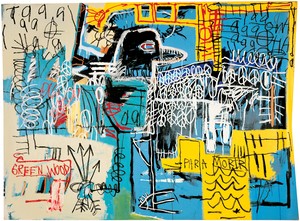
Jessica BeckJean-Michel grew up listening to jazz from his father’s record collection. While musical influence started from an early age, the references to jazz began to appear with great frequency and zeal in his paintings between 1982 and 1983, which was also the period he created his first record, “Beat Bop,” with friends and collaborators Rammellzee and K-Rob. The timing of the crossover with his painting practice also aligns with the release of an important publication on the genre: Black Beauty, White Heat: A Pictorial History of Classical Jazz, 1920-1950, published in 1982, and Charlie Parker’s The Complete Savoy Studio Sessions, a set of five LPs, which was released in 1978. As Basquiat is fully digesting this history as a young adult, the references and symbols of these great American icons start to appear in his work, and this further reveals the diversity and richness of the collection of visual material that he surrounded himself with in his studio, which went beyond art history books and ranged from anatomy to poetry and sociology to the history of jazz.
LMWas he inspired by the music?
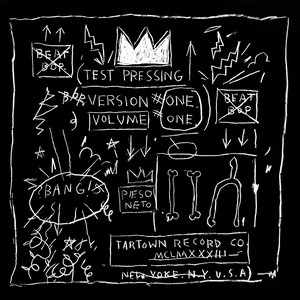
JBYes, incredibly so. Basquiat was known to listen to music in his studio while working at all hours. Music was part of his creative process. There are fascinating parallels between the compositions of his paintings and the structure of jazz: He was, in a sense, thinking and painting musically. In 1982 and 1983, his compositions started to mirror the structural traits of jazz with wide-ranging references and directional symbols like arrows, ladders, compasses, and even musical notes that connect phrases and symbols in the work. These devices appear in his first silkscreen edition, Tuxedo (1982), which was created in partnership with Fred Hoffman and Larry Gagosian in Los Angeles and shares a similar aesthetic to the cover art of “Beat Bop.” By extension, his compositions also reflect the flow and style of hip-hop, which was emerging during Basquiat’s rise in New York and Los Angeles. There is a voraciousness to his use of different styles in his work, and he was known for a particularly diverse taste in music ranging from Prince to David Byrne to Donna Summer to Bach to opera, but his paintings were dominated by the history of Black jazz musicians and his hero Charlie Parker.
LMIt seemed that he was particularly affected by the early bebop pioneers of the ’40s and ’50s—Charlie Parker, Dizzy Gillespie, Miles Davis, Max Roach, and Lester Young—because he made art that featured them. What was it about that era that inspired him so much?
JBBasquiat’s choice of musicians was similar to his selection of athletes in his work: He chose figures who were celebrated and revered within the Black community. Many of the musicians whose lives and music Basquiat addressed suffered extreme prejudice during their lifetimes. In his compositions, Basquiat pays tribute to these great figures while embedding his compositions with references that underscore and critique their treatment in society. These celebrated musicians also reached prodigious heights of fame, and their lives acted as parallels to Basquiat’s own.
LMHe reportedly had a large record collection, much of which was jazz. Did he do the artwork for any jazz album covers?
JBBasquiat was known to have an extraordinary collection of records, and within this collection, which is said to have summed 3,000 records, he had in-depth holdings in jazz and blues. His interest, one might say passion, was so deep that he was known to trade paintings for rare blues and bebop LPs. He was even said to have cherished Ross Russell’s biography Bird Lives!: The High Life and Hard Times of Charlie (Yardbird) Parker (1973) so dearly that he kept a case of books in his studio to distribute to friends. While Basquiat’s work was not commissioned for a specific jazz album cover, many of his paintings in 1983 abound with references to the genre and its history. As mentioned earlier, he also created a cover for “Beat Bop,” which draws a direct connection to Charlie Parker, a pioneering figure in the development of bebop. It’s also significant to note that while Basquiat frequently references jazz musicians in his paintings, he also draws deeper references to the musicians’ lives and the wider sociopolitical history of the music. For instance, a work like Untitled (Estrella) from 1985, a drawing heavy with text, makes several references to Charlie Parker’s career, which one can see with the repetition of Dial records floating through the drawing, the label that Parker recorded under from 1946–47. But Basquiat also includes the phrase “RUBBER RATIONING,” which, as Lotte Johnson writes in the exhibition catalogue Basquiat: Boom for Real from the Barbican Art Gallery, points to the rubber shortage during the Second World War, which made it difficult for jazz musicians to tour by bus and therefore share their music widely. The genius in Basquiat’s work is that he conjures a figure through various symbols and phrases, and he calls on the viewer to do the mental work to construct the final portrait. It’s a conceptual act as much as a visual one.
LMDid he often play jazz when painting?
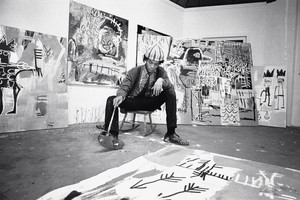
JBYes, music was a consistent part of his studio practice. In his catalogue essay for Basquiat’s 1993 survey at the Whitney Museum of American Art, Robert Farris Thompson recalls a studio visit with the artist in 1984 and was mesmerized watching him finish a collage while listening to a collection of Afro-Cuban styles of jazz, from mambo-inflected to hard bop to early bop. The rhythm of the music aligned with the stages of the artwork. Tamra Davis, a friend and young filmmaker, who recorded Basquiat during his stays in Los Angeles between 1982 and 1986, had a similar experience with Basquiat and filmed him in the studio in California bobbing to the horns of Duke Ellington’s 1938 Boy Meets Horn. Basquiat bounced between the canvas and his notebook in sync with the rhythm of the music. Her footage captures how his compositions became intricately connected with music, specifically jazz.
LMDid he often go to jazz clubs in the city? If so, which ones?
JBBasquiat came of age during a particularly rich period in the music scene in New York, and he moved in and out of musical spaces not just performing with his band, Gray, but connecting with fellow artists and showing his artwork in these spaces. One of the cofounders of the Mudd Clubb, Diego Cortez, curated the legendary New York/New Wave exhibition in 1981 at what’s now MoMA PS1, which was the moment that Basquiat’s artwork attracted the attention of legendary art dealers Annina Nosei, Bruno Bischofberger, and Larry Gagosian. While I have not come across specific jazz clubs that he frequented, we know that musical venues offered a creative networking circle for Basquiat, where he crossed paths with fellow hip-hop artists like Fab 5 Freddy and emerging talents like Debbie Harry and Madonna, whom he briefly dated in 1982.
LMHe also played the clarinet and apparently auditioned for John Lurie’s band, The Lounge Lizards. He then created his own ensemble, Gray. Talk about that endeavor.
JBBasquiat played in Gray, a noise band, from 1979–80 with his friends Nick Taylor, Wayne Clifford (aka Justin Thyme), and Michael Holman, who played respectively on guitar, keyboard, and percussion. Shannon Dawson and Vincent Gallo also played with the band at different points in its iteration. Basquiat performed on triangle, bell, clarinet, synthesizer, and sometimes guitar, which he played with a metal file. They performed at the Mudd Club, CBGB, and Hurrah in New York, where Blondie and the Talking Heads were at the time emerging. Basquiat described Gray’s style as “incomplete, abrasive, and oddly beautiful.”
The band itself was interwoven into his art practice. The name came from Gray’s Anatomy, a book that his mother gifted him in the hospital when he was recovering after being hit by a car in Brooklyn at eight years old. Anatomy is not only a throughline in his artistic practice, but the book also sparked an early fascination with drawing and the human form.
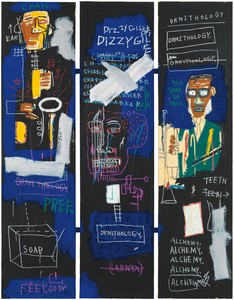
His close study of the body in pieces and parts again aligns with his ability to conjure a figure from seemingly disparate phrases and symbols. In a work like Horn Players (1983), Basquiat points to Charlie Parker’s famous composition “Ornithology,” a phrase which appears five times across the canvas, and to Parker’s colleague in modern jazz, Dizzy Gillespie. The up-down-up of the painted figures’ heads and the placement of the album title direct the eye across the canvas with a distinct musical rhythm. Even more, he paints aspects of anatomy as coded references to the genre. “EAR,” for instance, reminds us that jazz stems from oral roots as improvised more than written down. “LARNYX” points to its scattering sounds from the voice box, and “SOAP,” the art historian Stanley Tarver states, alludes to a common descriptor of jazz as “clean” or “aesthetically impeccable.”
Basquiat had a lifelong involvement with music, not simply in listening to it but in living it, reading its history, and incorporating the free-forming complexity of the genre into his artistic practice.
LMWhere can people see some of his jazz-themed art?
JBBasquiat’s stunning triptych Horn Players (1983) can be seen at the Broad Museum in Los Angeles and other tributes to Charlie Parker, such as Pink Parker (1983) and Charles the First (1982), are both owned by the Jean-Michel Basquiat estate, which recently toured a major exhibition, King Pleasure, in New York and Los Angeles. The spirit of jazz and the references to its complex sonic compositions can be seen throughout his paintings. Now you’ll know how to spot them!