Alison McDonaldPlease describe how the performance came together—illuminate a little bit about your process, from early ideas, inspirations, and conversations, to selecting music, rehearsals, and the final performance.
Vincent GardnerI’ve always been a fan of Charlie Parker and Dizzy Gillespie, with Gillespie being one of my earliest musical references. My father, who was a trumpet player, showed me a picture of him when I first began to play trombone and was developing a bad habit and said, “He’s the ONLY one that can play an instrument looking like that. DON’T puff out your cheeks when you play!” As far as inspirations, I was thoroughly immersed in bebop by the amazing historian Phil Schaap and many of the older Brooklyn musicians and jazz fans I met when I lived there. The most prominent message that I learned from them is that the music was the statement from the youth of the 1940s on the way that they wanted music and the world to look in the years after World War II. It was to be based on both fun and virtuosity, and inclusive of everyone who had the skills to play it. This was the real “Bebop Revolution,” so in selecting music, I chose pieces that showcase not only the distinctive language that was only played during the bebop period but also pieces that were written by beboppers for some of the swing bands of the earlier era, showcasing how the music was being used to cross barriers of race and age.
AMBebop was groundbreaking when it emerged, and it has influenced generations of creators since. What impact did bebop specifically have on your work and early formation as musicians, and what thoughts might you have about jazz more generally and its traces in the works of Jean-Michel Basquiat?
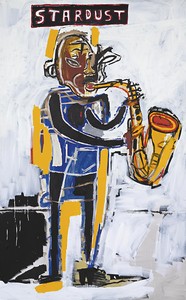
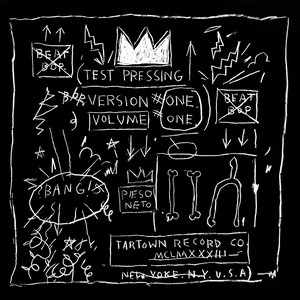
VGFirst, I was astonished by the virtuosity of Charlie Parker, Dizzy Gillespie, Max Roach, Thelonious Monk, Bud Powell, and J.J. Johnson. As I learned more about jazz, I could hear that not only were they playing with astonishing technique and presence, but they were creating new language in jazz, putting notes and phrases together as no one had done before in earlier eras. They also did it at a time when the public, after a terrible war, would rather hear something familiar in their music instead of something new and innovative. Their integrity in proclaiming that this is the new music of that time and not bending to the pressure to conform is extremely inspiring. The cutting-edge nature of these new sounds, the bebop culture it created with the young people of the 1940s, and the folklore of Charlie Parker’s life influenced artists of all disciplines, and Basquiat created some of the most impactful references to it in his art.
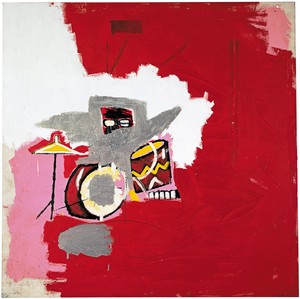
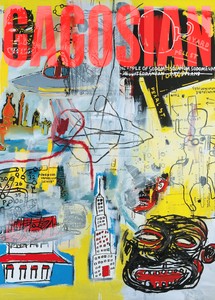
My favorite out of those is Max Roach (1984). It has many clear layers to me that paint a powerful total statement. There are two ghost-like images in the painting, one which reminds us of Lester Young, clearly outlining the shape of his signature pork pie hat near the drums, and a larger, more menacing figure that seems to evoke how Roach’s influence took over all bebop drumming for a time and was the basis for the transition into the hard-bop style of the 1950s.
AMThere is a conversational nature in improvised jazz, and I wonder if you see anything similar reflected in Basquiat’s work. There is an elevated harmonic language and rhythmic structure to bebop that you might also identify in the work of Basquiat.
VGI do agree and see a parallel in Basquiat’s work. In anything improvisational there still must be both balance between all of the contributing elements and also occasional moments of imbalance, which make it feel human and in realtime. I enjoy the interplay in Basquiat’s works between those features, sometimes reflected in color, texture, or a complete or partial reference to an image that may at first seem unrelated but only for a short time until you reexamine the work.
AMA few years ago you put together a suite of music inspired by the short stories of Langston Hughes. What was it like to take inspiration from writing and storytelling and transform that into musical composition?
VGIt was very similar to what we are discussing today. I naturally gravitate to artists such as Hughes and Basquiat who have jazz elements in their output. As I’m experiencing it, I can feel the give and take of jazz and the interplay between a soloist/arrangement and the drums.
AMIt might be interesting to think about color in musical terms—each instrument has a unique sound (which we might think about as line drawing) and the harmony in music is where those lines of each instrument get filled in by color. Jazz harmony is another layer built on top, adding additional notes, dissonances, and tensions, which can then be resolved (or not). Visual artists carefully consider color choices—how to blend them, where to place them, what they are adjacent to—to build tension and connect to emotions or feelings. Is this something you relate to, and have you ever thought about it as a connection between music and visual art?
VGMost definitely, I tend to think of color in an orchestration the same way. We have many instrumentation options in the jazz band, including saxophonists who also play clarinets and flutes, different mutes for the brass instruments, and multiple ways to blend them all. When a passage I’m composing takes a certain direction, I’ll often think of the color, weight, and texture of how I’d like to orchestrate it with the various choices available.
AMBasquiat’s friends consistently recall him working in his studio along to music, and there are many references to music or specific musicians written directly onto the surface of his work. However there are also allusions to musical notation or more elusive connections that emerge over a longer period of time spent looking. Do you see this in his work? And do you see a parallel in the ways that longer, more dedicated listening can open up new dimensions in music, specifically in bebop?
VGYes, I do see this in his work. As with most great artists, there are multiple layers that are usually much too complex to be seen in total on the first hearing or viewing. Your own personal emotional state at the time of the experience can also influence what or how you experience it. Bebop has these very experiences embedded in it. Normally in a recording of music we only focus on what is the loudest or placed the most upfront in the audio mix, but if you listen to a great bebop record and force yourself to listen to the piano, bass, drums individually or the rhythm section as a unit, you experience the music in a completely different way. Then if you again return to focusing on the soloist, you’ll hear how those elements in the rhythm section influenced or did not influence the soloist to play how or what they played.
AMBebop has traditionally been performed by smaller groups, and you will be performing it with a big band. Is there a benefit to that? And please tell us a bit about Ashley Pezzotti and what she brings to the performance.
VGThe orchestration of bebop is equally as innovative as the genre itself. The pianist Tadd Dameron and the arranger Walter “Gil” Fuller were the two primary arrangers in bebop, and they took the innovations of the swing era and tailored them into a completely original style for bebop. The commissioned piece that is being premiered in the concert is inspired by many of those innovations. Ashley Pezzotti is a wonderful vocalist who came to our attention a few years ago, and not only does she have a beautiful voice that can deliver a melody with style and swing, but she is also an expert scat singer. She’s put out some amazing short clips on Instagram of her scatting along with difficult solos by John Coltrane, Fats Navarro, and others. This is a skill that was most refined during the bebop era and requires a vocalist to have a knowledge of harmony and rhythm equal to an instrumentalist—it’s very difficult to do. She’ll be singing the original version of one of Tadd Dameron’s most beautiful love songs and also is featured on all three movements of my piece.