Most of the paintings have one or two paintings under them.
— Jean-Michel Basquiat1
Scholars, curators, artists, poets, and journalists have written extensively about Jean-Michel Basquiat’s work, yet despite the great volumes of text on his brief nine-year career, there are still untold, or at least lesser-known, stories buried. The overwhelmingly dominant narrative casts him as a graffiti artist, working in New York, who suffered an untimely death. But the desire to locate and fix him in this way overlooks the importance of travel on his practice and the months out of each year that he spent working in destinations like Saint Moritz, Hawaii, Los Angeles, and Modena. While his creative output was limited to just nine years, his production underwent dramatic shifts; across just a few months one can see his style mature, his hand grow more expressive, and his use of language, signs, and symbols become more sophisticated. With every trip and with the preparation for each exhibition, he collected new references and influences that he poured back into his work. In paintings made in Modena and Los Angeles less than a year apart, one can find the influence of the earlier group of works manifesting in the later one, for instance when gestural brushstrokes from canvases painted in Italy seem to reappear as underpaintings for a new series produced in California.
In the summer of 1982, Basquiat was on his second stay in Modena at the invitation of the Italian collector and art dealer Emilio Mazzoli. He was twenty-one years old. It had been one year since his breakout moment in New York in Diego Cortez’s legendary exhibition New York/New Wave at P.S.1 Contemporary Art Center (now MoMA PS1), which launched his career and positioned him as part of a group of 118 artists from the burgeoning Lower East Side art scene. Even at this early stage, the twenty-two works that Basquiat submitted represented much of what would become the core imagery and concerns of his practice: the urban environment; sparse, gestural mark making (reminiscent of American painter Cy Twombly); angular forms (à la Picasso); an honoring of Black culture, history, and life; and the use of his signature crown to represent, in his own words, “royalty, heroism, and the streets.”2 The show caught the attention of several art dealers, including Mazzoli, Annina Nosei, and Bruno Bischofberger. Nosei offered Basquiat a studio in the basement of her SoHo gallery, and Mazzoli invited him to present his first-ever solo show in Modena.
At this point in his career, Basquiat was still signing his paintings as SAMO, the street tag for his graffiti practice. He was self-taught and learning to navigate the wave of attention that came swiftly, offering him little time or mental space to prepare. Despite his momentum in New York, the first exhibition in Modena was a flop: few people attended the opening, and the works did not sell.3 The timing was too soon, perhaps, and the pressure and time frame unforgiving. One year later, after the roaring success of solo shows at Nosei’s gallery in New York and with Larry Gagosian in Los Angeles, Basquiat was ready for another try and returned to Modena in June 1982 for a promised second solo show. With this new invitation to stay and paint in northern Italy, Basquiat traveled with his then-girlfriend, Suzanne Mallouk. Before heading to Modena they stayed in Rome, where Basquiat painted in a large warehouse provided by Mazzoli. Subsequently, in Modena, he completed eight paintings in a matter of a few days that today are considered pivotal in his oeuvre.
The new Modena show never came to fruition due to infighting between Nosei and Mazzoli, and the eight paintings were sold to European collectors, never to be shown together until the Beyeler Foundation reunited them for the first time in forty-one years in spring 2023.4 But even if Basquiat’s stay in Modena this time was plagued by disagreement, the paintings he made there are some of the most expressive and vivid of his career. With heavy, dripping brushstrokes and compositions dominated mostly by single figures, they give the impression of a musical narrative or opera in multiple acts, told through the characters of an angel, a devil, a prophet, a miser, a farmhand, and the goddess Venus. While the use of language is sparse, the gestures are impassioned and the paintings are ripe with ideas and complexity.
Basquiat was not the first to bring the passion and heat of an Italian summer to painting. Cy Twombly, an acknowledged influence on his work, was so moved by his trip to Italy with Robert Rauschenberg in 1957 that, three years later, he made it his permanent home and created some of the most celebrated paintings of his career there; these feature rich reds and pinks and a general intensity evocative of the heat and romance of his time in Rome. One can find clear compositional similarities between many of Basquiat’s 1981 works, especially Aaron I (1981), which is an homage to Hank Aaron, the African-American baseball player, and the spare, gestural marks of Twombly’s early paintings. In fact, art historian Kirk Varnedoe’s description of Twombly’s compositions could easily apply to Basquiat’s: “Offhand impulsiveness and obsessive systems; the defiling urge toward what is base and the complementary love for lyric poetry and the grand legacy of high Western culture; written words, counting systems, geometry, ideographic signs, and abstract fingerwork with paint—all ask to be understood in concert.”5 In his 1982 Modena works, Basquiat expressed much of the sensuality and aggressive energy that can be found in Twombly’s celebrated Roman paintings from 1961, yet he expounds on these sensations with his own style. And his interpretation of the allure of Roman myth and antiquity is most apparent in the one painting in the group with a female protagonist: Untitled, what has more recently been referred to as the Venus painting.
In general, Basquiat in this period was fusing the gestural mark making of Neo-Expressionism with details plucked from art history, culture, and politics. For instance he incorporated details from Pablo Picasso’s Les Demoiselles d’Avignon (1907) into an Untitled triptych from 1983 and two 1982 paintings, Three Quarters of Olympia Minus the Servant and Untitled (Detail of Maid from Olympia), that unpack political and racial elements from Édouard Manet’s Olympia (1863). Three Quarters of Olympia Minus the Servant blends references to Edgar Degas, another French Impressionist famous for his depictions of dancers and women bathing, while leaving out the central languishing white figure of Manet’s painting. In the sister canvas, Basquiat references the body of the white concubine with the word “FEET” and a squiggling outline of feet, but focuses mainly on the face of the Black maid, one of the most charged elements of Manet’s painting.
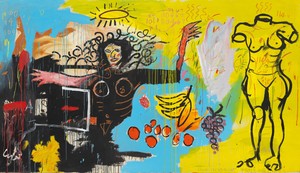
While women did not feature prominently in Basquiat’s work, when he did reference art historical depictions of women and beauty, he slyly challenged and deconstructed them. In a painting like the Venus completed in Modena, he sampled from the Italian Renaissance and inserted his own contemporary interpretation. The left side, with its dripping red brushstrokes, dense black shadows, and yellow numbers on a teal background, feels like an Abstract Expressionist painting. At the center of the canvas, a female figure with a black torso and pale, heavily made-up face with angular features reminiscent of a Picasso emerges from a black shadow. Her head is surrounded by a swirly mane of dark curls, and her black torso and breasts are outlined in shades of pink. She shares this central region of the painting with a still life floating on a teal background. Her arm reaches toward the right side of the canvas, pointing to a solo headless female figure in a field of bright yellow. The figure recalls Roman sculpture, or perhaps the iconic anatomy drawing by Leonardo da Vinci. The still life and the figure compete with the heavy, dripping shades of teal and yellow, which seem to blend all the components together into a vibrant Pop painting that joins references from Picasso and Roman antiquity with allusions to Mallouk, who was with him in Modena, and whom he often called “Venus” in notebooks and with friends due to her pale skin and dark hair.6 Here, Basquiat is freely sampling from many different references to create his own composition, his own score, his own beat.
Basquiat was brilliant at combining the principles of poetry, the politics of hip-hop, and the free associations of jazz in his painting process. His compositions are celebrated for their elliptical yet visceral references, and the Venus painting epitomizes his ability to mix styles and incorporate disparate elements, recalling William S. Burroughs’s cut-up method (which involved folding and cutting phrases from texts and piecing them together, and revolutionized modern poetry). But Basquiat’s sources ranged far and wide: he looked to African rock art, hobo signs found in Henry Dreyfuss’s Symbol Sourcebook (1972), and the anatomy drawings of Leonardo da Vinci, and blended them with influences from his upbringing in Brooklyn and his Puerto Rican and Haitian parentage.7
For this Venus painting, it is clear that he was sourcing images and references from his sojourn in Italy. While speaking with Henry Geldzahler for Interview magazine, he said he borrowed from Italian tour guides and condensed histories to make the Modena works. Surely Basquiat would have seen images of Sandro Botticelli’s The Birth of Venus (1485–86), a broadly reproduced and celebrated painting from the Italian Renaissance, in such a guide. In Botticelli’s version, the nude Venus is emerging from a clamshell and covering her body with her long, flowing hair, tendrils of which flutter in the gust of wind blown by Zephyr, who with Aura hovers on the left side of the painting. There is a similar relationship between the two figures in Basquiat’s Venus, but his composition keeps the interpretation more open-ended, the narrative more unfixed. Its rich and varied references participate more broadly in the referential echo chamber of art history.
While the figures in Basquiat’s Modena paintings are complex and compelling, the great strength of the series lies in the use of color and the heavy, flowing paint that joins the disparate elements into a single score. Similar Neo-Expressionist brushwork reappeared six months later in works that Basquiat painted during his stay in Los Angeles between the fall of 1982 and 1983. In Hollywood Africans (1983), the personal references are to his friends Rammellzee and Toxic, the geography he was exploring around Hollywood’s Walk of Fame, and his latest interests: hip-hop, movies, celebrities, and friendship. But while one might think the bright yellow and blue abstract underpainting in Hollywood Africans references the blue skies and sand of Venice Beach, looking at the works chronologically reveals that Basquiat had in fact been using this color combination in his Venus painting. In another painting from Los Angeles, Museum Security Broadway Meltdown (1983), the heavy dripping black paint in the background echoes the swirling dark cloud engulfing the female figure in his Venus painting from 1982. Just as the Modena canvases worked together as a score or theatrical narrative, in Los Angeles Basquiat created a large installation of seven eighty-four-inch-square canvases that are heavy with text and symbols, retain the intense palette and abstract brushwork of the Modena series, and likewise “read” together, in this case like a long scroll.8
In Untitled, Basquiat was certainly sampling and lifting specific styles and influences from his immediate surroundings, but he was also building directly on his own earlier work, referencing his established style, palette, and lexicon. The Modena paintings are unique within Basquiat’s practice for their undeniable momentum, bravado, and operatic emotion. But they also show how quickly and astutely he was maturing as a painter, building on his own practice and creating his own beat.