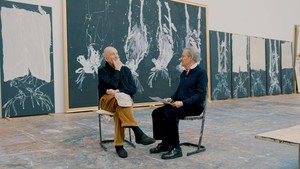
On the occasion of Baselitz: AVANTI! at the Museo Novecento in Florence, Italy, Holly EJ Black considers the roots and reverberations of Georg Baselitz’s printmaking.
Holly EJ Black is a London-based arts writer and author of The Story of Printmaking: A Global History of Art (Yale University Press, 2026).
The lineage of Georg Baselitz’s (1938–2026) printmaking oeuvre stretches back across the annals of history. Coded within the motifs of the late artist’s figurative black-line etchings, monumental relief cuts, and gestural aquatints, one can find not only the imprint of his painting and sculpture, but also the ghosts of Albrecht Dürer, Parmigianino, Rembrandt van Rijn, Edvard Munch, and Käthe Kollwitz. Each of these artists saw printmaking not as a means for producing a reproduction or facsimile, but as a potent form of expression with its own authority. As Baselitz himself declared, print has its own spirit, which allows an artist to do “something that just isn’t possible with paintings.”1
The artist’s earliest experiments with what is often termed “graphic art” (an expansive, yet strangely reductive title encompassing a multitude of techniques) took place at an etching workshop at Schloss Wolfsburg, Germany, in 1964. Here, the young artist began exploring the possibilities of intaglio, marking figurative lines onto a metal plate prepared with a layer of waxy ground, before plunging it into a vat of acid. Such caustic processes eat away at the desired marks to reveal an image that—when printed—is the exact reverse of the artist’s articulation.
Baselitz utilized vernis-mou (soft-ground) etching, which captures subtler, painterly lines due to its more pliant, tacky surface. These early plates (made during the residency and the following year) proved fruitful, producing iterations that closely resembled his wider practice during this period, including the haunting heads of Untitled (Ohne Titel) and Oberon (both 1964). They feature densely clustered lines and delicate smudges born from the pressure of hand and needle on the plate.
However, it was a six-month residency at Villa Romana in Florence, Italy, the following year that truly opened Baselitz’s eyes to the explosive capabilities of print. There, he not only encountered more expansive techniques ripe for experimentation, but entrenched himself in the rich printing history of the region, becoming enthralled by the Mannerist printmakers who had installed themselves in the city. By the 1500s,this crucible of the Renaissance had nurtured the peintre-graveur, a new form of “artist-printmaker” whereby the boundaries between masterful creativity and expert craftsmanship became more permeable.
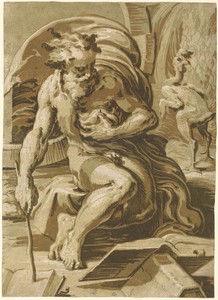
Among them was Ugo da Carpi, renowned for his development of the colored chiaroscuro woodcut in Italy. His most celebrated work is Diogenes (c. 1527), a vibrant depiction of the Greek philosopher picked out in swirling curves and subtle midtones. Baselitz counted one of these impressions in his own sizable collection of Mannerist prints, which proved so out of fashion when his interest was first piqued that they were relatively easy to acquire. After all, the mid-1960s was an era when the exacting precision of the screen print was favored by the avant-garde (though still largely considered something of a secondary art form). Now, his hoard is held in such high esteem that it is exhibited regularly, most recently at the Museum of Fine Arts, Budapest, in 2025–26.
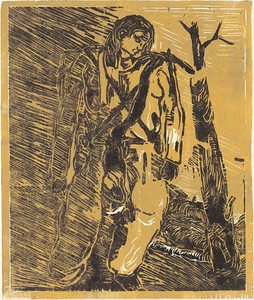
The influence of Ugo is evident in Baselitz’s earliest forays into woodcut printing, the most ancient and vernacular of printmaking techniques, which can be traced back to ninth-century East Asia, although its origins are most commonly associated with the fantastical and apocalyptic imagery of Dürer. In untitled works spanning 1966 to 1967 (usually termed the “chiaroscuro woodcuts”), Baselitz experimented with color and the inherent violence of the gouging tool, while maintaining an affinity with the acute line work of his forebears. Here, too, are allusions to Hendrick Goltzius, a German-Netherlandish artist whose flamboyant portrayals of twisted, impossibly muscular bodies are articulated in curvaceous ripples.
Although these formal likenesses are recognizable within Baselitz’s early editions, it was the unique marriage of conceptual and visceral materiality afforded by printmaking that truly struck a chord. In the case of the historical printmakers mentioned thus far, each commanded a deft ability to distill and translate imagery found in frescoes and oils, with nothing but line or keenly applied graphic tone. When compared with their source materials, these prints are often considered mere “reproductions,” yet they are undoubtedly works of art in their own right. In these expert hands the result is a crystallization of form, committed to permanence in a manner that Baselitz relished. In a text from 1993 the artist recalled his fascination: “Drawings turned into ciphers by means of dots and lines scratched or even etched into the plate, usually printed black, but also red and lilac. The art manifested in the Italian Renaissance with Raphael was put in an extremely unstable situation by these unusual prints. I am interested in such borderline cases in art.”2
Ugo da Carpi, Diogenes, c. 1527, chiaroscuro woodcut printed from 4 blocks: brown line block and 3 tone blocks in brown and green on laid paper, 18 ⅞ × 13 ⅜ inches (47.9 × 34 cm), National Gallery of Art, Washington, DC. Photo: Pepita Milmore Memorial Fund
Georg Baselitz, Partisan, 1966, woodcut on paper, 18 ¾ × 15 ⅞ inches (47.6 × 40.4 cm). Photo: Jochen Littkemann
A collapsing of traditional delineations extends within Baselitz’s own oeuvre. He always printed in parallel to his wider work, considering printmaking an essential force for distillation, as opposed to a supplementary practice.3 In his eyes, printmaking is more about the process than the pictorial, and is ultimately all about conviction. As he has stated, each print represents “the utmost finality of an idea of a drawing or painting that I had made,” without “any artistic excuse or alibi.”4
In the decades since his original excursions in Florence, Baselitz continually pushed the possibilities of print through a dedication to monumental scale inherent to so many of his works on canvas. His steadfast aversion to classification also meant that he had a far greater understanding of how the instinctual physicality of carving a block or etching a plate relates to other elements of his practice.5
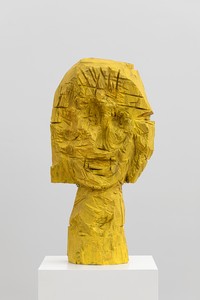
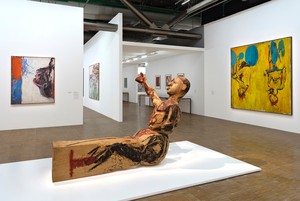
For example, he found that the act of cutting and gouging a wood or linoleum block to make a print bears a much closer relation to sculpture than to drawing.6 When encountering sculptures such as Dresdner Frauen – Elke (1989–2023), it is easy to see why. The violent, linear incisions that articulate the face demand the same sort of subtractive action as his favored form of relief printing, where dramatic gashes create uninked negative space (known as “white line”) to express the desired imagery.
Georg Baselitz, Dresdner Frauen – Elke (Women of Dresden – Elke), 1989–2023, patinated bronze and oil paint, 46 ½ × 23 ⅝ × 10 inches (118 × 60 × 25.5 cm). Photo: Manuel Nieberle
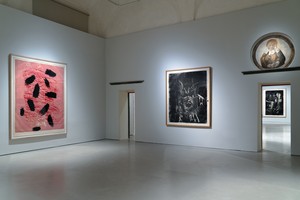
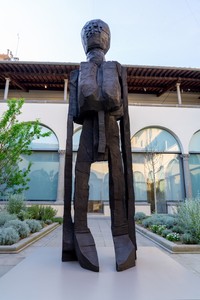
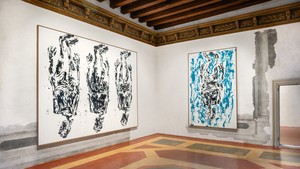
Georg Baselitz, 1965, 2024, installation view, Baselitz: AVANTI!,Museo Novecento, Florence, Italy, March 25–September 13, 2026. Photo: Elisa Norcini
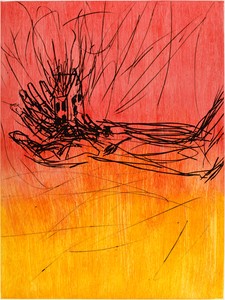
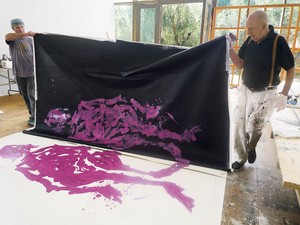
Oftentimes, this means that vast expanses of ink inform the majority of the surface, in a manner that recalls the claustrophobic printed works of Kollwitz and Munch. The latter was known for chopping up his plates and reassembling them to create variations on his compositions—something that inspired Baselitz’s Remix reliefs (2006–08). In these impressions, layers of black give way to vibrant gradients of pink, yellow, and blue. In other instances, the same subjects are revisited in nothing but bright hues, demonstrating the emotive power of the palette. For example, a figure that appears as if on fire in violent, molten shades seems closer to drowning when immersed in cobalt.
Georg Baselitz, Die Hand – Das brennende Haus (Remix) (The Hand – The Burning House [Remix]), 2006, drypoint, 26 ⅛ × 19 ⅝ inches (66.5 × 50 cm). Photo: G. Michaloudis, farbanalyse, Köln, Germany
Despite Baselitz’s resistance to perceived associations with German Expressionism, one cannot help but recall the roughly hewn woodcuts of Erich Heckel, who carved planks of discarded wood with a pocketknife while serving in the First World War. Baselitz shares a raw, unrefined approach to cutting, who referred to it as a “method of attack” that requires no specialist preparation when utilizing hard, relatively cheap wood.7 Although materially different, his etching shares a similar sensibility. Etching is usually considered a more intimate process due to the diminutive size of most plates, and the close kinship to the action of drawing, but it can also be explosive, and the artist even confessed to finding it somewhat frightening.8 Drypoint (another intaglio process, which involves dragging an etching needle over metal without a slippery ground), in particular, creates dramatic, jagged scratches with furred, velvety outlines that once defined Rembrandt’s most atmospheric prints.
In Baselitz’s hands etching articulates iterations of trees and upturned figures, while aquatint and sugarlift (more advanced forms of etching designed to emulate the liquidity and tonality of paint) produce grandiose, slathered marks infused with the frisson of an artist totally in tune with his technique. As the historian Siegfried Gohr attests in his essay “Georg Baselitz – Graphic Art as a Principle,” “[Baselitz’s] graphic skills lie not only in his ability to transform an image from one medium to another but in the way he endows the prints with an inherent tactility and surface presence.”9
This is particularly evident in the Eagle portfolio (1975), which consists of etchings, woodcuts, wood engravings, and hand painting, often incorporating multiple processes within the same print. The image of the raptor is clearly visible in some instances, before being abstracted to the point of obliteration through aggressive chisel marks or thick, expressive strokes.
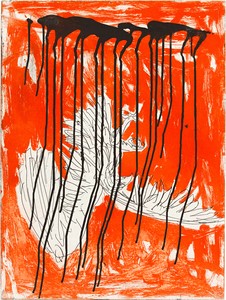
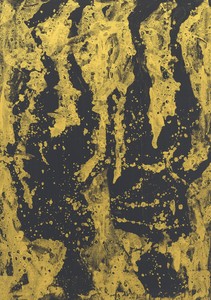
In a subsequent 2010 series of upturned eagles, printed from three plates and with various background shades of yellow, red, and blue, the scratched form of this magnificent bird is once again on the verge of annihilation. This time, the line-etched figure is maintained, while coal black, dripping lines are foregrounded, as if forming a cage.
Georg Baselitz, Hannoversche Treue, 2010, line etching and aquatint, 33 ¼ × 26 ⅛ inches (84.5 × 66.5 cm)
Baselitz long used this creature as a symbol for freedom and power, and therefore subjugation and oppression, particularly when it appears overturned (it has a close relationship to German heraldry, as well as being an emblem of fascism). Much has been made of the artist’s radical decision to begin painting “upside down,” so that he might do away with narrative and better contend with the elemental force of the work. Yet one must also wonder whether this consideration was informed—at least in part—by his considerable experience as a printmaker. The very act of conceiving and coding an image in reverse, so that the final mirrored print is accurately conveyed, might well have impacted his choice to upend the structure of his paintings. The actions involved in cutting, etching, inking, and printing could have also exerted influence. A plate is often picked up, turned, handled, and approached from all angles, quite unlike the conventional relationship between painter and canvas. Scholars such as Joann Moser have made such links within the work of Jackson Pollock (whom Baselitz greatly admired). Pollock’s technical training with master printer Stanley William Hayter at Atelier 17 in New York influenced his move toward complete abstraction and his unorthodox pouring techniques.10 Affinities within Baselitz’s practice certainly appear visible, even without direct comment from the artist.
It is no wonder that in recent years both scholarly texts and institutional exhibitions have taken note of printmaking as a vital facet of Baselitz’s practice. Generally speaking, prints are usually confined to lesser displays or treated as a footnote or addendum, but the latest examples of large-scale shows have given due consideration to his monumental contribution to the art form, including Georg Baselitz: A Life in Print at the Kode Bergen Art Museum, Norway (2025–26), and Baselitz: AVANTI! at Museo Novecento in Florence, on view through September 13, 2026. The latter is the first Italian survey to place considerable emphasis on Baselitz’s prints, and is something of a homecoming. Finally, his works are being celebrated in the same city as those canonical printmakers that he so long admired.
1Georg Baselitz, “Etching,” in Baselitz: A Life in Print, ed. Cornelius Tittel(Milan:Skira, 2025), p. 169.
2Diane Waldman, Georg Baselitz, Georg Baselitz (New York: Abrams/Solomon R. Guggenheim Museum, 1995), p. 247.
3Dorothea Dietrich-Boorsch, “The Prints of Georg Baselitz: An Introduction,” Print Collector’s Newsletter 12, no. 6 (1982), pp. 165–168.
4Ulrich Weisner, “Georg Baselitz: Woodcut,” in Baselitz: A Life in Print, ed. Tittel(Milan:Skira, 2025), p. 229.
5Detlev Gretenkort, Georg Baselitz: Collected Writings and Interviews, ed. Detlev Gretenkort with an introduction by Jill Lloyd (London: Ridinghouse, 2010).
10Holly EJ Black, The Story of Printmaking: A Global History of Art (New Haven, CT: Yale University Press, 2026). See also Joann Moser, “The Impact of Stanley William Hayter on Post-War American Art,” Archives of American Art Journal 18, no. 1 (1978): pp. 2–11.