
Now available
Gagosian Quarterly Summer 2026
The Summer 2026 issue of Gagosian Quarterly is now available, featuring Ellen Gallagher’s Fast-Fish and Loose-Fish (2026) on the cover.
Jean Nouvel
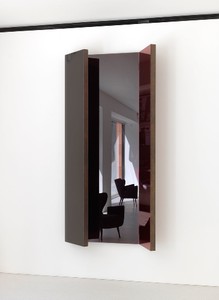
Miroir D, 2014
Walnut and colored mirrors, Dimensions variable, edition of 6
Photo by Mike Bruce
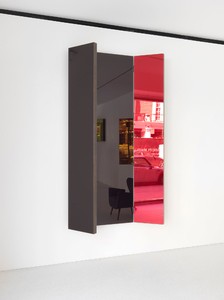
Jean Nouvel
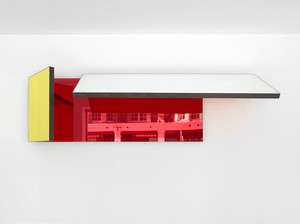
Mirror B, 2014
Walnut and colored mirrors, Dimensions variable, edition of 6
© Jean Nouvel Design, photo by Mike Bruce
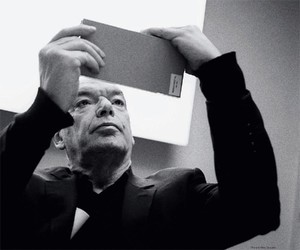
Jean Nouvel was born in Fumel in 1945 and studied at the Ecole des Beaux-Arts, Paris. A key protagonist of intellectual debate in France regarding architecture, he was a founding member of Mars 1976 and Syndicat de l’Architecture. Nouvel’s buildings include Musée du Quai Branly, Paris; Fondation Cartier pour l'Art Contemporain, Paris; Lucerne Culture and Congress Centre, Switzerland; Torre Agbar, Barcelona; and Guthrie Theater, Minneapolis. The Louvre Abu Dhabi, the National Museum of China (NAMOC), and the Philharmonie de Paris at La Villette are among the projects currently in planning. Nouvel’s distinctions include the Aga Khan Award for Architecture for the Institut du Monde Arabe (1989); the Gold Medal of the Royal Institute of British Architects (2001); the Wolf Prize in Arts (2005); and the Pritzker Prize (2008). Exhibitions of his work—including “Jean Nouvel,” a retrospective at Centre Georges Pompidou, Paris (2001)—have been held throughout the world, from New York to Rio de Janeiro and Tokyo.
In 1995 Nouvel created the Jean Nouvel Design Agency (JND) to develop design and interior architecture projects in parallel with the architectural practice Ateliers Jean Nouvel. Several series of furniture and industrial objects have been developed and commercialized, from the Less collection (Unifor), coffee service (Alessi), lighting (Artemide & Troll), partitioning systems (Methis), seating (Roset), and tables (Cassina & Molteni).
Nouvel collaborated with Gagosian in the design of a 1850 square meter gallery at Le Bourget, Paris, which opened in October 2012. He has also designed a limited edition mirrored shoe in collaboration with Ruco Line, Italy, that accompanied the Gagosian Davies Street, London exhibition.
The Summer 2026 issue of Gagosian Quarterly is now available, featuring Ellen Gallagher’s Fast-Fish and Loose-Fish (2026) on the cover.

In this video, Jenny Saville sits down inside her first major exhibition in Venice to discuss how the great Venetian artists of the past and the city’s heritage influence her work. The show brings together more than thirty canvases and works on paper from the 1990s to the present, tracing the development of her practice, which is deeply rooted in the history of painting.
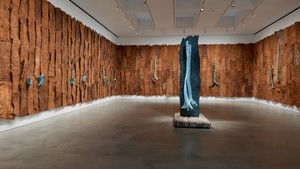
On the occasion of his exhibition The Reflection of Bronze at Gagosian, New York, Giuseppe Penone and curator Adam D. Weinberg sit down to discuss the genesis of, and their collaboration on, the show.
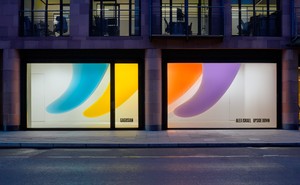
Ahead of Alex Israel’s exhibition of four new Fin sculptures at Gagosian, London, the artist spoke with Susan Casey, author of The Wave: In Pursuit of the Rogues, Freaks, and Giants of the Ocean (2010), about the ocean, surfing, and Los Angeles.
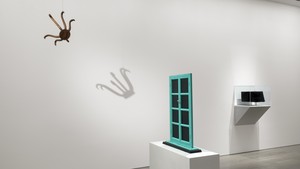
Marcel Duchamp is the inaugural exhibition of the gallery’s new ground-floor space in the historic building at 980 Madison Avenue. In this video, the Quarterly’s Alison McDonald discusses the artist’s most iconic readymades and their connection to New York City.
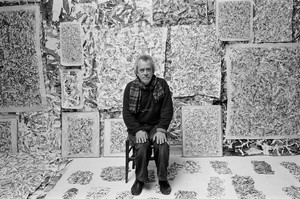
On July 9, Simon Hantaï: the last studio opens at Gagosian, Gstaad. Curated by Anne Baldassari, the show comprises sixteen of the artist’s dernier atelier (last studio) paintings of 1982–85. The exhibition is accompanied by an illustrated catalogue, copublished by Gagosian and Skira, which features an essay by Baldassari and an extensive portfolio of previously unpublished photographs by Édouard Boubat. Here, we share the introductory chapter from the publication.
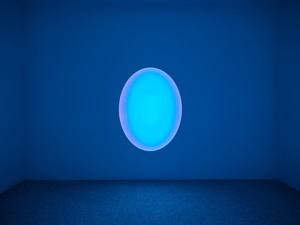
An exhibition at Gagosian, Hong Kong, brings together three of James Turrell’s Glasswork pieces along with site plans, photographs, and models of his Skyspaces and Roden Crater. Here, Alice Godwin explores the history of the Glassworks and their relationship to the artist’s wider practice.

On April 16, the Institute of Contemporary Art, Boston, opened the first midcareer survey of Derrick Adams’s multidisciplinary practice. Covering over twenty years of work, the exhibition, titled View Master, brings together the artist’s painting, sculpture, collage, performance, and video, as well as a vibrant new commission created for the museum’s façade. Ahead of the opening, Adams met with Tessa Bachi Haas, cocurator of the survey, to discuss his formative experiences with television, the impact of his work in arts education on his practice, and the importance of taking a more complex, more joyful, and more expansive approach to Black American life and culture.

Adam D. Weinberg has been working with Giuseppe Penone on an exhibition of the artist’s new sculptures, The Reflection of Bronze, that opens at Gagosian, New York, on April 22. The works explore the character and possibilities of bronze. Here, Weinberg considers Penone’s enduring engagement with the alloy and addresses the conceptual underpinnings of the exhibition’s three-room structure.

Jeff Koons tells Alison McDonald about his appreciation for the pioneering artist and thinker Marcel Duchamp.
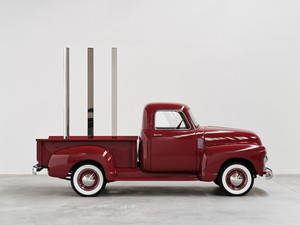
The Singular Experience at Gagosian’s Le Bourget gallery is the largest exhibition of Walter De Maria’s work in France in several decades. Organized by Donna De Salvo, senior adjunct curator at Dia Art Foundation, the exhibition marks the first time De Maria’s final sculpture, Truck Trilogy (2011–17), is being shown outside of the United States. Here, De Salvo speaks with artist Lucy Raven about her evolving kinship with De Maria and more.
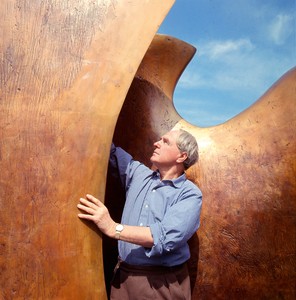
Laura Bruni writes about a major exhibition celebrating the work of the British sculptor Henry Moore at the Royal Botanic Gardens, Kew, London.

