
Now available
Gagosian Quarterly Summer 2026
The Summer 2026 issue of Gagosian Quarterly is now available, featuring Ellen Gallagher’s Fast-Fish and Loose-Fish (2026) on the cover.
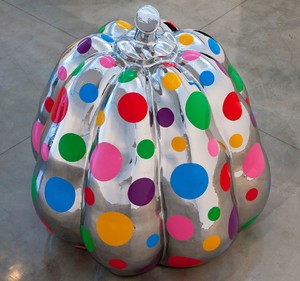
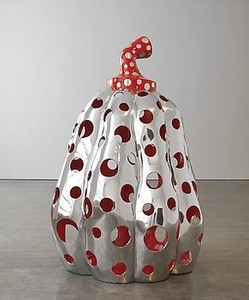
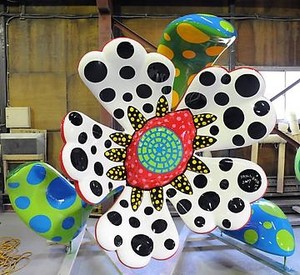
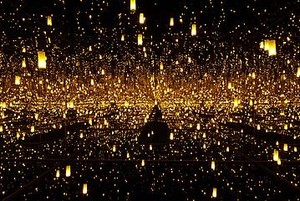
Yayoi Kusama was born in Matsumoto City, Japan in 1929. She studied Nihonga painting, a rigorous formal style developed during the Meiji period (1868–1912) to deflect the wholesale influence of Western art through the revitalization of the traditions of Japanese painting and their synthesis with aspects of Western art. Attracted by the experimental promise of the postwar international art scene, Kusama moved to New York City in 1958. As a young struggling artist in New York, Kusama produced her first astonishing Net paintings in 1959—vast canvases measuring up to 33 feet in width, entirely covered in rhythmic undulations of small, thickly painted loops. The inherent philosophical paradox of these paintings—that "infinity" could be quantified and constrained within the arbitrary structure of a readymade canvas—combined with the more subjective and obsessional implications of their process, distinguish these works from Minimalist abstraction, which would dominate the New York art scene several years later. The mesmerizing, transcendent space of the Nets was further reinforced by Kusama's own insistent psychosomatic associations to her paintings. She went on to develop other striking bodies of work, including the phallic soft-sculptures Accumulation, Sex Obsession, and Compulsion Furniture, which she later incorporated into full-scale sensorial environments. From 1967 she staged provocative happenings in various locations, from the New York Stock Exchange to Central Park to the Museum of Modern Art. Painting the participants' bodies with polka dots or dressing them in her custom-made fashion designs, she created risqué situational performances that merged her inner artistic world with external realities. In the early 1970s Kusama returned to Japan, where she began writing shockingly visceral and surrealistic novels, short stories, and poetry, including The Hustler's Grotto of Christopher Street (1983) and Violet Obsession (1998). Later, in her art, she began to revisit earlier themes, including the Infinity Net paintings and Accumulation sculptures. In recent years she has continued to invent ingenious embodiments of infinity in dizzying walk-in mirror rooms and freestanding sculptures, such as Passing Winter—hand-beveled mirrored cubes that yield an abyss of endlessly repeating self-portraits to their viewers. Following the success of her project for the Japanese Pavilion at the Venice Biennale in 1993—a dazzling mirror room filled with pumpkin sculptures, like an artful pumpkin patch over which she presided in magician's garb—Kusama went on to produce a huge, vivid yellow pumpkin covered with an optical pattern of black spots as an outdoor sculpture. The pumpkin, like the infinity net, became a kind of alter ego for her. She has since completed major outdoor sculptural commissions, mostly in the form of brightly hued, monstrous plants and flowers, for public and private institutions including the Fukuoka Prefectural Museum of Art, Fukuoka, Japan; Benesse Art Site Naoshima, Japan; Matsumoto City Museum of Art, Matsumoto, Japan; Eurolille, Lille, France; and Beverly Hills City Council, Beverly Hills, California. Kusama's work is in the collections of leading museums throughout the world, including the Museum of Modern Art, New York; Los Angeles County Museum of Art, Los Angeles; Walker Art Center, Minneapolis; Tate Modern, London; Stedelijk Museum, Amsterdam; Centre Pompidou, Paris; and the National Museum of Modern Art, Tokyo. Major exhibitions of her work include Kitakyushu Municipal Museum of Art, Kitakyushu, Japan, 1987; Center for International Contemporary Arts, New York, and the Museum of Modern Art, Oxford, 1989; "Love Forever: Yayoi Kusama, 1958–1969", Los Angeles County Museum of Art, Los Angeles, 1998 (traveled to the Museum of Modern Art, New York; Walker Art Center, Minneapolis; and Museum of Contemporary Art, Tokyo, 1998–99); Le Consortium, Dijon, 2000 (traveled to Maison de la Culture du Japon, Paris; Kunsthallen Brandts, Odense, Denmark; Les Abattoirs, Toulouse; Kunsthalle Wien, Vienna; and Artsonje Center, Seoul, 2001–03); KUSAMATRIX, Mori Art Museum, Tokyo, 2004 (traveled to Art Park Museum of Contemporary Art, Sapporo Art Park, Hokkaido); Eternity's Modernity, National Museum of Modern Art, Tokyo, 2004 (traveled to the National Museum of Modern Art, Kyoto and other venues in Japan, 2004–05); and "The Mirrored Years," Museum Boijmans Van Beuningen, Rotterdam, 2008 (traveling to Museum of Contemporary Art, Sydney, and City Gallery, Wellington, New Zealand, 2009). Kusama lives and works in Tokyo.
The Summer 2026 issue of Gagosian Quarterly is now available, featuring Ellen Gallagher’s Fast-Fish and Loose-Fish (2026) on the cover.

In this video, Jenny Saville sits down inside her first major exhibition in Venice to discuss how the great Venetian artists of the past and the city’s heritage influence her work. The show brings together more than thirty canvases and works on paper from the 1990s to the present, tracing the development of her practice, which is deeply rooted in the history of painting.
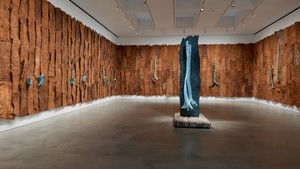
On the occasion of his exhibition The Reflection of Bronze at Gagosian, New York, Giuseppe Penone and curator Adam D. Weinberg sit down to discuss the genesis of, and their collaboration on, the show.
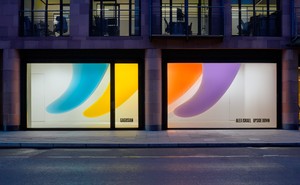
Ahead of Alex Israel’s exhibition of four new Fin sculptures at Gagosian, London, the artist spoke with Susan Casey, author of The Wave: In Pursuit of the Rogues, Freaks, and Giants of the Ocean (2010), about the ocean, surfing, and Los Angeles.
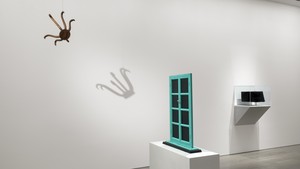
Marcel Duchamp is the inaugural exhibition of the gallery’s new ground-floor space in the historic building at 980 Madison Avenue. In this video, the Quarterly’s Alison McDonald discusses the artist’s most iconic readymades and their connection to New York City.
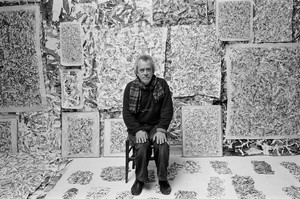
On July 9, Simon Hantaï: the last studio opens at Gagosian, Gstaad. Curated by Anne Baldassari, the show comprises sixteen of the artist’s dernier atelier (last studio) paintings of 1982–85. The exhibition is accompanied by an illustrated catalogue, copublished by Gagosian and Skira, which features an essay by Baldassari and an extensive portfolio of previously unpublished photographs by Édouard Boubat. Here, we share the introductory chapter from the publication.
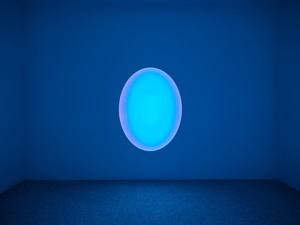
An exhibition at Gagosian, Hong Kong, brings together three of James Turrell’s Glasswork pieces along with site plans, photographs, and models of his Skyspaces and Roden Crater. Here, Alice Godwin explores the history of the Glassworks and their relationship to the artist’s wider practice.

On April 16, the Institute of Contemporary Art, Boston, opened the first midcareer survey of Derrick Adams’s multidisciplinary practice. Covering over twenty years of work, the exhibition, titled View Master, brings together the artist’s painting, sculpture, collage, performance, and video, as well as a vibrant new commission created for the museum’s façade. Ahead of the opening, Adams met with Tessa Bachi Haas, cocurator of the survey, to discuss his formative experiences with television, the impact of his work in arts education on his practice, and the importance of taking a more complex, more joyful, and more expansive approach to Black American life and culture.

Adam D. Weinberg has been working with Giuseppe Penone on an exhibition of the artist’s new sculptures, The Reflection of Bronze, that opens at Gagosian, New York, on April 22. The works explore the character and possibilities of bronze. Here, Weinberg considers Penone’s enduring engagement with the alloy and addresses the conceptual underpinnings of the exhibition’s three-room structure.

Jeff Koons tells Alison McDonald about his appreciation for the pioneering artist and thinker Marcel Duchamp.
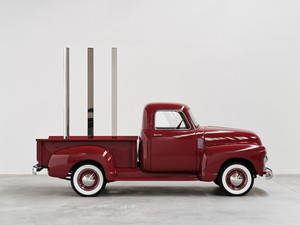
The Singular Experience at Gagosian’s Le Bourget gallery is the largest exhibition of Walter De Maria’s work in France in several decades. Organized by Donna De Salvo, senior adjunct curator at Dia Art Foundation, the exhibition marks the first time De Maria’s final sculpture, Truck Trilogy (2011–17), is being shown outside of the United States. Here, De Salvo speaks with artist Lucy Raven about her evolving kinship with De Maria and more.
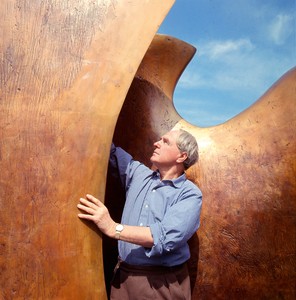
Laura Bruni writes about a major exhibition celebrating the work of the British sculptor Henry Moore at the Royal Botanic Gardens, Kew, London.

