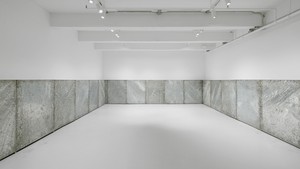
Donald Judd: Untitled: 1970
In this video, Flavin Judd, the artist’s son and artistic director of Judd Foundation, discusses a historic large-scale work by his father from 1970, ahead of its presentation at Art Basel Unlimited 2024.
Summer 2026 Issue
From the perspectives of their respective fields, three international cultural figures—artist and designer Ronan Bouroullec, fashion visionary Michèle Lamy, and chef and restaurateur Enrique Olvera—reflect on Donald Judd’s work in furniture, the subject of recent exhibitions in South Korea and Japan.
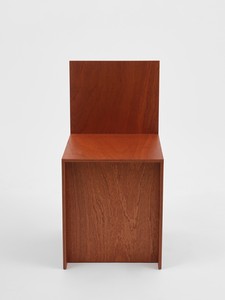
Donald Judd, Front Recessed Plywood Chair 84-12 in Sapele Plywood, designed in 1991, 30 × 15 × 15 inches (76 × 38 × 38 cm)
Donald Judd, Front Recessed Plywood Chair 84-12 in Sapele Plywood, designed in 1991, 30 × 15 × 15 inches (76 × 38 × 38 cm)
More than thirty years ago, when I was in my twenties, I stole a book from a bookshop. I remember this vividly because it was probably the only thing I’ve ever shoplifted. The book was Donald Judd: Räume Spaces (1994), published by Hatje Cantz. At the time I knew nothing about Judd, or Marfa, or Spring Street; I was simply magnetized by the cover image. The book is a repertoire of places, objects, artworks, installations. I think I know every square millimeter of it: the way the baseboards are finished, the pencils on the worktables, the faucet that feeds the bathtub, the quality of the concrete in the outdoor pieces. It’s a world of absolute coherence: the synthetic force of the anodization of the sculptures, the sensual sheen of the paints coating the steel, the roughness of a Mexican rug, a Thonet chair, military-issue cutlery, a horseshoe, Gerrit Rietveld, Dan Flavin, an anonymous piece of Sicilian pottery, a lamp clamped to the edge of a bed in the New York apartment building. For me Judd remains one of the most important references—for his work, of course, but just as much for the richness of the environment that he patiently constructed.
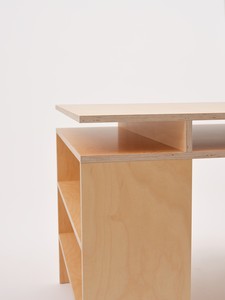
Donald Judd, Desk 33 in Clear Birch Plywood, designed in 1982 (detail), 30 × 48 × 33 inches (76 × 122 × 84 cm)
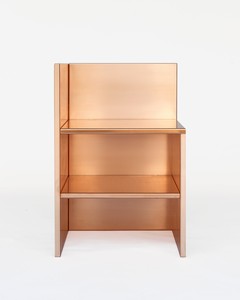
Donald Judd, Metal Corner Chair 115 in Copper, designed in 1984, 29 ½ × 19 ¾ × 19 ¾ inches (75 × 50 × 50 cm)
In the early 1970s, Judd began designing furniture for his home at 101 Spring Street in New York. His first design was a wooden bed. As Gilles Deleuze wrote, “The act of creation is an act of resistance, defying the forces that seek to control and define society.” In 1990 Rick Owens Furniture built our Army blanquette bed . . . happy to have followed the master.
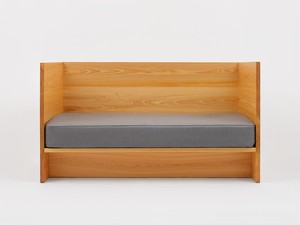
Donald Judd, Single Daybed 32 in Cypress, designed in 1982, 44 × 80 × 45 ½ inches (112 × 203 × 115 cm)
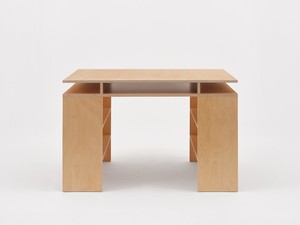
Donald Judd, Desk 33 in Clear Birch Plywood, designed in 1982, 30 × 48 × 33 inches (76 × 122 × 84 cm)
Each piece has a clarity of purpose, a purity of line, and an attention to material that feels almost sacred. Sitting in or around his work, you sense the quiet rigor—the way proportions, space, and weight converse with each other. There is no artifice, no attempt to impress, yet it impresses nonetheless, not by grand gestures but by integrity. Judd’s furniture invites presence: to notice, to inhabit, and to respect the space it occupies. For me, as a chef, there is a resonance here with the act of creation—where every element, every ingredient, and every gesture exists in harmony, and where simplicity, when true, is profoundly generous.
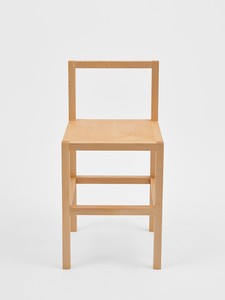
Donald Judd, Narrow Frame Chair 72 in Maple, designed in 1989, 29 ½ × 14 ¾ × 14 ¾ inches (75 × 37.5 × 37.5 cm)
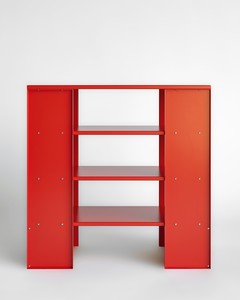
Donald Judd, Metal Bookshelf 114 in Raspberry Red/RAL 3027, designed in 1984, 39 × 39 × 19 ¾ inches (100 × 100 × 50 cm)
Donald Judd Furniture © Judd Foundation; photos: Timothy Doyon © Judd Foundation
Donald Judd: Furniture, Hyundai Card Storage, Seoul, November 27, 2025–April 26, 2026
Donald Judd: Design, ISETAN THE SPACE, Shinjuku, Japan, February 7–March 8, 2026
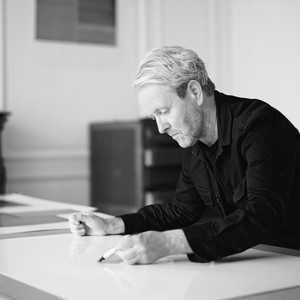
Ronan Bouroullec is a French artist and designer born in 1971 in Quimper, Brittany. A graduate of the École Nationale Supérieure des Arts Décoratifs, he founded his own studio in 1995. His work blends craftsmanship and industrial production, is characterized by simplicity and sophistication, and spans various fields, including furniture, lighting, interior design, and public-space projects. He has practiced drawing since childhood and it holds a central place in his daily life. He has been the subject of several exhibitions in prestigious international museums and his work is held in major museum collections worldwide. Photo: Marion Berrin
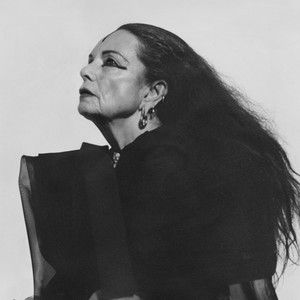
Michèle Lamy is an artist, entrepreneur, producer, collaborator, and performer. She studied philosophy under poststructuralist Gilles Deleuze and worked as a defense lawyer before becoming life partner to Rick Owens, with whom she cofounded their brand, Owenscorp, where she acts as the managing director of art and furniture. In 2014, Lamy created LAMYLAND, an umbrella term for her independent creative endeavors, including such projects as the cultural gathering space BARGE. In March 2026, Lamy was honored by Performance Space New York for her work in performance, and in April 2026, received a Lifetime Achievement Award in Fashion and Culture from Fashion Trust US. Portrait: Youssef Nabil, Michèle Lamy, Paris, 2016 (detail), hand-colored gelatin silver print, 10 ¼ × 15 ⅜ inches (26 × 39 cm) © Youssef Nabil
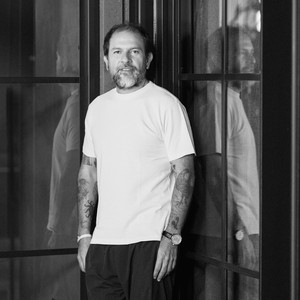
Enrique Olvera has constantly celebrated Mexican cuisine since the opening of his restaurant Pujol, Mexico City, in 2000. His work has attracted international attention to the city as a gastronomic destination and he has functioned as a teacher and mentor for countless culinary talents. He and his team are a driving force of creativity in the hospitality business in Mexico and the world.
In this video, Flavin Judd, the artist’s son and artistic director of Judd Foundation, discusses a historic large-scale work by his father from 1970, ahead of its presentation at Art Basel Unlimited 2024.
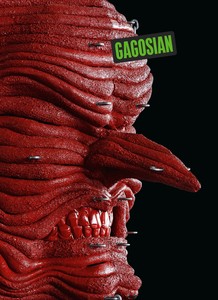
The Fall 2022 issue of Gagosian Quarterly is now available, featuring Jordan Wolfson’s House with Face (2017) on its cover.
In this second installment of a two-part essay, Julian Rose continues his exploration of Donald Judd’s engagement with architecture. Here, he examines the artist’s proposals for projects in Bregenz, Austria, and in Basel, arguing that Judd’s approach to shaping space provides a model for contemporary architectural production.
Richard Shiff speaks with Caitlin Murray, director of archives and programs at Judd Foundation, about the archive of Donald Judd, how to approach materials that occupy the gray area between document and art, and some of the considerations unique to stewarding an archive housed within and adjacent to spaces conceived by the artist.
Julian Rose explores the question: what does it mean for an artist to make architecture? Delving into the archives of Donald Judd, he examines three architectural projects by the artist. Here, in the first installment of a two-part essay, he begins with an invitation in Bregenz, Austria, in the early 1990s, before turning to an earlier project, in Marfa, Texas, begun in 1979.
Art historian Eileen Costello and Yale School of Art professor Marta Kuzma discuss Donald Judd’s two-dimensional work and how the lessons he learned from the innovations of Abstract Expressionist and Color Field paintings permeate his entire body of work. Their conversation is moderated by Caitlin Murray, director of archives and programs at Judd Foundation.
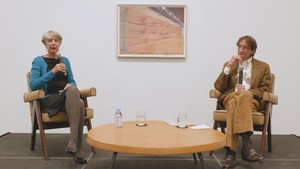
Peter Ballantine, Donald Judd’s longtime fabricator of plywood works, and Martha Buskirk, professor of art history and criticism at Montserrat College of Art in Beverly, Massachusetts, discuss the development, production, and history of the largest plywood construction Judd ever made, an untitled work from 1980.
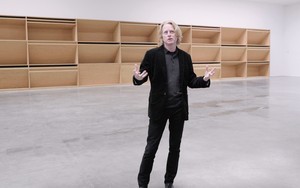
In this video, Flavin Judd, the artist’s son and artistic director of Judd Foundation, leads a walkthrough of the exhibition Donald Judd: Artwork: 1980 at Gagosian, West 21st Street, New York. Flavin connects the work to the concurrent retrospective at the Museum of Modern Art, New York, and the permanent installations in Marfa, Texas, highlighting how it fits within Judd’s oeuvre.
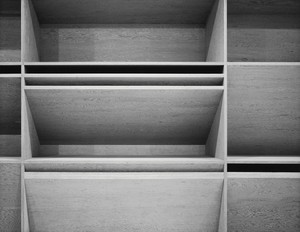
Flavin Judd, the artist’s son and artistic director of Judd Foundation, speaks with Kara Vander Weg about the recent installation of the sculptor’s eighty-foot-long plywood work from 1980 at Gagosian, New York.
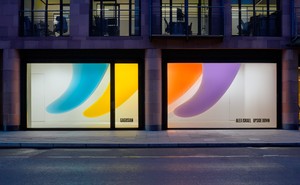
Ahead of Alex Israel’s exhibition of four new Fin sculptures at Gagosian, London, the artist spoke with Susan Casey, author of The Wave: In Pursuit of the Rogues, Freaks, and Giants of the Ocean (2010), about the ocean, surfing, and Los Angeles.
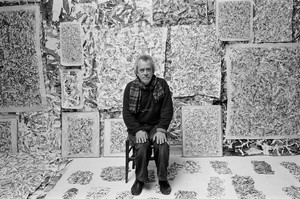
On July 9, Simon Hantaï: the last studio opens at Gagosian, Gstaad. Curated by Anne Baldassari, the show comprises sixteen of the artist’s dernier atelier (last studio) paintings of 1982–85. The exhibition is accompanied by an illustrated catalogue, copublished by Gagosian and Skira, which features an essay by Baldassari and an extensive portfolio of previously unpublished photographs by Édouard Boubat. Here, we share the introductory chapter from the publication.

Adam D. Weinberg has been working with Giuseppe Penone on an exhibition of the artist’s new sculptures, The Reflection of Bronze, that opens at Gagosian, New York, on April 22. The works explore the character and possibilities of bronze. Here, Weinberg considers Penone’s enduring engagement with the alloy and addresses the conceptual underpinnings of the exhibition’s three-room structure.