Francis Bacon lived and worked in Paris for a decade starting in the mid-1970s. The city and the art he encountered there provided a profound backdrop for his austere late style, which often brings together smooth, colorful backgrounds, spare architectural signifiers, and sculptural human forms. Here, three striking paintings from that period are considered by Sebastian Smee.
Sebastian Smee is the author of The Art of Rivalry: Four Friendships, Betrayals, and Breakthroughs in Modern Art (2016) and Paris in Ruins: Love, War, and the Birth of Impressionism (2024), as well as several books on Lucian Freud and one on Mark Bradford. He won the Pulitzer Prize for Criticism in 2011 while at the Boston Globe and was art critic at the Washington Post from 2018 to 2026. Photo: Amber Davis Tourlentes
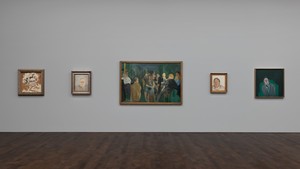
In 1984, twelve years after Bernardo Bertolucci had used a sequence of Francis Bacon paintings for the opening credits of Last Tango in Paris (1972), Bacon’s show at Galerie Maeght-Lelong in the French capital was mobbed by crowds. The excitement was so great that French police had to close off the street. During its run, a wall outside the home of the pop-culture icon Serge Gainsbourg was inscribed with graffiti declaring “ONLY FRANCIS BACON IS MORE WONDERFUL THAN YOU.”
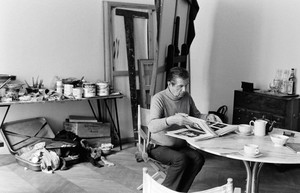
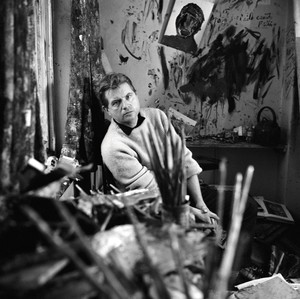
Bacon was by then nearing the end of his late-flowering romance with Paris. From the summer of 1975, he had occupied a home and studio in the Marais, and for approximately a decade thought of it as his primary abode. Bacon spoke French fluently. He read Honoré de Balzac, Charles Baudelaire, and Jean Racine in the original, admired the twentieth-century writings of Georges Bataille and Roland Barthes, and kept Marcel Proust by his bedside. He was close friends with Michel Leiris, the mandarin Maoist—a giant of French letters who championed his work—and he was delighted to be the subject of Francis Bacon: Logique de la sensation (1981), an incisive book by the French philosopher Gilles Deleuze.1
Bacon loved taking the train and night ferry back and forth between London and the Gare du Nord, as Mark Stevens and Annalyn Swan explain in their 2021 biography of the artist, Revelations. He loved the cruising scene on the rue Sainte-Anne, and it pleased him to have easy access, a few blocks away, to the Louvre. He enjoyed, too, the resonances of living in the city Pablo Picasso had made home. The Spaniard had not only “unlocked” images in Bacon, he said, but “also ways of thinking, and even ways of behaving.”2
Back in London, friends were dying. Long-standing relationships were getting too complicated or simply withering. “The atmosphere in Paris was lighter than in London,” explain Stevens and Swan, “and he rarely had to make amends.”3 Life felt simpler, which Bacon seemed to require as he got on with distilling his art, making it more emphatic and essential, carving out a veritable “late style,” with all the power implied by that epithet.
In some ways it seems incredible that Bacon would ever again wish to set foot in Paris. After all, this was the city in which, on October 24, 1971, his lover had been discovered dead in the bathroom of their hotel suite on the same morning that he, Bacon, was to attend a press preview of a landmark retrospective of his work at the Grand Palais. Bacon had had a famously intense and fractious relationship with George Dyer, and the circumstances of his death—sex, alcohol, a drug overdose—were squalid. And yet for many years Bacon made a point of returning not just to Paris but to the same hotel, where he usually requested the same suite he’d stayed in with Dyer.
After Bacon’s Grand Palais show, a friend, the Irish painter Louis le Brocquy, had written to him, effusing that “to me it is here in the Grand Palais—in the great circumstance of Paris—that your gesture is seen finally to assume and assert its universality. . . . You are progressively regarded as central to your time and preeminent in it.”4 Le Brocquy’s use of the word “circumstance” would have lodged in the painter’s mind. Bacon could be in Paris—in the galleries of his own exhibition at the Grand Palais, in the Louvre, or in the finest restaurant—and understand the city as “a great circumstance.” But in Bacon’s conception of life, the hotel bathroom where Dyer had vomited into the basin was also “a great circumstance.”
A “circumstance,” after all, is simply a situation, an existential condition. And for Bacon, any circumstance was fired with potential. It wasn’t a question of wallowing in depression or morbidity—it was really the opposite. People thought the things he painted were horrific, he noted in a late, filmed interview with David Sylvester, but this was only because he was trying to “give over,” as directly as he possibly could, “the excitement of life.” In making his work “intensely real” for himself, he explained further, “I may bring in very strongly this quality of mortality, because the more violently, the more strongly you feel about life, the more strongly you must be aware of death.”5
When it came to influences, Bacon was voracious. There were almost no images of the human body—and especially the body in motion—that didn’t interest him. The medium didn’t matter. But for all his undersung brilliance as a colorist, he preferred the images he worked from (be they sports photography, reproductions of sculptures and old master paintings, or illustrations in medical textbooks) to be black and white. Reducing them all to the same level (often literally at his feet on the studio floor) made them easier to assimilate.
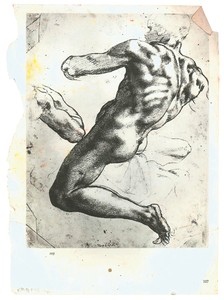
Michelangelo had long been a crucial figure for Bacon, but he became especially important later on. The Florentine was “deeply important in my way of thinking about form,” he told Sylvester.6 What he most admired was the voluptuousness with which Michelangelo handled the male nude—especially in his drawings.
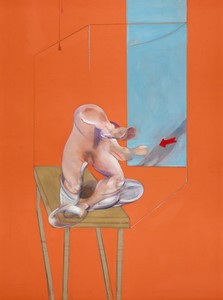
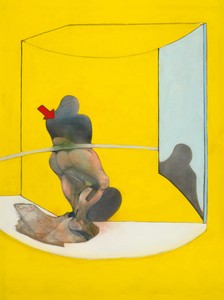
In the first two paintings here—Study from the Human Body—Figure in Movement, an oil painting from 1982, and Study from the Human Body, a painting from 1986 that combines oil paint with pastel, aerosol paint, and dry transfer (for the lettering)—we sense not only voluptuousness but a kind of brute, dynamic power. The figure is intensely muscled, especially around the legs, and coiled with a kind of torque that rhymes with the curving armatures that minimally define the pictorial space, threatening to send everything spinning in an anticlockwise direction. Bacon tended to mix up in his mind the drawings of Michelangelo and another crucial source, the sequential photographs by Eadweard Muybridge of humans and animals in motion. He wanted to combine the positions in Muybridge’s photos with Michelangelo’s ampleness and grandeur of form. And he connected both with his own experiences: “I think of the contours of those bodies that have particularly affected me,” he said, “but then they’re grafted very often onto Muybridge’s bodies.”7
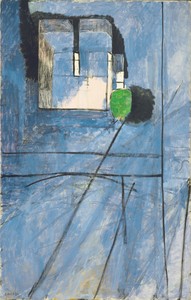
Of the great twentieth-century painters, Bacon much preferred Picasso (his “first and most important father figure,” according to Michael Peppiatt) to his counterpart Henri Matisse.8 Matisse didn’t, he said, “have the brutality of fact which Picasso had,” and he was guilty of “turning fact into lyricism.”9 And yet Bacon admitted to admiring Matisse’s sculptures, which were in turn deeply influenced by Michelangelo. Matisse was obsessed by the figure of Night (1526–31) from the Medici tombs in Florence, and his series of increasingly abstracted relief sculptures of a woman’s back, with their shifting configurations of clenched muscles suggesting an inscrutable inner tension, were indebted to Michelangelo.
Before even Picasso, Matisse had adopted the principle of “deformation”—distorting the human figure to maximize its expressive potential. And of course, the voluptuousness Bacon found in Michelangelo was vital for Matisse—notwithstanding that in Bacon and Michelangelo voluptuousness centered on male bodies and in Matisse on females.
In the three late Bacon paintings here it’s possible to see formal qualities one also finds in Matisse’s 1913–17 period, especially View of Notre Dame (1914) and The Piano Lesson (1916), both in the collection of the Museum of Modern Art, New York. Both share with the Bacon paintings a severe geometry (including an off-center shape in the background suggesting a window or mirror), linear armatures, and near-monochrome color. The simplified, semi-theatrical presentations of the human form that distinguish Bacon’s late work also resonate with Matisse’s Painter in His Studio (1916–17), in the collection of the Centre Pompidou, Paris, and Studio Quai St-Michel (1916), in the Phillips Collection, Washington, DC, both of which present a vulnerable body held up for scrutiny, like an actor on a stage or a sculpture on a plinth, yet seen at a slight remove, set deep in the picture’s space or reflected in a mirror.
Of course the differences are also clear. Where Matisse powerfully integrated the depicted reality—persuading the viewer that he not only saw what he painted but was part of the scene himself—Bacon embraced a more distant aesthetic of collage and disjunction. Instead of integrating his figures within the spaces they occupied, he used artificial color—often spray-painted onto the canvas—and pictorial fields stripped of incident to set up stark contrasts between figure and ground. His use of cadmium orange, and less commonly an intense sunflower yellow tinged with red, suggests the influence of Pop artists like Richard Hamilton and Andy Warhol. (After visiting Warhol at the Factory in New York, he came away impressed by the combination of intense, artificial color and macabre subject matter, indifferently treated, in the Car Crash and Electric Chair screen prints.)
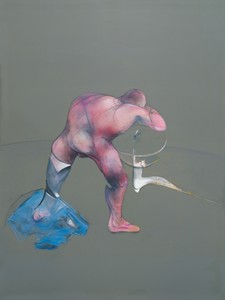
The third and latest painting here, Man at a Washbasin from 1989–90, is also the most radically distilled. No window relieves the gray ground. Completed less than three years before Bacon’s death, it recalls Gustave Caillebotte’s Man at His Bath (1884), held at the Museum of Fine Arts, Boston, a landmark painting of an unidealized male nude in realistic, everyday circumstances. Caillebotte’s generally static image is given a subtle dynamism by the vigorous rubbing action of the towel and by the white fabric (his nightshirt?) arrayed like a Baconian convulsion on the floorboards. The suggestion of scrotum visible beneath his buttocks is amplified in Bacon’s Man at a Washbasin, which derives from a photograph in Muybridge’s sequence of a man shadowboxing that he’d used several times before. The man’s position over the washbasin suggests he might be vomiting—an extreme, involuntary action, both physical and psychological, which inevitably recalls the death of Dyer.
Bacon had delivered the painting to his gallery in London about twelve months after starting work on it. He later retrieved it, wanting to make changes, mostly aimed at reduction. He painted out the light bulb, the rectangular frame around the figure, and a black circle surrounding the denim shorts at the bottom.
Bacon’s drive toward greater simplicity was not, as critics at the time suggested, a symptom of reduced ambition or the seductions of repeating an established “brand”—any more than was the case with Samuel Beckett’s radically distilled and repetition-dependent dialogues. Instead, Bacon was trying to clear away the unnecessary. The “circumstances” of life and artmaking were always connected in his mind to gambling. In his bid to “deepen the game,” as he framed it, he was trying to distill his best discoveries into something more essential.10 “You’re more conscious of the fact that nine-tenths of everything is inessential,” he said of aging. “What is called ‘reality’ becomes so much more acute.”11
Increasingly, the paint used for figures in these late works, though richly mottled and complex, is smooth and thinned out. It no longer mattered to Bacon that the paint itself should testify to a great struggle. He hated being mistaken for a surrealist or an expressionist, which may explain why he became obsessed through these final years with the idea that he was reinventing realism. He decided that realism meant recording appearances along with the sensations those appearances suggested. These sensations might be a particular person’s emanations; their awareness of—or blindness to—their circumstances; both their sexual attractiveness and what could be sensed of their own desires; or their feelings of connection, isolation, anxiety, obliviousness, mortality, and so on. Realism also meant seeing with eyes rinsed of rhetoric. Inherited artistic conventions—including so-called realism—only obscured all the sensations Bacon wished to “capture” or “trap.” And so he played up the strangeness of appearances. The truth, he knew, always comes through a strange door.
“I would like,” he said to Sylvester in 1974, “quite apart from the attempt to do sculpture, to make the painting itself very much more sculptural.”12 Picasso again provided a model of potential here: The Spaniard, if he wasn’t actually sculpting, was always painting and drawing sculptures, and even painting on sculptures. But Bacon also liked the idea of representing his increasingly sculptural figures in paint as fragments, in the manner of Auguste Rodin.
He visited the Musée Rodin in Paris several times, including in the summer of 1986. The museum is in the eighteenth-century Hôtel Biron, once occupied by Rodin, in the grounds of a former convent; Matisse had also used the building as both a studio and a school after moving there at the end of 1907.
Rodin, whose career was all but unthinkable without Michelangelo, loved snatching human figures or parts of figures from earlier contexts and recombining them in new, improvised arrangements that thrived on repetition, doubling, and dissonance. Rodin is so familiar and domesticated today that people glide over the chief characteristics of his work (at least in the context of classical sculpture): its wild gaucheness, its constant intensification of feeling through strategies of disruption, thwarted movement, and psychological “stuckness.”
Bacon loved all this, just as he loved the strangeness of bodies unnaturally compressed or cut off from their upper half, limbs and hips twisting into impossible new shapes. He used shadows and mirrors, too, to create doublings and discontinuities. In this way his late paintings suggest not only the hauntings of mortality but the roles we constantly play and the inevitable oozing out, from the facts of our circumstances, of some insidious leakage.
But against the ooze and deformation we associate with Bacon, there is also a suggestion of classicism in his late works, tied to both his simplified compositions and the smoothing over of the tumult of brushwork that characterized his earlier work. But the forms of classicism to which Bacon was drawn—above all the works of the great French neoclassicist Jean-Auguste-Dominique Ingres—tended to appeal to his perversity as well. When Odilon Redon was once pressed about the strange quality of his own pictures, he protested, “But it is Ingres who has made monsters!”13 Picasso heartily agreed—and so did Bacon. Ingres took extraordinary liberties with his sitters’ anatomies, dislocating shoulders here, adding vertebrae there. It’s often assumed that Ingres’s deformations resulted from his wish to subordinate all the elements of his pictures—even the sovereign human body—to the dictates of his Raphaelesque conception of grace and order. But this explanation glides too easily over what most appealed to Picasso (and later to Bacon) about Ingres: the morbid voluptuousness of his bodies; the sense of high-temperature melodrama being plunged into pools of emotional frigidity; and the simmering strangeness of the Frenchman’s amalgam of photographic fidelity to appearances and logically impossible anatomy.
Bacon, in his late phase, was attracted to Ingres’s lucidity but also to his desire to evoke a sort of legendary remoteness. Robert Rosenblum likened Ingres’s portrait of Madame Moitessier from 1856, in the National Gallery, London, to “a modern oracle,” an idea that held great appeal for Bacon, who loved Egyptian art and painted sphinxes and furies. But in the end, it was the sheer intensity of Ingres’s portraits that Bacon valued. Turning away from Ingres’s portrait of Monsieur de Norvins from 1811–12 (also in the National Gallery, London), for instance, would be like turning away from someone who has just pulled out a knife. Bacon wanted his own paintings to exert a similar force. In his late work he continually found ways to combine beauty with that same level of urgency.
1 Gilles Deleuze, Francis Bacon: Logique de la sensation, 1981, Eng. trans. as Francis Bacon: The Logic of Sensation, trans. Daniel W. Smith (London and New York: Continuum, 2003).
2 Francis Bacon, quoted in Wilfried Seipel, Barbara Steffen, and Christoph Vitali, Francis Bacon and the Tradition of Art, exh. cat. (Milan: Skira, for the Kunsthistorisches Museum, Vienna, and the Fondation Beyeler, Riehen/Basel, 2003), p. 352.
3 Mark Stevens and Annalyn Swan, Francis Bacon: Revelations (New York: Alfred A. Knopf, 2020), p. 575.
8 Michael Peppiatt, Francis Bacon: Anatomy of an Enigma (New York: Skyhorse Publishing, 2009), p. 72.
9 Bacon, quoted in Seipel, Steffen, and Vitali, Francis Bacon, p. 349.
10 Bacon, in David Sylvester. The Brutality of Fact: Interviews with Francis Bacon (London: Thames & Hudson, 1993), p. 29.
11 Bacon, quoted in Peppiatt, Anatomy of an Enigma, p. 377.
12 Bacon, in Sylvester, The Brutality of Fact, p. 114.
13 Odilon Redon, quoted in Robert Rosenblum, Ingres (New York: Harry N. Abrams, 1990), p. 21.
Francis Bacon, Gagosian, rue de Castiglione, Paris, April 11–May 30, 2026
Sebastian Smee is the author of The Art of Rivalry: Four Friendships, Betrayals, and Breakthroughs in Modern Art (2016) and Paris in Ruins: Love, War, and the Birth of Impressionism (2024), as well as several books on Lucian Freud and one on Mark Bradford. He won the Pulitzer Prize for Criticism in 2011 while at the Boston Globe and was art critic at the Washington Post from 2018 to 2026. Photo: Amber Davis Tourlentes