Now available
Gagosian Quarterly Summer 2026
The Summer 2026 issue of Gagosian Quarterly is now available, featuring Ellen Gallagher’s Fast-Fish and Loose-Fish (2026) on the cover.
Francesco Vezzoli: Sacrilegio
Installation view, photo by Rob McKeever
Francesco Vezzoli: Sacrilegio
Installation view, photo by Rob McKeever
Francesco Vezzoli: Sacrilegio
Installation view, photo by Rob McKeever
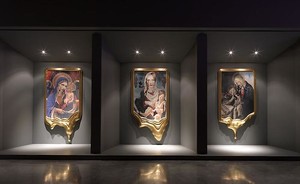
Francesco Vezzoli: Sacrilegio
Installation view, photo by Rob McKeever
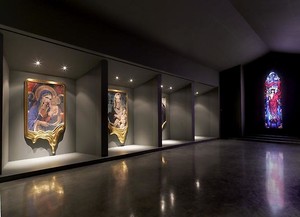
Francesco Vezzoli: Sacrilegio
Installation view, photo by Rob McKeever
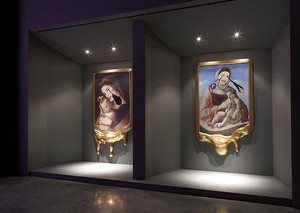
Francesco Vezzoli: Sacrilegio
Installation view, photo by Rob McKeever
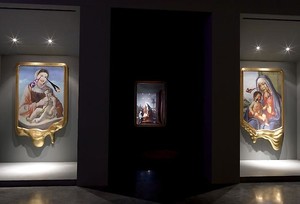
Francesco Vezzoli: Sacrilegio
Installation view, photo by Rob McKeever
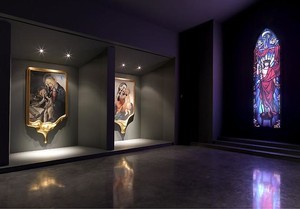
Francesco Vezzoli: Sacrilegio
Installation view, photo by Rob McKeever
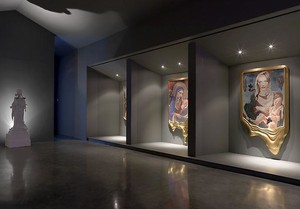
Francesco Vezzoli: Sacrilegio
Installation view, photo by Rob McKeever
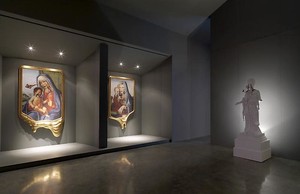
Francesco Vezzoli: Sacrilegio
Installation view, photo by Rob McKeever
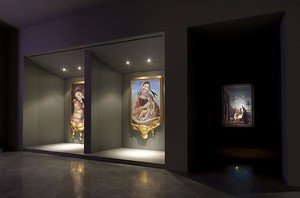
Francesco Vezzoli: Sacrilegio
Installation view, photo by Rob McKeever
Francesco Vezzoli: Sacrilegio
Installation view, photo by Rob McKeever
Francesco Vezzoli
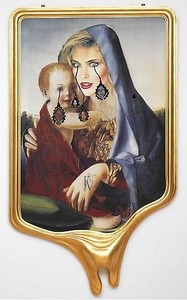
CRYING PORTRAIT OF KIM ALEXIS AS A RENAISSANCE MADONNA WITH HOLY CHILD (AFTER GIOVANNI BELLINI), 2010
Inkjet print on canvas, cotton and metallic embroidery, fabric, custom jewelry, watercolours, make-up & artist's frame, 94 ½ × 51 3/16 × 7 ⅞ inches (240 × 130 × 20 cm)
Francesco Vezzoli
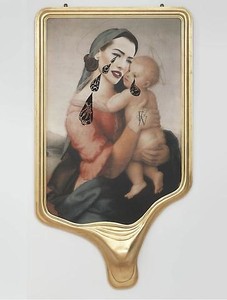
CRYING PORTRAIT OF TATJANA PATITZ AS A RENAISSANCE MADONNA WITH HOLY CHILD (AFTER RAFFAELLO), 2010
Inkjet print on canvas, cotton and metallic embroidery, fabric, custom jewelry, watercolor, make-up & artist's frame, 93 × 53 × 6 inches (236.2 × 134.6 × 15.2 cm)
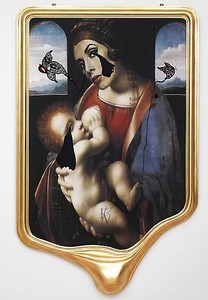
Francesco Vezzoli
CRYING PORTRAIT OF WILHELMINA AS A RENAISSANCE MADONNA WITH HOLY CHILD (AFTER LEONARDO), 2010
Inkjet print on canvas, cotton and metallic embroidery, fabric, custom jewelry, watercolours, make-up & artist's frame, 83 × 53 × 5 ⅜ inches (210.8 × 134.6 × 13.7 cm)
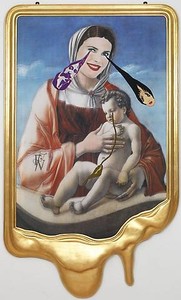
Francesco Vezzoli
CRYING PORTRAIT OF CHRISTIE BRINKLEY AS A RENAISSANCE MADONNA WITH HOLY CHILD (AFTER GIOVANNI BELLINI), 2010
Inkjet print on canvas, cotton and metallic embroidery, fabric, custom jewelry, watercolor, make-up & artist's frame, 88 × 53 × 4 inches (223.5 × 134.6 × 10.2 cm)
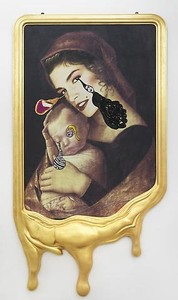
Francesco Vezzoli
CRYING PORTRAIT OF CINDY CRAWFORD AS A RENAISSANCE MADONNA WITH HOLY CHILD (AFTER ANDREA MANTEGNA), 2010
Inkjet print on canvas, cotton and metallic embroidery, fabric, custom jewelry, watercolor, make-up & artist's frame, 96 × 53 × 4 ⅜ inches (243.8 × 134.6 × 11.1 cm)
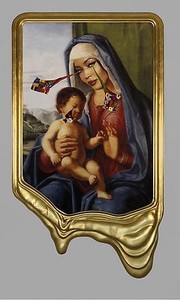
Francesco Vezzoli
CRYING PORTRAIT OF NAOMI CAMPBELL AS A RENAISSANCE MADONNA WITH HOLY CHILD (AFTER CIMA DA CONEGLIANO), 2010
Inkjet print on canvas, cotton and metallic embroidery, fabric, custom jewelry, watercolor, make-up & artist's frame, 93 × 53 × 4 ½ inches (236.2 × 134.6 × 11.4 cm)
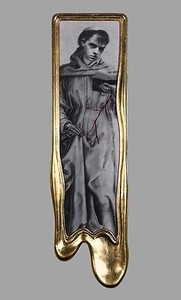
Francesco Vezzoli
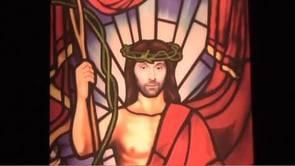
CRYING PORTRAIT OF TRUMAN CAPOTE AS SAINT ANTONIO DI PADOVA (AFTER COSME' TURA), 2011
Inkjet print on canvas, cotton and metallic embroidery, fabric, & artist's frame, 44 × 11 × 1 ¾ inches (111.8 × 27.9 × 4.4 cm)
Whatever great artist or thinker we choose to look at, they’ve all used whatever weapon they might have to attract interest to their thoughts. I don’t see anything wrong with using celebrities to make clearer, more understandable statements or, in my case, simply to reflect a reality that has a huge power over our lives. I insist that the taboo surrounding my work comes from the fact that people get stuck on the presence of Gore Vidal or Cate Blanchett. I’m kind of stuck...too.
—Francesco Vezzoli
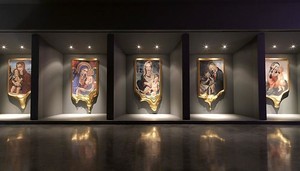
Gagosian Gallery is pleased to present “Sacrilegio,” Francesco Vezzoli’s first solo exhibition in New York.
Over the last decade, in a series of titillating works that have explored the undisputed power of contemporary media culture, Vezzoli has staged his ongoing preoccupations with the fundamental ambiguity of truth, the seductive power of language, and the instability of the human persona. These include a trailer for a remake of Gore Vidal's Caligula (2005), starring Vidal himself, Helen Mirren, and Courtney Love; an advertising campaign directed by Roman Polanski for Greed, a fictitious perfume; and elaborate, site-specific performances inspired by Pier Paolo Pasolini, Luigi Pirandello, and Salvador Dalí that have featured superstars like Catherine Deneuve, Cate Blanchett, and Lady Gaga.
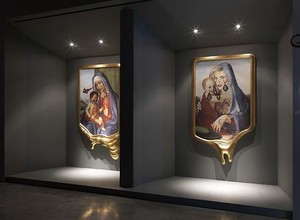
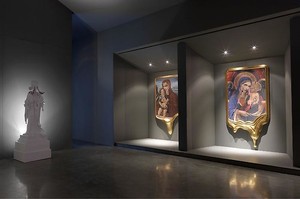
As the title of the exhibition suggests, Vezzoli has pushed his ideas regarding the sanctification of secular and materialistic obsessions to their ultimate hyperbole. Transforming Gagosian’s vast gallery into a Renaissance chapel, he has installed enlarged reinterpretations of fifteenth- and sixteenth-century Madonna-and-Child paintings by Giovanni Bellini, Leonardo da Vinci, Sandro Botticelli and others. But instead of the beatific Madonnas that grace each of the historical precedents, Vezzoli’s women are contemporary supermodels—Claudia Schiffer, Tatjana Patitz, Linda Evangelista, Stephanie Seymour, and Kim Alexis, among others. In conflating supermodels with historical religious icons, Vezzoli points to the societal worship of figures from the fashion and celebrity industries.
The Summer 2026 issue of Gagosian Quarterly is now available, featuring Ellen Gallagher’s Fast-Fish and Loose-Fish (2026) on the cover.

In this video, Jenny Saville sits down inside her first major exhibition in Venice to discuss how the great Venetian artists of the past and the city’s heritage influence her work. The show brings together more than thirty canvases and works on paper from the 1990s to the present, tracing the development of her practice, which is deeply rooted in the history of painting.
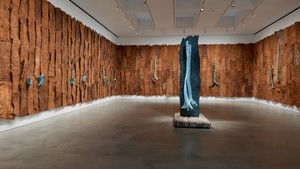
On the occasion of his exhibition The Reflection of Bronze at Gagosian, New York, Giuseppe Penone and curator Adam D. Weinberg sit down to discuss the genesis of, and their collaboration on, the show.
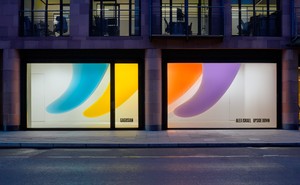
Ahead of Alex Israel’s exhibition of four new Fin sculptures at Gagosian, London, the artist spoke with Susan Casey, author of The Wave: In Pursuit of the Rogues, Freaks, and Giants of the Ocean (2010), about the ocean, surfing, and Los Angeles.
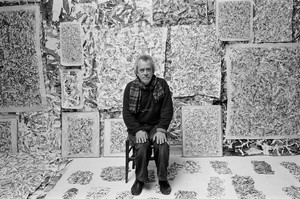
On July 9, Simon Hantaï: the last studio opens at Gagosian, Gstaad. Curated by Anne Baldassari, the show comprises sixteen of the artist’s dernier atelier (last studio) paintings of 1982–85. The exhibition is accompanied by an illustrated catalogue, copublished by Gagosian and Skira, which features an essay by Baldassari and an extensive portfolio of previously unpublished photographs by Édouard Boubat. Here, we share the introductory chapter from the publication.
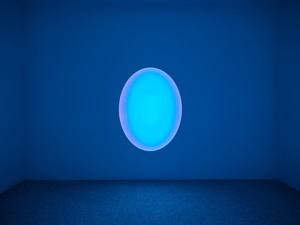
An exhibition at Gagosian, Hong Kong, brings together three of James Turrell’s Glasswork pieces along with site plans, photographs, and models of his Skyspaces and Roden Crater. Here, Alice Godwin explores the history of the Glassworks and their relationship to the artist’s wider practice.

On April 16, the Institute of Contemporary Art, Boston, opened the first midcareer survey of Derrick Adams’s multidisciplinary practice. Covering over twenty years of work, the exhibition, titled View Master, brings together the artist’s painting, sculpture, collage, performance, and video, as well as a vibrant new commission created for the museum’s façade. Ahead of the opening, Adams met with Tessa Bachi Haas, cocurator of the survey, to discuss his formative experiences with television, the impact of his work in arts education on his practice, and the importance of taking a more complex, more joyful, and more expansive approach to Black American life and culture.

Adam D. Weinberg has been working with Giuseppe Penone on an exhibition of the artist’s new sculptures, The Reflection of Bronze, that opens at Gagosian, New York, on April 22. The works explore the character and possibilities of bronze. Here, Weinberg considers Penone’s enduring engagement with the alloy and addresses the conceptual underpinnings of the exhibition’s three-room structure.

Jeff Koons tells Alison McDonald about his appreciation for the pioneering artist and thinker Marcel Duchamp.
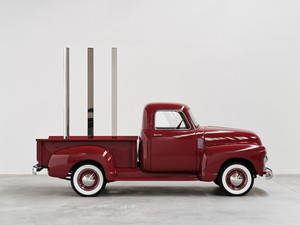
The Singular Experience at Gagosian’s Le Bourget gallery is the largest exhibition of Walter De Maria’s work in France in several decades. Organized by Donna De Salvo, senior adjunct curator at Dia Art Foundation, the exhibition marks the first time De Maria’s final sculpture, Truck Trilogy (2011–17), is being shown outside of the United States. Here, De Salvo speaks with artist Lucy Raven about her evolving kinship with De Maria and more.
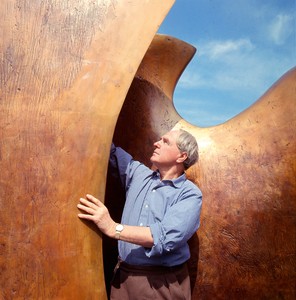
Laura Bruni writes about a major exhibition celebrating the work of the British sculptor Henry Moore at the Royal Botanic Gardens, Kew, London.
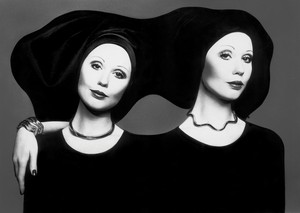
The exhibition Pomellato, Le Joaillier Révolutionnaire opened at Palais de Tokyo, Paris, on June 24. The Italian jewelry house’s trailblazing advertising campaigns—created by some of the most consequential names in photography—act as the narrative arc of the exhibition, curated by Alba Cappellieri. Here, Sarah Godfrey tracks Pomellato’s history, speaks with Cappellieri about what drew her to this project, and examines some of the key photographs from the show.