Now available
Gagosian Quarterly Summer 2026
The Summer 2026 issue of Gagosian Quarterly is now available, featuring Ellen Gallagher’s Fast-Fish and Loose-Fish (2026) on the cover.
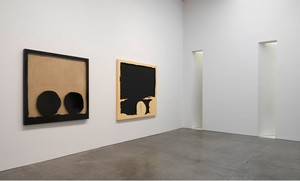
Installation view, photo by Rob McKeever
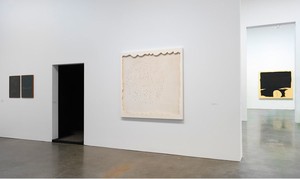
Installation view Photo by Rob McKeever
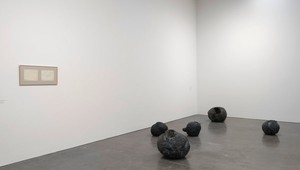
Installation view Photo by Rob McKeever
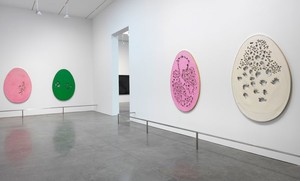
Installation view Photo by Rob McKeever
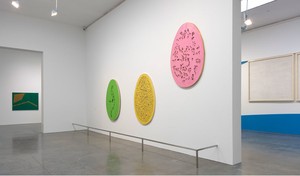
Installation view Photo by Rob McKeever
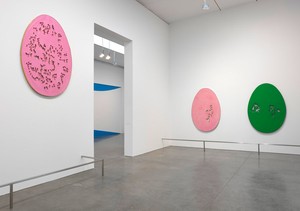
Installation view Photo by Rob McKeever
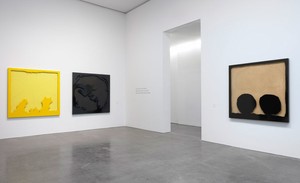
Installation view Photo by Rob McKeever
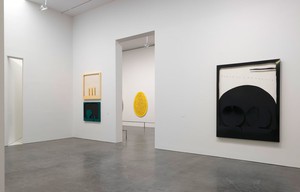
Installation view Photo by Rob McKeever
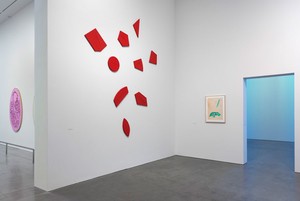
Installation view Photo by Rob McKeever
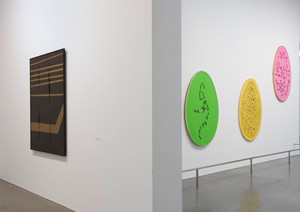
Installation view Photo by Rob McKeever
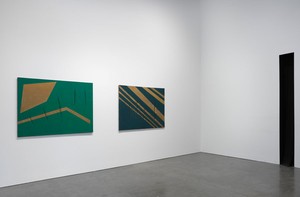
Installation view Photo by Rob McKeever
Installation view Photo by Rob McKeever
Installation view Photo by Rob McKeever
Installation view Photo by Rob McKeever
Installation view Photo by Rob McKeever
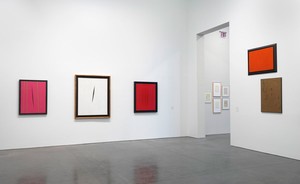
Installation view Photo by Rob McKeever
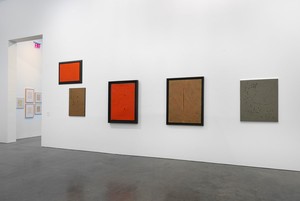
Installation view Photo by Rob McKeever
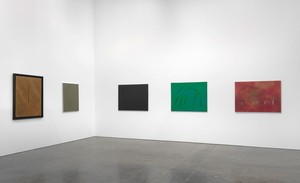
Installation view Photo by Rob McKeever
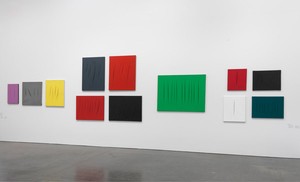
Installation view Photo by Rob McKeever
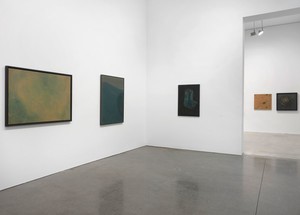
Installation view Photo by Rob McKeever
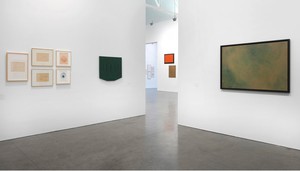
Installation view Photo by Rob McKeever
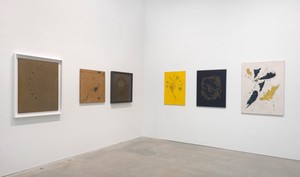
Installation view Photo by Rob McKeever
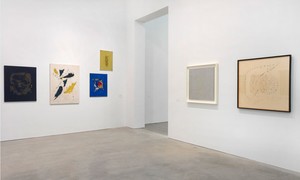
Installation view Photo by Rob McKeever
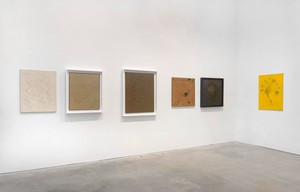
Installation view Photo by Rob McKeever
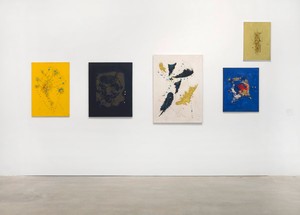
Installation view Photo by Rob McKeever
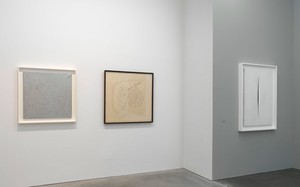
Installation view Photo by Rob McKeever
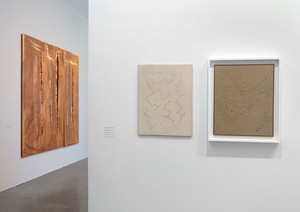
Installation view Photo by Rob McKeever
Installation view Photo by Rob McKeever
Installation view Photo by Rob McKeever
Installation view Photo by Rob McKeever
Installation view Photo by Rob McKeever
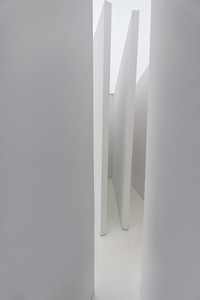
Installation view Photo by Rob McKeever
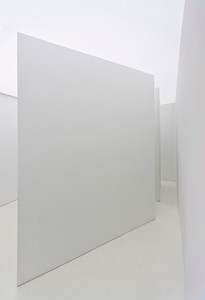
Installation view Photo by Rob McKeever
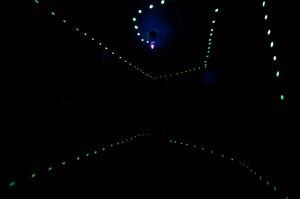
Installation view Photo by Rob McKeever
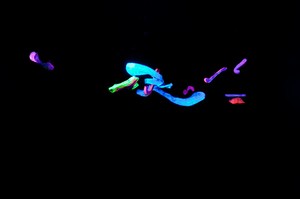
Installation view Photo by Rob McKeever
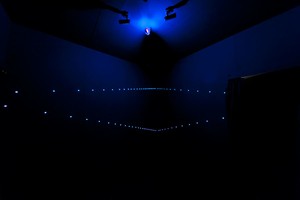
Installation view Photo by Rob McKeever
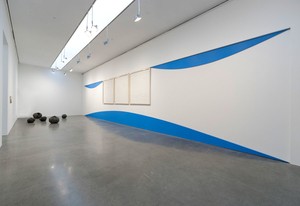
Installation view Photo by Rob McKeever
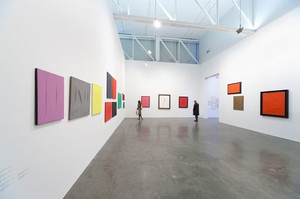
Installation view Photo by Rob McKeever
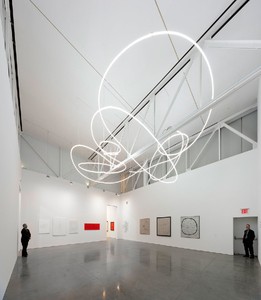
Installation view Photo by Rob McKeever
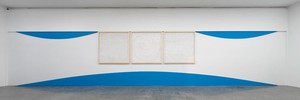
Installation view Photo by Rob McKeever
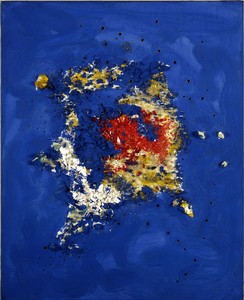
Lucio Fontana
Concetto spaziale, 1955
Oil and glass on canvas, 37 ⅞ × 25 ½ inches (96.2 × 64.8 cm)
© Fondazione Lucio Fontana. Courtesy FaMa Gallery, Verona
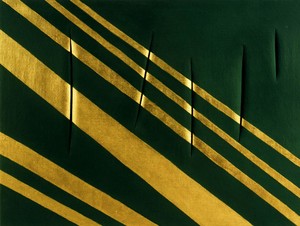
Lucio Fontana
Concetto spaziale, Attese, 1959
Water-based paint and oil on canvas, 49 ¼ × 65 inches (125.1 × 165.1 cm)
© Courtesy of the Fondazione Lucio Fontana. Private Collection, Milan
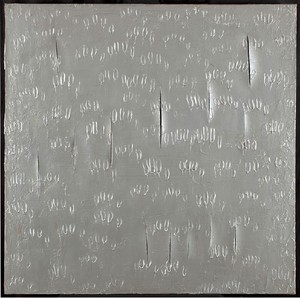
Lucio Fontana
Concetto spaziale, Notte d'Amore a Venezia, 1961
Acrylic on canvas, 59 × 59 inches (149.9 × 149.9 cm)
© Courtesy of the Fondazione Lucio Fontana. Private collection
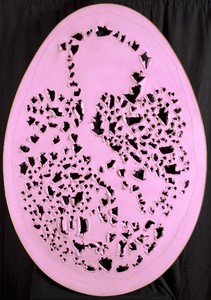
Lucio Fontana
Concetto spaziale, La fine di Dio, 1963
Oil on canvas, 70 ⅛ × 48 ⅜ inches (178 × 123 cm)
© Fondazione Lucio Fontana. Private Collection
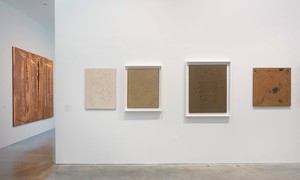
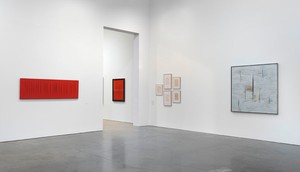
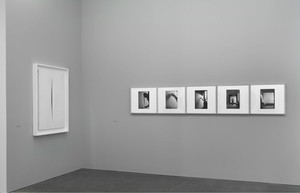
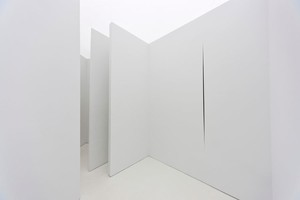
Gagosian Gallery is pleased to announce a major and unprecedented survey of the work of Lucio Fontana. Six of his groundbreaking environments, known as Ambienti Spaziali, have been faithfully reconstructed, providing a completely new perspective for the rich and varied retrospective of more than one hundred major works that surrounds them. Curated by Germano Celant, assisted by Gagosian director Valentina Castellani in close collaboration with the Fondazione Lucio Fontana in Milan, the exhibition includes many works that have rarely been seen and reunites important series from public and private collections.
Fontana's fascination for the advancements of science and technology during the twentieth century led him to approach art as a series of investigations into a wide variety of mediums and methods. As a sculptor, he experimented with stone, metals, ceramics, and neon; as a painter he attempted to transcend the confines of the two-dimensional plane. In a series of manifestos, beginning with the Manifesto blanco (White Manifesto) of 1946, Fontana announced his goals for a "spatialist" art, one that could engage technology to achieve an expression of the fourth dimension in a radical new aesthetic idiom that melded the categories of architecture, sculpture, and painting.
A sculptor trained in classical techniques, Fontana was initially known for grand and innovative sculptures produced for trade fairs and exhibitions promoting the ideology of Fascism in Italy. But these early examples already contained a rationalist abstract language that pointed to an awareness of the most daring rationalist architectonic experiments of Edoardo Persico and Giuseppe Terragni
Upon his return to Milan from Argentina in 1947, Fontana found his studio and works completely destroyed in the Allied bombings of Milan. Due to this abrupt tabula rasa, he considered himself to belong rather to the post-war generation of Italian artists: thus the story of his career is, effectively, the story of his last twenty years. In Buenos Aires, with his students at the newly founded Academia of Altamira, Fontana conceived of an art that could reflect the excitement of contemporaneous discoveries in science and physics and thus continue evolving its very means. Inspired by, but surpassing, the language of Futurism, they advocated doing away with the traditional supports of painting and sculpture. With the act of cutting a thinly painted monochromatic canvas with a sharp knife, Fontana exploded the definition—or at least the conventional space—of art. This act challenged the entire history of Western easel painting and led him to the understanding that painting was no longer about illusion contained within the dimensions of a canvas but, rather, a dynamic concept that blended form, color, architectural space, gesture, and light. Thus the concept of spazialismo was born.
The Summer 2026 issue of Gagosian Quarterly is now available, featuring Ellen Gallagher’s Fast-Fish and Loose-Fish (2026) on the cover.

In this video, Jenny Saville sits down inside her first major exhibition in Venice to discuss how the great Venetian artists of the past and the city’s heritage influence her work. The show brings together more than thirty canvases and works on paper from the 1990s to the present, tracing the development of her practice, which is deeply rooted in the history of painting.

Francis Bacon lived and worked in Paris for a decade starting in the mid-1970s. The city and the art he encountered there provided a profound backdrop for his austere late style, which often brings together smooth, colorful backgrounds, spare architectural signifiers, and sculptural human forms. Here, three striking paintings from that period are considered by Sebastian Smee.
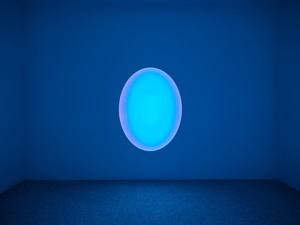
An exhibition at Gagosian, Hong Kong, brings together three of James Turrell’s Glasswork pieces along with site plans, photographs, and models of his Skyspaces and Roden Crater. Here, Alice Godwin explores the history of the Glassworks and their relationship to the artist’s wider practice.

Janne Sirén considers Anselm Kiefer’s new paintings, the subject of an exhibition at Gagosian, New York, entitled Seal My Ears Shut and I Shall Hear You Still.

On April 16, the Institute of Contemporary Art, Boston, opened the first midcareer survey of Derrick Adams’s multidisciplinary practice. Covering over twenty years of work, the exhibition, titled View Master, brings together the artist’s painting, sculpture, collage, performance, and video, as well as a vibrant new commission created for the museum’s façade. Ahead of the opening, Adams met with Tessa Bachi Haas, cocurator of the survey, to discuss his formative experiences with television, the impact of his work in arts education on his practice, and the importance of taking a more complex, more joyful, and more expansive approach to Black American life and culture.

Adam D. Weinberg has been working with Giuseppe Penone on an exhibition of the artist’s new sculptures, The Reflection of Bronze, that opens at Gagosian, New York, on April 22. The works explore the character and possibilities of bronze. Here, Weinberg considers Penone’s enduring engagement with the alloy and addresses the conceptual underpinnings of the exhibition’s three-room structure.

On March 28, a major exhibition of Jenny Saville’s work opened at Ca’ Pesaro–Galleria Internazionale d’Arte Moderna in Venice, bringing together nearly thirty paintings from the 1990s to the present. The exhibition is curated by Elisabetta Barisoni, head of the museums division at Venice’s Ca’ Pesaro, Museo Fortuny, and head of MUVE in Mestre. Saville’s monumental canvases are set in dialogue with the great Venetian artists of the past, creating a unique encounter between contemporary painting and the city’s artistic heritage. Here, the artist speaks with Stefania Ventra, professor with Ca’ Foscari University of Venice, about her early trips to Venice, the radicality of Titian’s painting, and depicting emotional truth.

Jeff Koons tells Alison McDonald about his appreciation for the pioneering artist and thinker Marcel Duchamp.
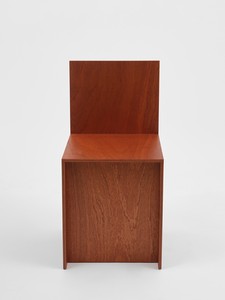
From their respective fields, three international cultural figures—artist and designer Ronan Bouroullec, fashion visionary Michèle Lamy, and chef and restaurateur Enrique Olvera—reflect on Donald Judd’s work in furniture, the subject of recent exhibitions in South Korea and Japan.
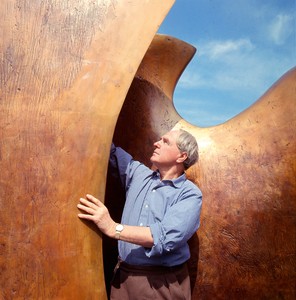
Laura Bruni writes about a major exhibition celebrating the work of the British sculptor Henry Moore at the Royal Botanic Gardens, Kew, London.
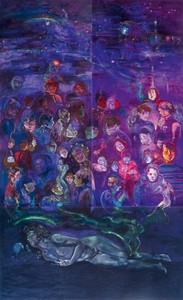
The most recent edition of Picture Books, an imprint organized by Emma Cline and Gagosian, pairs Mary Gaitskill’s novella STAUF: A Tragedy with Jill Mulleady’s painting The Shift. In celebration of this forthcoming publication, Gaitskill and Mulleady discuss the myth of Faust, good and evil in the digital age, and the channeling of raw matter into art.