Now available
Gagosian Quarterly Summer 2026
The Summer 2026 issue of Gagosian Quarterly is now available, featuring Ellen Gallagher’s Fast-Fish and Loose-Fish (2026) on the cover.
Extended through March 31, 2017
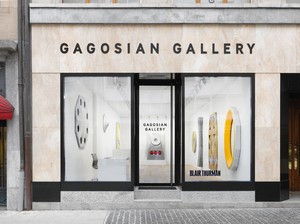
Installation view
Artwork © Blair Thurman. Photo: Annik Wetter
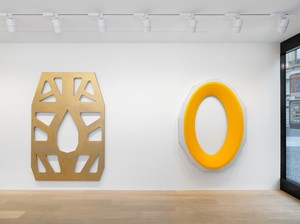
Installation view
Artwork © Blair Thurman. Photo: Annik Wetter
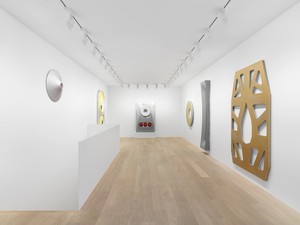
Installation view
Artwork © Blair Thurman. Photo: Annik Wetter
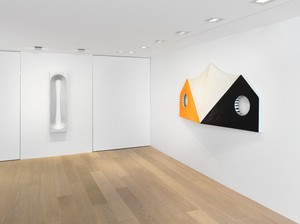
Installation view
Artwork © Blair Thurman. Photo: Annik Wetter
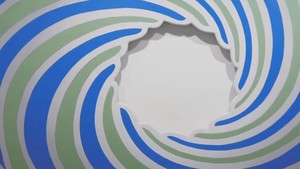
Installation video
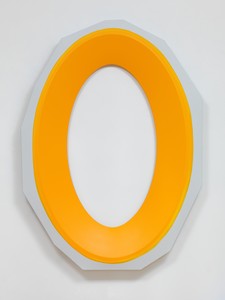
Blair Thurman
And now, a bubble burst, And now, a world, 2017
Acrylic on canvas on wood, 72 ½ × 54 × 5 inches (184.2 × 137.2 × 12.7 cm)
© Blair Thurman. Photo: Rob McKeever
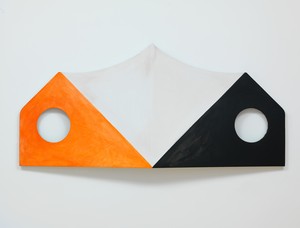
Blair Thurman
Nite Owl, 2016
Acrylic on canvas on wood, 37 × 80 × 9 ½ inches (94 × 203.2 × 24.1 cm)
© Blair Thurman. Photo: Rob McKeever
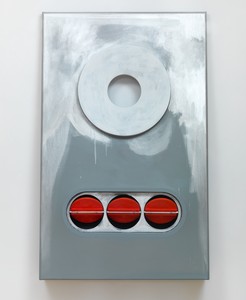
Blair Thurman
Color Me Gone!, 2017
Acrylic on canvas on wood, 70 ½ × 44 × 9 ½ inches (179.1 × 111.8 × 24.1 cm)
© Blair Thurman. Photo: Rob McKeever
A lot of my work in painting is layered on previous works. If I make a painting and I like it, I want to relive that . . . thus I wind up with a natural lineage.
—Blair Thurman
Gagosian is pleased to present new shaped canvas works by Blair Thurman. This is his first exhibition with the gallery in Switzerland.
Thurman’s influences range from Pop art and Minimalism to relics from childhood, popular music, and 1970s cinema. His standardized forms, pulled from slot-car racetracks, architectural frameworks, and found shapes from daily life take on a nostalgic register, the fascinations of boyhood working to render abstract geometries more idiosyncratic and accessible. Thurman transposes the formal details of these everyday objects into the subliminal realm of abstraction.
Repeating previously used motifs and introducing new ones, Thurman produces dimensional paintings recalling the pleasures of the road or the silver screen of his childhood era. He enlarges the concave slots of model racetracks and paints them in bold colors that recall the Spectraflame paint and decals of Hot Wheels toy cars. These recurring references, however, also begin to resemble unrelated forms to which he alludes in his titles—including Shades of Pemberton (2016), Nite Owl (2016), and Hippie Car Spin-Out #3 (2017). Nite Owl, a new motif born from the abstracted form of a hubcap, which evolved from one of the “mask” works, consists of both flat and curved planes, its clean angles protruding from the wall. With panels in orange, white, and black, it simultaneously evokes Constructivist painting and the graphics of racing, while its title and visible brushstrokes encourage imagining the two circles on either side as the wise bird’s eyes. Thurman’s eccentric references and private jokes coincide with his serious motivation to give painting an inside edge.
Thurman allows feeling to pervade objectivity. Artist Steven Parrino called him a “Pop Sensitive.” Influenced by Parrino, as well as Frank Stella, Andy Warhol, and Nam June Paik, he participates in a dialogue about the limits of image-making by seeking out subjects that have been left out of art history and presenting them through formal techniques of repetition, light, and contour. His works are static, yet their slopes and junctures brim with latent energy, causing the eyes to move quickly around them—the active gaze standing in for absent racing cars. Thurman refers to the style and significance of his work as its “signature-content” as he investigates the intersection between our cultural environment and our imagined fantasies, examining the memory and poetry embedded in the very act of looking.
The Summer 2026 issue of Gagosian Quarterly is now available, featuring Ellen Gallagher’s Fast-Fish and Loose-Fish (2026) on the cover.

In this video, Jenny Saville sits down inside her first major exhibition in Venice to discuss how the great Venetian artists of the past and the city’s heritage influence her work. The show brings together more than thirty canvases and works on paper from the 1990s to the present, tracing the development of her practice, which is deeply rooted in the history of painting.

Francis Bacon lived and worked in Paris for a decade starting in the mid-1970s. The city and the art he encountered there provided a profound backdrop for his austere late style, which often brings together smooth, colorful backgrounds, spare architectural signifiers, and sculptural human forms. Here, three striking paintings from that period are considered by Sebastian Smee.
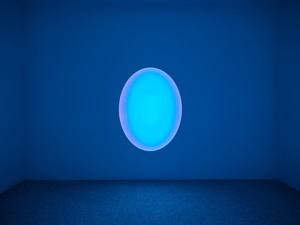
An exhibition at Gagosian, Hong Kong, brings together three of James Turrell’s Glasswork pieces along with site plans, photographs, and models of his Skyspaces and Roden Crater. Here, Alice Godwin explores the history of the Glassworks and their relationship to the artist’s wider practice.

Janne Sirén considers Anselm Kiefer’s new paintings, the subject of an exhibition at Gagosian, New York, entitled Seal My Ears Shut and I Shall Hear You Still.

On April 16, the Institute of Contemporary Art, Boston, opened the first midcareer survey of Derrick Adams’s multidisciplinary practice. Covering over twenty years of work, the exhibition, titled View Master, brings together the artist’s painting, sculpture, collage, performance, and video, as well as a vibrant new commission created for the museum’s façade. Ahead of the opening, Adams met with Tessa Bachi Haas, cocurator of the survey, to discuss his formative experiences with television, the impact of his work in arts education on his practice, and the importance of taking a more complex, more joyful, and more expansive approach to Black American life and culture.

Adam D. Weinberg has been working with Giuseppe Penone on an exhibition of the artist’s new sculptures, The Reflection of Bronze, that opens at Gagosian, New York, on April 22. The works explore the character and possibilities of bronze. Here, Weinberg considers Penone’s enduring engagement with the alloy and addresses the conceptual underpinnings of the exhibition’s three-room structure.

On March 28, a major exhibition of Jenny Saville’s work opened at Ca’ Pesaro–Galleria Internazionale d’Arte Moderna in Venice, bringing together nearly thirty paintings from the 1990s to the present. The exhibition is curated by Elisabetta Barisoni, head of the museums division at Venice’s Ca’ Pesaro, Museo Fortuny, and head of MUVE in Mestre. Saville’s monumental canvases are set in dialogue with the great Venetian artists of the past, creating a unique encounter between contemporary painting and the city’s artistic heritage. Here, the artist speaks with Stefania Ventra, professor with Ca’ Foscari University of Venice, about her early trips to Venice, the radicality of Titian’s painting, and depicting emotional truth.

Jeff Koons tells Alison McDonald about his appreciation for the pioneering artist and thinker Marcel Duchamp.
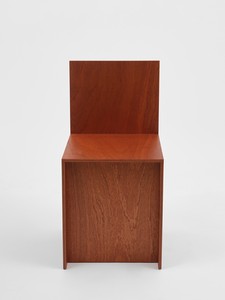
From their respective fields, three international cultural figures—artist and designer Ronan Bouroullec, fashion visionary Michèle Lamy, and chef and restaurateur Enrique Olvera—reflect on Donald Judd’s work in furniture, the subject of recent exhibitions in South Korea and Japan.
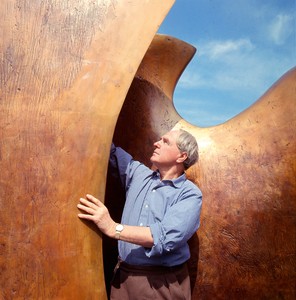
Laura Bruni writes about a major exhibition celebrating the work of the British sculptor Henry Moore at the Royal Botanic Gardens, Kew, London.
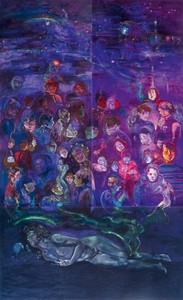
The most recent edition of Picture Books, an imprint organized by Emma Cline and Gagosian, pairs Mary Gaitskill’s novella STAUF: A Tragedy with Jill Mulleady’s painting The Shift. In celebration of this forthcoming publication, Gaitskill and Mulleady discuss the myth of Faust, good and evil in the digital age, and the channeling of raw matter into art.