Richard Serra: Steve Reich’s “Music for Pieces of Wood”
In this video, musical ensemble Sō Percussion performs Steve Reich’s “Music for Pieces of Wood” inside the exhibition Richard Serra: Running Arcs (For John Cage), 1992, at Gagosian, New York.

Richard Serra
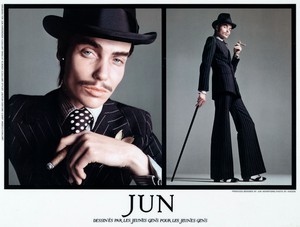
Television Delivers People, 1973 (still)
Video, color, sound, 6 min. 21 sec., Circulating Film and Video Library, Museum of Modern Art, New York
© 2020 Richard Serra/Artists Rights Society (ARS), New York
Hannah Wilke
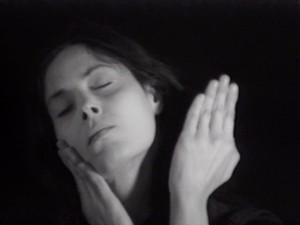
Gestures, 1974 (still)
Video, black and white, sound, 33 min. 1 sec., Hannah Wilke Collection & Archive, Los Angeles
© 2020 Marsie, Emanuelle, Damon, and Andrew Scharlatt/Licensed by VAGA at Artists Rights Society (ARS), New York.
Courtesy Electronic Arts Intermix (EAI), New York; Alison Jacques Gallery, London; Marc Selwyn Fine Art, Los Angeles
Walter De Maria
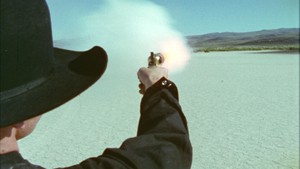
Hard Core, 1969 (still)
16mm film, color, sound, 26 min. 38 sec., edition of 100
© The Estate of Walter De Maria
Chris Burden
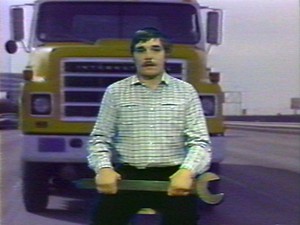
Big Wrench, 1980 (still)
Video of live broadcast on KTSF-TV, San Francisco, on November 5, 1979; color; sound; 17 min. 29 sec.
Produced by La Mamelle
© 2020 Chris Burden/Licensed by the Chris Burden Estate and Artists Rights Society (ARS), New York
You’re only as young as the last time you changed your mind.
—Timothy Leary
Broadcast: Alternate Meanings in Film and Video employs the innate immediacy of time-based art to spark reflection on the here and now. Looking to the late 1960s—a historical moment marked by deep uncertainty, social unrest, and radical transformation—this online exhibition loosely adopts famed psychologist and countercultural icon Timothy Leary’s mantra “turn on, tune in, drop out” as a guide for negotiating our present moment.
The fourth chapter of Broadcast features historical films and videos by artists who worked at the forefront of their respective mediums during the late 1960s and ’70s.
The “Turn On” section of the exhibition presents two videos from the mid-1970s that demonstrate divergent approaches to generating self-awareness, on the level of both the audience and the artist. In Television Delivers People (1973), Richard Serra subverts familiar audio and video conventions in order to expose the ways in which audiences are exploited within the economics of broadcast television. In contrast, in her performance video Gestures (1974), Hannah Wilke turns the camera onto herself as she enacts hundreds of repetitive facial expressions and gesticulations, manipulating her face as sculptural material in order to emphasize the ways that such actions both defy and become coded within societal conventions of representation.
In his 1969 film Hard Core, Walter De Maria combines cinematographic methods drawn from experimental cinema along with Hollywood movie conventions to “tune in” to an alternative perspective on his surroundings in the Black Rock Desert of Nevada.
Representing the curatorial category of “Drop Out,” Chris Burden’s Big Wrench (1980) presents the artist’s deadpan semiautobiographical account of his short-lived “love affair” with a tractor trailer, an alternative model to romantic obsessions that both dramatizes America’s infatuation with car culture and takes it to illogical ends.
“Turn On”
Richard Serra
Television Delivers People, 1973
Adopting the format of closing credits from commercial television by using a text-based scroll and classic Hollywood instrumental music, Serra’s Television Delivers People jolts viewers into recognition of their own complacency as audiences. Articulating the instrumentalization of television viewers as consumer products generated for corporate advertisers, the video exposes the broadcast’s integral role in such a reversal of consumer and consumed, wittily using the medium’s own visual and auditory conventions against itself.
Hannah Wilke
Gestures, 1974
Assuming roles of both performer and director in Gestures, Wilke explores her own face as artistic material. Whether kneading her skin into misshapen contortions or enacting stereotypical poses, she stages a fluid, continuous sequence of actions in front of the camera. Her performance calls attention to and deconstructs familiar representations of women, as well as encourages the viewer’s personal or cultural associations with these gestures while also reclaiming agency over such depictions as her own.
“Tune In”
Walter De Maria
Hard Core, 1969
Filmed in Nevada’s barren Black Rock Desert in July 1969, Hard Core opens with an establishing shot of an expansive blue sky immediately evoking the American West, which sets the scene for De Maria’s innovative and experimental film. The work intercuts two differing cinematic approaches: one that explores the observational potential of the medium through wide-angle, 360-degree shots that pan over the changing desert landscape, and the other that appropriates familiar visual tropes taken from the Hollywood Western movie genre—such as pistols, Levi’s jeans, boot spurs, and leather chaps—and implements them in a performance. The soundtrack is an edited compilation of two of De Maria’s “drum compositions,” Cricket Music (1964) and Ocean Music (1968), which creates a sense of anticipation for the viewer. In the last minute of the film, a series of unexpected events unfolds in rapid succession, producing a dramatic climax.
“Drop Out”
Chris Burden
Big Wrench, 1980
In the fall of 1977, Burden first laid eyes on “BIG JOB,” a sixteen-thousand-pound 1952 Ford tractor trailer parked on Lincoln Boulevard in Venice, California, that became the object of the artist’s fixation. As he later recounted, “It was a bad truck and I wanted it.” In Big Wrench, Burden adopts a confessional approach, facing the camera as he delivers a freewheeling account of his relationship with the truck gone awry—complete with obsessional behavior, projected fantasies, accusations of stolen property, a hit-and-run accident, and even the involvement of the Los Angeles Police Department and California Highway Patrol. Through this narrative, BIG JOB’s lasting influence on the artist and the experimental possibilities of the medium are readily apparent.
In this video, musical ensemble Sō Percussion performs Steve Reich’s “Music for Pieces of Wood” inside the exhibition Richard Serra: Running Arcs (For John Cage), 1992, at Gagosian, New York.

Join exhibition curator Donna De Salvo as she discusses her selection of the artist’s rarely seen sculptures, drawings, films, and archival materials in Walter De Maria: The Singular Experience at Gagosian, Le Bourget. Chief among these is Truck Trilogy (2011–17), De Maria’s final sculpture and the centerpiece of the exhibition.

Tracking works by Chris Burden, Bruce Nauman, Maria Nordman, and Eric Orr as outliers and outcroppings of the California Light and Space movement, Michael Auping argues that darkness—the absence of light and space—is a key element of the aesthetic.

As American identity once again comes into question during a politically charged election cycle, the Quarterly revisits the motif of the American flag in art. Here, John B. Ravenal contextualizes Robert Lazzarini’s new wall-based flag sculptures and elucidates the tensions they lay bare in the symbol of our nation.
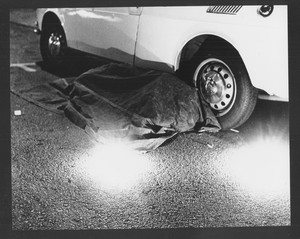
Sydney Stutterheim has published Artist, Audience, Accomplice: Ethics and Authorship in Art of the 1970s and 1980s (Duke University Press, 2024), a survey of performance art and related practices that involve, in various manners, the figure of the accomplice. To celebrate the publication, the Quarterly is publishing an excerpt that examines Chris Burden’s Deadman (1972).
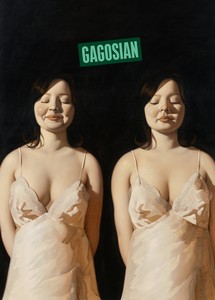
The Winter 2022 issue of Gagosian Quarterly is now available, featuring Anna Weyant’s Two Eileens (2022) on its cover.
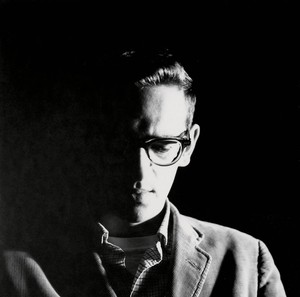
The definitive monograph on the work of Walter De Maria was published earlier this fall. To celebrate this momentous occasion, Elizabeth Childress and Michael Childress of the Walter De Maria Archive talk to Gagosian senior director Kara Vander Weg about the origins of the publication and the revelations brought to light in its creation.
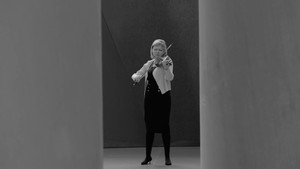
Violinist Alina Ibragimova performs Bach’s Sonata for Solo Violin No. 1 in G Major: Adagio (BWV 1001, c. 1720) from within Richard Serra’s sculpture Transmitter (2020) at Gagosian, Le Bourget. Organized by Bold Tendencies, a nonprofit organization that commissions artists to produce site-specific projects and present performances, in collaboration with Gagosian, this recorded performance took place on May 8, 2022 before a live concert of Olivier Messiaen’s Quatuor pour la fin du temps (Quartet for the End of Time, 1941).
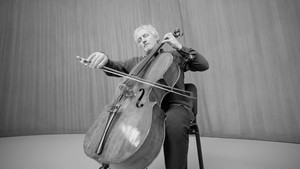
Cellist Mario Brunello performs Bach’s Cello Suite No. 1 in G Major: Prelude (BWV 1007, c. 1717–23) within Richard Serra’s sculpture Transmitter (2020) at Gagosian, Le Bourget. Organized by Bold Tendencies—a nonprofit that commissions artists to produce site-specific projects and present performances—in collaboration with Gagosian, this recorded performance took place on May 8, 2022, before a live concert of Olivier Messiaen’s Quatuor pour la fin du temps (Quartet for the End of Time, 1941).
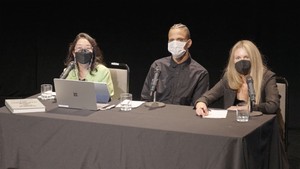
Join Gagosian to celebrate the publication of Poetic Practical: The Unrealized Work of Chris Burden with a conversation between American Artist, Yayoi Shionoiri, and Sydney Stutterheim presented at the Kitchen, New York. Considering the book’s sustained examination of sixty-seven projects that remained incomplete at the time of Burden’s death in 2015, the trio discuss the various ways that an artist’s work and legacy live on beyond their lifetime.
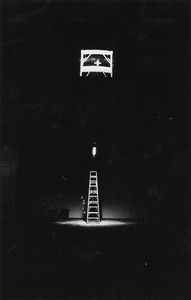
Michael Auping tells the Quarterly’s Alison McDonald about the preparations for a performance by Chris Burden at the Newport Harbor Art Museum in Southern California in 1974—and the event’s abrupt cancellation—providing a glimpse into the mindset of a young, aggressive, and ambitious artist in the early stages of his career.
The Summer 2022 issue of Gagosian Quarterly is now available, with two different covers—featuring Takashi Murakami’s 108 Bonnō MURAKAMI.FLOWERS (2022) and Andreas Gursky’s V & R II (2022).
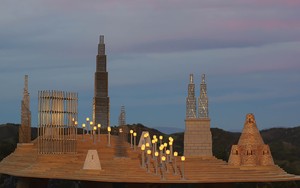
A new publication exploring the work that Chris Burden conceived but left unrealized delves into his archive to present sixty-seven visionary projects that reveal the aspirations of this formidable artist. The book’s editors, Sydney Stutterheim and Andie Trainer, discuss its development with Yayoi Shionoiri, executive director of the Chris Burden Estate.
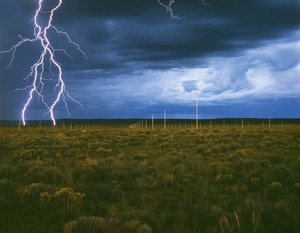
In this second installment of a two-part essay, John Elderfield resumes his investigation of Walter De Maria’s The Lightning Field (1977), focusing this time on how the hope to see lightning there has led to the work’s association with the Romantic conception of the sublime.
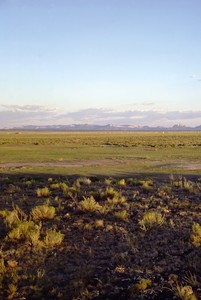
In the first of a two-part feature, John Elderfield recounts his experiences at The Lightning Field (1977), Walter De Maria’s legendary installation in New Mexico. Elderfield considers how this work requires our constantly finding and losing a sense of symmetry and order in shifting perceptions of space, scale, and distance, as the light changes throughout the day.
The Spring 2021 issue of Gagosian Quarterly is now available, featuring Gerhard Richter’s Helen (1963) on its cover.

In response to enduring racial injustices and the recent widespread civil unrest, Richard Serra urges people to watch this video commentary by Trevor Noah, host of The Daily Show.
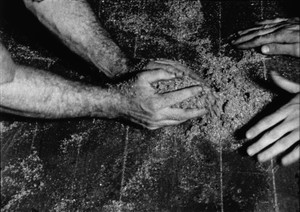
For eleven years, from 1968 to 1979, Richard Serra created a collection of films and videos that felt out the uncharted phenomenological boundaries of the medium. Carlos Valladares explores a selection of these works.
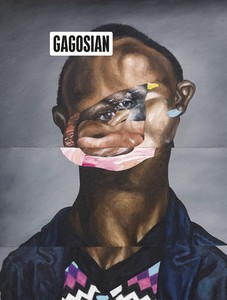
The Fall 2019 issue of Gagosian Quarterly is now available, featuring a detail from Sinking (2019) by Nathaniel Mary Quinn on its cover.
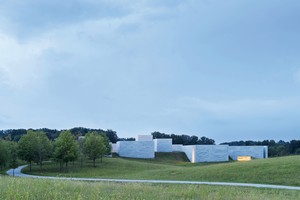
Paul Goldberger tracks the evolution of Mitchell and Emily Rales’s Glenstone Museum in Potomac, Maryland. Set amid 230 acres of pristine landscape and housing a world-class collection of modern and contemporary art, this graceful complex of pavilions, designed by architects Thomas Phifer and Partners, opened to the public in the fall of 2018.