
Hidden in Plain Sight: New Discoveries in the Art of Jasper Johns
In the first part of a two-part essay, art historian John B. Ravenal considers Jasper Johns’s continued engagement with the motif of woodgrain.
October 10, 2024
As American identity once again comes into question during a politically charged election cycle, the Quarterly revisits the motif of the American flag in art. Here, John B. Ravenal contextualizes Robert Lazzarini’s new wall-based flag sculptures and elucidates the tensions they lay bare in the symbol of our nation.
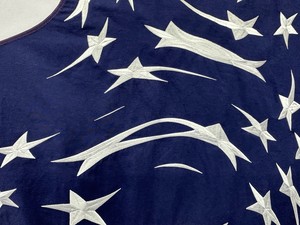
Robert Lazzarini, American flag, 2023 (detail), cotton, thread, and brass, in 3 parts, overall: 108 × 66 inches (274.3 × 167.6 cm) © Robert Lazzarini
Robert Lazzarini, American flag, 2023 (detail), cotton, thread, and brass, in 3 parts, overall: 108 × 66 inches (274.3 × 167.6 cm) © Robert Lazzarini
When Jasper Johns made his first flag painting in 1954–55, he attributed his choice of subject to a flash of inspiration—“One night I dreamed that I painted a large American flag, and the next morning I got up and I went out and bought the materials to begin it.”1 The iconic nature of the flag, he later said, fitted with his interest in painting “things the mind already knows.”2 Johns also used the word “neutral” to describe his preferred motif, although he stretched the understanding of that term by acknowledging that “‘Neutral’ expresses an intention.”3 By choosing a subject where the design decisions have already been made, Johns felt free to focus on the act of making the painting, with its built-up surface of collaged newsprint with oil and encaustic brushstrokes.
Left unsaid in this emphasis on form over content was the social and political backdrop of mid-1950s America: the Cold War, the McCarthy hearings, nuclear weapons testing, CIA-backed military coups in Iran and Guatemala, the executions of Julius and Ethel Rosenberg, Civil Rights protests, and a hostile climate for homosexuality—a context that makes the notion that the US flag is a neutral motif seem rather disingenuous. It is often noted that by reproducing its subject so faithfully, Johns’s Flag presented an ontological riddle: is the painting itself a flag or only a representation of a flag? This ambiguity extends to the work’s stance toward its subject: is it a celebration of patriotism or a critique? Johns has famously demurred on questions of interpretation. But in 1958, when the Museum of Modern Art’s Founding Director, Alfred H. Barr, sought to acquire the work for the permanent collection, Johns’s equivocation posed a hindrance. MoMA’s trustees saw the piece as anti-American, and Barr had to find a work-around by asking the architect and board member Philip Johnson to buy the painting and donate it at a later date.
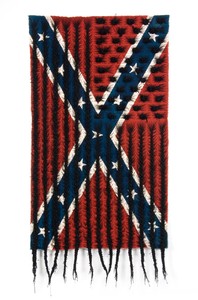
Sonya Clark, Black Hair Flag, 2010, paint, canvas, thread, 52 × 26 inches (132.1 cm × 66 cm), Virginia Museum of Fine Arts, gift of Pamela K. and William A. Royall, Jr. © Sonya Clark. Photo: Taylor Dabney
Many prominent artists since Johns have taken the American flag as subject, including most recently Robert Lazzarini with his distorted wall-based sculptures. These works have taken diverse approaches, from embellishment to alteration to disintegration. David Hammons’s African-American Flag (1990) leaves the Stars and Stripes intact, but replaces its colors with the red, green, and black of the Pan-African flag. A simple shift in a readymade image yields a charged symbol for the complexity of Black American identity and the nation’s history of racism and racial violence.
Known for unraveling Confederate flags thread by thread and using African American hair as both subject and medium, Sonya Clark used cotton thread in her Black Hair Flag (2010), weaving Bantu knots and cornrows in the pattern of the Stars and Stripes through an image of the Confederate “Stars and Bars.” “I was reflecting on the complicated ways that American and Confederate histories coincide. But in a larger sense, it was my way of negotiating my identity as a Black woman from the North who had recently moved to the South.”4
Disintegration rather than merger was Pope L.’s strategy in Trinket (2008/15), a theatrically lit, 45-foot-long US flag blown by industrial fans. Over the course of the show, the constant blowing shredded the flag. At once monumental and diminished, it symbolizes both the potency and fraying of patriotism, democracy, and national identity.
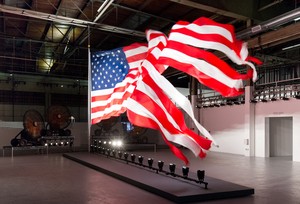
Installation view, William Pope.L: Trinket, Geffen Contemporary at MOCA, Los Angeles, March 20–June 28, 2015. Artwork © William Pope.L. Photo: Brian Forrest, courtesy Museum of Contemporary Art, Los Angeles
Disintegration also runs through Yukinori Yanagi’s Study for American Art—Three Flags, (2000), which replicates one of Johns’s iconic paintings with colored sand in thin plastic boxes. Into the carefully made work, Yanagi released live ants—an unpredictable and disruptive force whose ceaseless tunneling eroded the symbolic image.
Cady Noland’s brooding installations juxtapose the US flag with less exalted bits of Americana—stacked six-packs of Budweiser, scaffolding, and handcuffs. In Gibbet (1993–94), a flag-draped wooden structure, pierced with holes for a person’s legs, arms, and head, recalls the traditional pillory. With its overreliance on restraint, confinement, and violence, it seems to be a warning to both the average citizen (or noncitizen) and to America as a whole.
Chris Burden never realized The Ever Burning American Flag (2009), as the concept exceeded the available technology.5 Burden envisioned the eternally blazing standard as a symbol of the nation’s indestructibility and proposed it be carried into battle by marines and displayed behind the president when he addressed the nation. In a nod to the work’s potential irony, Burden added that it could never be burned because it was already on fire.
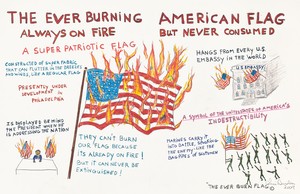
Chris Burden, drawing for The Ever Burning American Flag, 2009 © 2024 Chris Burden/Licensed by the Chris Burden Estate and Artists Rights Society (ARS), New York. Photo: courtesy the Chris Burden Estate
Robert Lazzarini makes his American flag works from the same materials as the object that serves as his model. He thereby raises the same questions as Johns did with his paintings—whether they are actual flags or representations. But rather than faithfully render the conventional, or normative image, as Johns had done, Lazzarini does the opposite. He manipulates a digital image on the computer to introduce up to half a dozen sine wave patterns into each version, creating radically altered shapes; he then works closely with seamsters and embroiderers to produce the finished works. Curiously, despite the extent of its deformation across the series, the identity of the flag remains clear and immediate. Each work activates a tension between the legibility of commonplace objects and the defamiliarization unleashed by distortion—a dialectic of familiarity and strangeness.
While Lazzarini’s earlier work already addressed the dark underside of American society, foregrounding a collective preoccupation with death and violence, the American flags are his most politically charged and ideologically specific objects. The choice of subject, as well as the pressure that he exerts on the flag’s form seem especially relevant in this time of heighted social and political tension. Like Johns’s painting, Lazzarini’s flags offer no polemic or bromide, leaving open their position to competing interpretations. But in applying his signature use of distortion to the American flag, Lazzarini activates its loaded content, tapping into its history and status as a site of conflict.
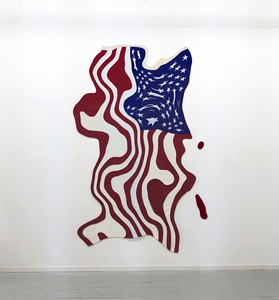
Robert Lazzarini, American flag, 2023, cotton, thread, and brass, in 3 parts, overall: 108 × 66 inches (274.3 × 167.6 cm) © Robert Lazzarini
The US flag is governed by a national code that specifies rules of use and care, including admonitions ingrained into Americans from childhood: it should not be dipped to any person or thing; should not touch the ground or anything else beneath it; should not be displayed with the union down except to signal dire distress; should not be used for decoration, advertising, or apparel; and so on, even down to the manner of its hoisting (raised briskly, lowered ceremoniously), what to do in bad weather, and its exact position in a parade.
Despite these strict guidelines for handling and display, the code does not impose penalties for misuse. In 1968, in response to protests against the Vietnam War that involved flag burning, Congress passed the Flag Protection Act, imposing fines and/or jail time to “Whoever knowingly mutilates, defaces, physically defiles, burns, maintains on the floor or ground, or tramples upon any flag of the United States.”6 For the next two decades, critics tried unsuccessfully to overturn this act on the grounds that it violated the First Amendment. In 1989, the Supreme Court agreed to hear the case of Texas v. Johnson and, in a five–four decision, declared flag burning an act of protected speech.
In response, Congress quickly passed a new flag protection act, which was soon challenged by new acts of public flag burning. In 1990, in United States v. Eichman, the Court again struck down Congress’s Act, stating that “While flag desecration . . . is deeply offensive to many, the Government may not prohibit the expression of an idea simply because society finds the idea itself offensive or disagreeable.”7 Since then, federal legislators have made numerous attempts to overturn the court ruling by passing a constitutional exception to the First Amendment that succinctly states, “Congress shall have the power to prohibit the physical desecration of the flag of the United States.” Some of these efforts have come close to passing into law, gaining repeated approval in the House of Representatives but falling short in the Senate—by only one vote in 2006.
The flag is considered a living symbol because it represents a living, changing country, and because its form can be modified without it losing authority.
How such a broad amendment would even be interpreted and implemented remains an open question. A report issued in 2005 by the First Amendment Center predicted an endless series of disputes were it to pass, focused on the need to define the key phrases: “the flag of the United States” and “physical desecration.”8 At its narrowest, the flag might be considered “a cloth or other material readily capable of being waved or flown with the characteristic of the official flag of the United States as described in 4 U.S.C. §1.”9 But this would allow an easy sidestepping of the law, for example by burning a flag with only forty-nine stars. On the other hand, defining the flag as “anything that a reasonable person would perceive to be a flag of the United States even if it were not precisely identical to the flag as defined by statute”10 would seem to allow for considerable overreach, such as the 1974 case of a Massachusetts teenager who was sentenced to six months in jail for wearing a flag patch on his jeans.11
Defining physical desecration poses similar challenges. Must it be enacted on an actual flag or would offensive language and gestures, or digital manipulation of an image, also constitute such an act? Excluding verbal and virtual assaults would seem to effectively limit the amendment’s scope, although its drafters acknowledged that the word “desecration” was chosen specifically to be as widely encompassing as possible.12 Would it also require proving intent? If so, does burning a symbol in support of the principles it purports to represent constitute a dishonoring or a defense? If desecration does not turn on intent, is the beholder’s response the deciding factor? One can imagine offense taken at a broad range of acts that have no intent to provoke. And what of undermining the symbolic value of the flag by those who profess to love it? Witness Major General Patrick Brady’s 2004 testimony in support of the amendment: “It should be obvious that demanding—indeed, forcing—patriotism is the bedrock of our freedom.”13
How, then, should we understand Lazzarini’s flags in relation to these conflicting issues? His precisely calibrated balance of realism and distortion, applied to a symbol tinged with the aura of sanctity, intentionally locates these works at a point of maximum tension in the ongoing flag debate. But one might ask again, as with Johns’s painting, if his works are even flags at all or whether their fabrication from scratch, and the level of alteration, locates them in another category entirely. As art, are they unable to also function as flags, despite their close resemblance? Conversely, given the strong similarity, are we right to ask whether the degree of manipulation applied to a revered symbol is a celebration or a desecration, and if the latter, whether it is an act of protected speech?
One way to further unpack the swirl of questions raised by Lazzarini’s flags is to consider their close connection with the body. The flag Lazzarini uses as his source is the official military funeral flag: the 9 ½ × 5-foot version specified by the US Government to drape the casket or accompany the urn of a deceased veteran of the US armed forces. The function of what is sometimes called a “coffin draper,” underscores the special bond between the body and the American flag. Not only does it symbolize our body politic, but through the almost mystical reverence accorded it, the flag has acquired the power to inspire the ultimate sacrifice.
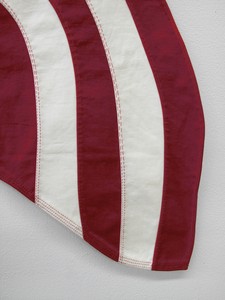
Robert Lazzarini, American flag, 2023 (detail), cotton, thread, and brass, in 3 parts, overall: 108 × 66 inches (274.3 × 167.6 cm) © Robert Lazzarini
This tight and profound link has created a symbolic equivalence between the body and the flag—that is, between a special kind of body sanctified by sacrifice and a flag identified with the sacred body.14 Lazzarini’s distorted flags build on this close identification by incorporating formal signs of bodily presence into the very fabric of his works. Deviating from their rectilinear source through the impact of the sine waves, his flags assume an organic, or, one might even say, anatomical, quality. Some have a flame-like appearance. Others recall distinctive patterns that are said to “figure” wood, such as curling, quilting, and spalting. Still others exhibit a liquefied character that reinforces the color red’s association with sacrifice and which is enhanced by occasional artifacts—dots of color that seem to have flown off the edges of the main area like splashes. This sensation of corporeal motion creates the uncanny impression that these flags possess agency and that we are catching them in the act of transmogrification.
It is this attitude of heightened mutability that some may see as the locus of desecration in Lazzarini’s work. But in fact, transformation is woven deeply into the flag’s own history. The flag is considered a living symbol because it represents a living, changing country, and because its form can be modified without it losing authority. Over the past nearly 250 years, since its adoption in 1777 by the Second Continental Congress, the US flag has gone through twenty-six official alterations, including in the number of stars and stripes and the overall official dimensions. While the current flag, adopted in 1960, is the longest-serving version, designs already exist for adding more stars. In this sense, the mutability of Lazzarini’s flags literalizes both the US flag’s past and its future.
Taken a step further, the concept of the living symbol may also best summarize the essence of Lazzarini’s project in the present. Carl Jung envisaged symbols as the one true means for achieving psychic equilibrium—a function they perform by reconciling life’s major contradictions: between good and evil, civilized and primitive, the accepted and the rejected. As Jung described, “The raw material shaped by thesis and antithesis, and in the shaping of which the opposites are united, is the living symbol.”15 In Lazzarini’s works, distortion of the American flag serves as a device to surface its many conflicting meanings. Joined to the nation’s symbol, his manipulations create a potent analog. They are the optical equivalent of the spectacle of truth and falsehood, hope and fear, reason and power, locked in an endless and epic public battle. To try to ascertain where Lazzarini’s flags land in a simplified opposition between critique and celebration is pointless. Like Johns’s Flag, they refuse this reductive closure. Instead, they reflect on contradictions engaged in a deeper dialectic of thesis and antithesis. Whether a more constructive synthesis can ultimately arise or whether, instead, we are witnesses to a process of unyielding self-destruction is ultimately for the viewer, or time, to tell.
1 As quoted in Kirk Varnedoe, Jasper Johns: A Retrospective, (New York: Museum of Modern Art, 1996), p. 124.
2 “Art: His Heart Belongs to Dada,” Time, May 4, 1959, p. 58.
3 “Book A (Sketchbook)”, p. 31, c. 1963, quoted in Jasper Johns, Writings, Sketchbook, Notes, Interviews, ed. Kirk Varnedoe (New York: Museum of Modern Art, 1996), p. 50.
4 Email from Sonya Clark to the author, c. 2014.
5 In 2007, Chris Burden contacted the Fabric Workshop and Museum in Philadelphia to inquire about the feasibility of his ever-burning flag. Project Coordinator and Master Printer Mary Anne Friel spent several years researching materials but ultimately the piece remains unrealized. See Unpacking Our Stories, Episode 3: Chris Burden: https://www.youtube.com/watch?v=91PFKIA4qCE.
6 US Code Title 18. Crimes and Criminal Procedure § 700, “Desecration of the flag of the United States; penalties”: https://www.govinfo.gov/app/details/USCODE-2011-title18/USCODE-2011-title18-partI-chap33-sec700.
7 U.S. Supreme Court United States v. Eichman, 496 U.S. 310 (1990). Justia: U. S. Supreme Court: https://supreme.justia.com/cases/federal/us/496/310/.
8 Robert Corn-Revere, “Implementing a Flag-Desecration Amendment to the U.S. Constitution. An end to the controversy . . . or a new beginning? First Reports: A First Amendment Center Publication, 6, no. 1, July 2005: https://studylib.net/doc/8665961/implementing-a-flag-desecration-amendment-to-the-u.s.-con...#google_vignette.
9 Ibid.
10 Ibid.
11 U.S. Supreme Court, Smith v. Goguen, 415 U.S. 566 (1974): https://supreme.justia.com/cases/federal/us/415/566/. The verdict was upheld by the Massachusetts Supreme Court but overturned by the US Supreme Court.
12 Corn-Revere, “Implementing a Flag-Desecration Amendment.”
13 Quoted in Corn-Revere, “Implementing a Flag-Desecration Amendment.”
14 Carolyn Marvin, “Theorizing the Flagbody: Symbolic Dimensions of the Flag Desecration Debate, or, Why the Bill of Rights Does Not Fly in the Ballpark,” Critical Studies in Mass Communication, 1991, vol. 8, pp. 119–38: https://core.ac.uk/download/pdf/219382686.pdf.
15 As quoted in Sanford L. Drob, “Jung on Symbols and the Self, Wednesday, December 23, 2009”: http://theredbookofcgjung.blogspot.com/2009/12/jung-on-symbols-and-self.html.

John B. Ravenal is an independent curator and art historian based in Cambridge, Massachusetts. He was formerly executive director of the deCordova Sculpture Park and Museum in Lincoln, Massachusetts, and served before that as curator of modern and contemporary art at the Virginia Museum of Fine Arts.
In the first part of a two-part essay, art historian John B. Ravenal considers Jasper Johns’s continued engagement with the motif of woodgrain.
Gillian Pistell writes on the loaded symbol of the American flag in the work of postwar and contemporary artists.

On January 22, Gagosian, in partnership with Castelli Gallery, opened an exhibition of historic works by Jasper Johns at the 980 Madison Avenue gallery in New York. A survey of the crosshatch paintings and drawings that dominated his practice from 1973 to 1983, the presentation united works that have rarely been seen with loans from sources including distinguished American museums. The exhibition commemorates the fiftieth anniversary of this body of work’s debut at Castelli Gallery in 1976. Here, Larry Gagosian speaks with the Quarterly’s Alison McDonald about the impetus for this project, his memories of seeing the exhibition in 1976, and the enduring impact of these paintings on artists and collectors.

Nearly fifty years ago, Samuel Beckett and Jasper Johns met in Paris and began a collaboration on what would become Foirades/Fizzles, a deluxe limited-edition artist’s book published by Petersburg Press in 1976. Now, on the occasion of the Jasper Johns retrospective at the Philadelphia Museum of Art and New York’s Whitney Museum of American Art, Gagosian Quarterly looks back to the genesis of this project with a conversation between independent researcher Anthony Atlas and Gagosian director Bob Monk. Their discussion focuses on the creative encounter between the artist and the writer and on how the book and related works became a generative source in Johns’s art.

Tracking works by Chris Burden, Bruce Nauman, Maria Nordman, and Eric Orr as outliers and outcroppings of the California Light and Space movement, Michael Auping argues that darkness—the absence of light and space—is a key element of the aesthetic.

In the second part of a two-part essay, art historian John B. Ravenal considers Jasper Johns’s continued engagement with the motif of woodgrain.
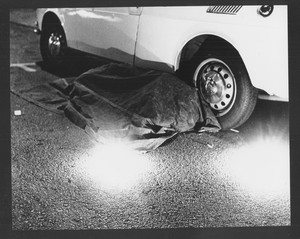
Sydney Stutterheim has published Artist, Audience, Accomplice: Ethics and Authorship in Art of the 1970s and 1980s (Duke University Press, 2024), a survey of performance art and related practices that involve, in various manners, the figure of the accomplice. To celebrate the publication, the Quarterly is publishing an excerpt that examines Chris Burden’s Deadman (1972).

Join Gagosian to celebrate the publication of Poetic Practical: The Unrealized Work of Chris Burden with a conversation between American Artist, Yayoi Shionoiri, and Sydney Stutterheim presented at the Kitchen, New York. Considering the book’s sustained examination of sixty-seven projects that remained incomplete at the time of Burden’s death in 2015, the trio discuss the various ways that an artist’s work and legacy live on beyond their lifetime.
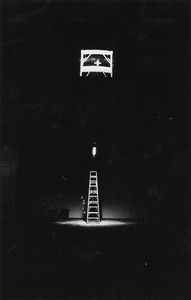
Michael Auping tells the Quarterly’s Alison McDonald about the preparations for a performance by Chris Burden at the Newport Harbor Art Museum in Southern California in 1974—and the event’s abrupt cancellation—providing a glimpse into the mindset of a young, aggressive, and ambitious artist in the early stages of his career.
The Summer 2022 issue of Gagosian Quarterly is now available, with two different covers—featuring Takashi Murakami’s 108 Bonnō MURAKAMI.FLOWERS (2022) and Andreas Gursky’s V & R II (2022).
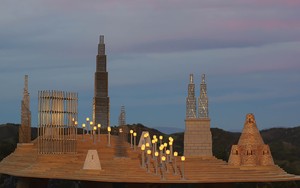
A new publication exploring the work that Chris Burden conceived but left unrealized delves into his archive to present sixty-seven visionary projects that reveal the aspirations of this formidable artist. The book’s editors, Sydney Stutterheim and Andie Trainer, discuss its development with Yayoi Shionoiri, executive director of the Chris Burden Estate.
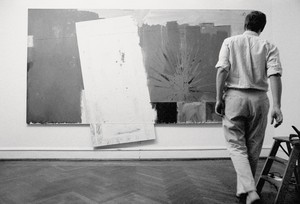
Carlos Basualdo, the Keith L. and Katherine Sachs Senior Curator of Contemporary Art at the Philadelphia Museum of Art, and Scott Rothkopf, Senior Deputy Director and Nancy and Steve Crown Family Chief Curator at the Whitney Museum of American Art, New York, spoke with the Quarterly’s Alison McDonald ahead of the opening of the unprecedented collaborative retrospective Jasper Johns: Mind/Mirror to discuss the goals, revelations, and unique structure of the project.